
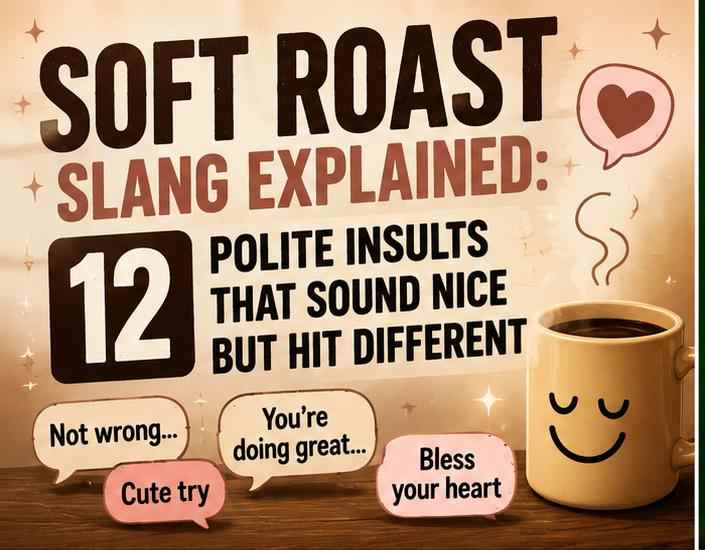
I noticed that the Internet culture has mastered a very specific kind of communication that feels friendly on the surface but carries a subtle sting underneath. It is not full blown insult territory, and it is not exactly praise either. It sits in that interesting middle ground where someone smiles while lightly dragging you at the same time.
This is where soft roast slang comes in.
Soft roast slang is basically the art of saying something that sounds polite, calm, or even supportive, while the actual meaning carries a hint of shade. It is the kind of language people use when they want to react without being too harsh, but still make their point clear.
Think of it as emotional seasoning. The words look sweet, but there is spice underneath.
From group chats to comment sections to TikTok reactions, soft roast slang has become a whole communication style. And honestly, it is one of the funniest parts of modern internet language.
Let us break it down properly.
Table of Contents
In a Nutshell
- It is polite sounding language used to gently insult or tease someone
- It is common in online chats, comments, and short video reactions
- It often hides criticism behind humor or sarcasm
- It helps people express honesty without being openly rude
Why Soft Roast Slang Exists
Before jumping into the catchphrases, it helps to understand why people even use this style of speech.
One thing I have noticed from online conversations is that people want to express themselves honestly, but not aggressively. Nobody wants to be labeled as rude, yet everyone still wants to react when something looks questionable, funny, or bold.
So instead of saying something direct like “that is a bad idea,” people soften it.
What actually works is wrapping the criticism inside humor or politeness. It makes the message easier to accept and also funnier to read.
Soft roast slang also works because internet culture rewards clever responses. A simple insult is forgettable. A polite sounding roast, on the other hand, can go viral.
READ ALSO: From 67 to 520: 45 Number Slangs You Keep Seeing Online and What They Mean
12 Soft Roast Slang Phrases and What They Really Mean
Let us go through twelve popular soft roast slang expressions and what people actually mean when they use them.
1. Bless your heart
This is probably one of the most famous soft roast phrases ever.
On the surface, it sounds caring and sweet. It feels like someone is wishing you well or showing sympathy. But depending on context, it can mean “you tried, but that was not it.”
It is often used when someone makes a questionable decision or says something that does not fully make sense.
Example usage:
“Bless your heart, you really thought that would work.”
Slangwise Thought:
It is polite shade at its finest. You walk away smiling, but slightly confused about whether you just got insulted.
2. Interesting choice
This one is very subtle.
When someone says “interesting choice,” they are usually not impressed. It is a neutral sounding phrase that hides mild judgment.
It is often used when someone picks something unexpected or questionable.
Example usage:
“You wore that to the event. Interesting choice.”
Slangwise Thought:
It is the verbal version of raising one eyebrow without saying anything else.
3. Could be worse
This sounds comforting, but it is not exactly praise.
It usually means the situation is not great, but at least it did not completely fail.
Example usage:
“How does my new haircut look?”
“Could be worse.”
Slangwise Thought:
It is emotional damage wrapped in optimism.
DISCOVER: The Ultimate List of 250 Most Popular Internet Slang Words of 2026
4. That’s bold
This phrase is very flexible.
It can mean admiration in some cases, but in soft roast context, it often means “you had the confidence to do that, even though you probably should not have.”
Example usage:
“You sent that message to your boss? That is bold.”
Slangwise Thought:
It respects the courage while quietly questioning the decision.
5. You tried
This one is short, simple, and powerful.
It does not say you succeeded or failed. It just acknowledges effort in a very neutral way.
Example usage:
“That drawing is something.”
“You tried.”
Slangwise Thought:
It is the final boss of soft disappointment phrased politely.
6. I see what you were going for
This is a classic soft roast recovery line.
It means the intention is understood, but the execution did not quite land.
Example usage:
“I see what you were going for with that outfit.”
Slangwise Thought:
It is like saying the idea exists, but the reality needs improvement.
DISCOVER: 80 Most Popular Gen Alpha Slang Words You’ll Hear In 2026 (updated)
7. That is one way to do it
This phrase is almost never used for praise.
It means there are better methods, but you chose that path anyway.
Example usage:
“You solved it like that? That is one way to do it.”
Slangwise Thought:
It is polite confusion disguised as acceptance.
8. Not what I expected
This is soft disappointment in disguise.
It can sound neutral, but the undertone depends heavily on tone and context.
Example usage:
“Your presentation is very different. Not what I expected.”
Slangwise Thought:
Expectation and reality had a meeting, and they did not agree.
9. You have a unique style
This is often used when someone’s taste is unusual.
It is not directly negative, but it is rarely plain praise either.
Example usage:
“You have a unique style with your outfits.”
Slangwise Thought:
It is appreciation with a hint of polite confusion.
READ ALSO: 12 Slangs for the Rizz Family: The Language of Flirt Game, Charm, and Confidence
10. That is different
This is another subtle reaction phrase.
It can mean you are unsure how to feel about something.
Example usage:
“You redesigned your room like that? That is different.”
Slangwise Thought:
It is neutral language doing emotional hiding work.
11. I respect the confidence
This one sounds like praise, but often it is not.
It usually means the action was questionable, but the boldness is acknowledged.
Example usage:
“You posted that online? I respect the confidence.”
Slangwise Thought:
It is courage acknowledgment mixed with silent judgment.
12. Well, that happened
This is the final boss of soft roast reactions.
It is used when something goes wrong or becomes awkward, and there is nothing else to say.
Example usage:
“He dropped his phone in the soup.”
“Well, that happened.”
Slangwise Thought:
It is emotional shutdown in sentence form.
13. Oh wow, you went for it
This one sounds like encouragement at first glance, but the tone usually does the real talking.
It is what people say when someone makes a choice that is clearly outside expectations, sometimes risky, sometimes unnecessary, sometimes just confusing.
Example usage:
“You mixed those patterns together? Oh wow, you went for it.”
Slangwise Thought:
It is admiration mixed with silent “I would not have done that myself.”
DISCOVER: 9 Sigma Slangs for Quiet Confidence, Lone Energy, and the Walk Away Vibe
14. That’s a decision
This phrase is the definition of controlled neutrality.
It does not say good, it does not say bad, it just acknowledges that something was done and now we are all witnessing the outcome.
Example usage:
“You quit your job without a backup plan? That is a decision.”
Slangwise Thought:
It is less about judgment and more about disbelief dressed up as calm language.
15. I would have done it differently
This is soft roast disguised as personal preference.
It is often used when someone’s choice is questionable, but instead of attacking it directly, the speaker distances themselves from it.
Example usage:
“You painted the wall neon green? I would have done it differently.”
Slangwise Thought:
It is polite disagreement with a hidden side of “but why that way though.”
16. That is one of the ways
This is a slightly upgraded version of “that is one way to do it.”
It suggests there are multiple options, and the one chosen is not necessarily the best or most common.
Example usage:
“You fixed it using duct tape and hope? That is one of the ways.”
Slangwise Thought:
It quietly implies there are better methods, but it will let you live with your choice.
17. I am sure it made sense at the time
This is peak soft roast reflection energy.
It acknowledges that the decision probably felt logical in the moment, even if it does not hold up now.
Example usage:
“You sent that text at 2 a.m.? I am sure it made sense at the time.”
Slangwise Thought:
It is understanding wrapped around gentle embarrassment.
EXPLORE: 27 New Gen Alpha Slangs and Catchphrases That Blew Up in the Last 4 Months
18. Well, at least it is done
This is the final stage acceptance phrase.
It is used when something is finished, regardless of quality, outcome, or expectations.
Example usage:
“You finished the project like that? Well, at least it is done.”
Slangwise Thought:
It is closure disguised as positivity, with a quiet hint of resignation.
How Soft Roast Slang Shapes Online Communication
One thing I have come to realize after watching online conversations is that people prefer humor over direct criticism. Soft roast slang works because it keeps conversations light while still allowing honesty to come through.
It also builds social connection. Instead of attacking someone directly, people use playful language that everyone understands is not meant to hurt deeply.
From what I have observed, this style of communication helps reduce tension in group chats, comment sections, and even workplace banter when used carefully.
It is not about being fake nice. It is about being cleverly honest.
When to Use Soft Roast Slang
Soft roast slang works best when:
- You are joking with friends who understand your tone
- You want to react without sounding harsh
- You are commenting online in a playful space
- You want humor instead of direct criticism
However, it should be used carefully in serious situations. Tone can easily be misunderstood in text.
Conclusion
Soft roast slang is one of the most entertaining parts of modern internet language. It blends politeness with subtle humor and creates a communication style that feels light but meaningful.
Phrases like “bless your heart” or “you tried” may sound simple, but they carry layers of tone that depend entirely on context.
The real magic of soft roast slang is not in the words themselves, but in how they are said.
DISCOVER: 68 Most Popular TikTok Slang Words of 2026 – Quick Meaning and Examples
FAQs
Soft roast slang refers to polite sounding phrases used to lightly tease, joke, or criticize someone in a gentle way.
It can be, but it is usually playful rather than mean. The tone depends on context and relationship.
It is common in social media, group chats, comment sections, and casual conversations.
People use it to stay polite, avoid conflict, and make humor out of criticism.