
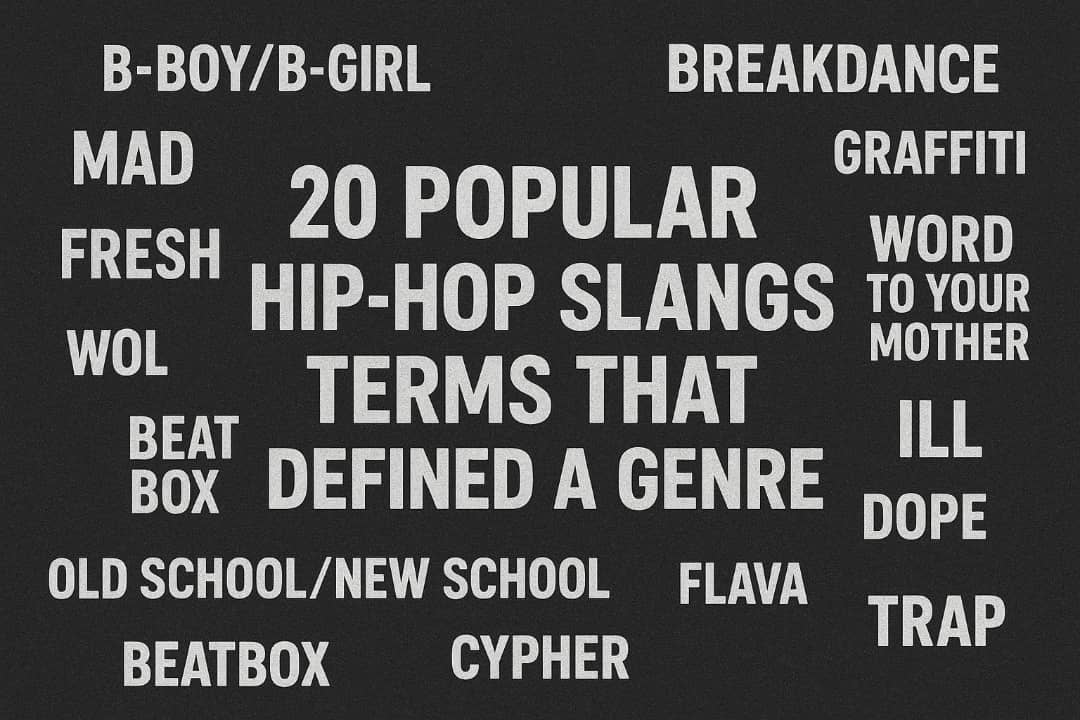
Hip hop did not just give the world a sound. It gave the world a language.
From Bronx block parties to stadium stages across the globe, hip hop slang has traveled far beyond its original neighborhoods. Some words came from dance floors. Some came from DJ booths. Some came from battle circles, street corners, and everyday conversations that were already full of rhythm before the music made them famous.
And that is the beautiful thing about hip hop slang. It is not frozen in one era. It keeps moving. It keeps changing. It keeps finding new life in music, fashion, social media, film, and the way people talk to each other every day.
This expanded guide looks at 35 hip hop slang terms that helped define the culture and leave a mark on the wider world. Some are classic. Some are more modern. All of them helped build the voice of a genre that has never stopped reinventing itself.
In a nutshell
- Hip hop built its own language: These terms came from community, creativity, and competition.
- Words became identity: Slang helped artists, dancers, DJs, and fans describe their world in their own voice.
- The culture spread fast: Hip hop slang moved from local scenes into global everyday speech.
- The language keeps evolving: New generations keep remixing old words and creating fresh ones.
SlangWise tip: “Hip hop slang works because it sounds lived in. It feels real before it even feels polished.”
Here is something worth remembering before we jump in. Hip hop slang is not just about sounding cool. It is about belonging. It is about attitude, rhythm, style, pride, and originality.
When a culture creates language that people outside the culture start using too, that is usually a sign that something powerful is happening.
Table of Contents
35 Hip Hop Slang Terms That Shaped the Genre
1. B boy / B girl
A B boy or B girl is a dancer deeply connected to breakdance and hip hop culture. The term grew out of the early days of block parties, when dancers would move during the break in the music and turn a short instrumental section into a full performance. That is where the name gets its energy.
Being a B boy or B girl was never only about dancing well. It was about style, discipline, timing, and personality. It meant you understood the culture and respected the roots. Even today, the term still carries that same weight. It tells people that the dancer is not just moving to the beat, the dancer is answering it.
Impact: B boys and B girls helped turn street dance into one of hip hop’s most visible global art forms.
2. Breakdance
Breakdance is the high energy street dance style that became one of hip hop’s most recognizable elements. It includes spins, freezes, footwork, and acrobatic moves that make people stop and watch. It is playful, competitive, and athletic all at once.
The style developed in New York in the 1970s when dancers started using the instrumental breaks in records as their stage. That gave them room to improvise and show off creativity without being tied to a singer or chorus. Over time, breakdance became a symbol of hip hop’s physical energy and fearless imagination.
It later spread through movies, competitions, and international performances, making it one of the first hip hop styles many people outside the culture ever recognized.
Impact: Breakdance helped push hip hop from neighborhood parties into global pop culture.
3. Graffiti
Graffiti is the visual voice of hip hop. It refers to lettering, tagging, and street art created on public surfaces, often without permission. In hip hop culture, graffiti was never just about writing a name. It was about being seen, being remembered, and creating identity in places where many people felt invisible.
During the rise of hip hop in New York City, graffiti artists turned trains, walls, and corners into moving and living canvases. Names like TAKI 183 became part of the city’s visual story. The style was bold, colorful, and impossible to ignore. It gave hip hop a face before many people fully understood the sound.
Graffiti later influenced fashion, album covers, advertising, and gallery art. What began as underground expression became an internationally recognized style.
Impact: Graffiti gave hip hop a strong visual identity and helped shape street art around the world.
4. MC
MC stands for Master of Ceremonies, but in hip hop it grew into something much bigger. The MC became the voice of the crowd, the storyteller, the battle artist, and the person who carried rhythm through language. At block parties, the MC was often the one who kept the energy alive.
The role has roots in Jamaican sound system culture, where spoken performance and crowd control were already part of the experience. Hip hop took that idea and gave it a new shape. Instead of only introducing the show, the MC became the show. Rhymes, timing, and charisma all became part of the craft.
Today, the title still carries respect. Calling someone an MC is a reminder that rap is not just about words on a page. It is about command, delivery, and presence.
Impact: The MC became the lyrical center of hip hop and helped turn live performance into an art form.
5. DJ
DJ means Disc Jockey, but in hip hop the role goes far beyond playing records. The DJ selects the music, blends tracks, isolates breaks, scratches vinyl, and creates the backbone of the sound. In many ways, the DJ is the architect of hip hop energy.
One of the biggest turning points in hip hop history came when DJs like Kool Herc began extending drum breaks at parties. That simple move gave dancers more time to shine and helped create the foundation for rap, breakdance, and sampling. From that moment on, the DJ was no longer just a selector. The DJ was a creator.
The techniques born in those early days still influence music production everywhere. Scratching, looping, and mixing are now part of the global music language.
Impact: DJs helped create the sound of hip hop and turned turntables into instruments.
READ ALSO: 25 Chef Slang Words You Will Hear in Real Kitchens and What They Actually Mean
6. Fresh
Fresh means stylish, cool, clean, or impressive. In hip hop, it became a strong compliment for anything that looked sharp or sounded exciting. A fresh outfit, a fresh beat, a fresh rhyme, the word has a wide range, and that is part of what makes it so useful.
Hip hop helped give fresh a new level of cultural power. It became a way to praise creativity and confidence without needing a long explanation. The word carries energy because it suggests something new, alive, and worth noticing right away.
Even now, fresh still works because it feels both simple and stylish. That balance is exactly why it lasted.
Impact: Fresh became one of hip hop’s most enduring ways to celebrate style and originality.
7. Word to your mother
Word to your mother is a classic phrase of agreement, emphasis, or playful affirmation. It can sound funny, serious, or just plain cool depending on how it is delivered. In hip hop, the phrase became part of the culture’s expressive personality.
It picked up traction in the 1980s and showed up in music and pop culture as a way to say, “I agree,” or “That is real.” What made it memorable was not just the meaning, but the rhythm of the phrase itself. It sounds like it belongs in a performance as much as in a conversation.
Even if people do not use it every day now, the phrase still feels like a snapshot of hip hop’s earlier voice, when slang could be both humorous and full of attitude.
Impact: The phrase helped push hip hop slang into mainstream speech and media.
8. Ill
Ill is one of hip hop slang’s smartest flips. Outside the culture, it usually means sick or unhealthy. Inside hip hop, it became a compliment that meant excellent, sharp, or impressive. That reversal is a perfect example of how slang can bend language into something fresh.
By the late 1980s and early 1990s, ill was everywhere in rap lyrics and street talk. It worked because it sounded raw and direct. A verse could be ill. A beat could be ill. A dancer could be ill. The word gave people a quick way to praise skill without sounding stiff.
It also became a reminder that hip hop often takes words that already exist and gives them new life. That is part of the culture’s magic.
Impact: Ill became a major praise word and a clear sign of hip hop’s creative language play.
9. Dope
Dope is a classic hip hop compliment that means outstanding, powerful, or very good. The word had older meanings before hip hop adopted it, but the culture gave it a new positive energy. Once that happened, it became one of the easiest ways to say something was great.
Dope works because it is short, sharp, and confident. You can use it for a song, a sneaker, a rhyme, a design, or a performance. It has that same no nonsense punch that a lot of hip hop language carries. You do not need to over explain it. If something is dope, people understand immediately.
That kind of wide use helped the word move into mainstream speech, where it still shows up often in casual conversation.
Impact: Dope became one of the most durable words for praise in hip hop and beyond.
10. Props
Props means respect, credit, or recognition. It comes from the idea of giving someone proper respect for what they did. In hip hop, props were important because the culture was built on skill, originality, and community acknowledgment.
When artists gave each other props, they were saying talent should be seen and appreciated. That matters in a competitive culture. Hip hop battles can be intense, but props remind people that competition and respect can live in the same room.
The word now shows up far outside hip hop, but the spirit behind it is still the same. Give credit where it is due. That is the message.
Impact: Props turned respect into a shared cultural value and helped define hip hop etiquette.
DISCOVER: 35 Fashion Slang Words That Style Lovers Keep Using In Fashion World
11. Old school / New school
Old school and new school are useful labels for talking about hip hop across generations. Old school usually refers to early pioneers, classic styles, and the roots of the culture. New school points to newer sounds, fresh artists, and more modern approaches.
As hip hop grew, people needed language that could describe its changing phases. These two terms made that possible. They helped fans compare eras without losing respect for the past or the present. Old school means foundation. New school means evolution.
That is why the pair still matters. It gives listeners a simple way to track the culture’s timeline while appreciating how much it has transformed.
Impact: The labels helped fans understand hip hop’s history and growth across generations.
12. Beatbox
Beatbox is the art of making percussion sounds with the mouth, lips, tongue, and voice. It is one of hip hop’s most impressive forms of live creativity because it turns the human voice into a drum machine without any actual machine.
Beatboxing became especially visible in the 1980s through artists who could mimic kicks, snares, hi hats, and other rhythmic sounds in real time. That made performances feel raw and exciting. It also showed how hip hop could create something powerful out of very little.
Beatbox still matters today because it represents one of the culture’s biggest strengths. Hip hop can innovate under pressure.
Impact: Beatboxing gave hip hop a uniquely human rhythm and expanded what performance could sound like.
13. Battling
Battling is the competitive side of hip hop. It can happen through rap, dance, or DJing, and it always comes with one goal. Show your skill and do it under pressure. A battle is where talent gets tested in public.
Battle culture started early in hip hop history, especially in the Bronx, where artists challenged one another to be sharper and more original. That competitive spirit pushed the culture forward. It made people practice harder, think faster, and develop stronger styles.
Modern battles still carry that same charge. Whether on a stage, in a cypher, or at a dance event, battling remains one of hip hop’s most exciting traditions.
Impact: Battling sharpened hip hop’s competitive energy and helped create unforgettable live moments.
14. Cypher
Cypher is a circle where MCs, dancers, or performers take turns showing their skills. The shape matters because it creates equality. Everyone is part of the moment. Nobody owns the space. The circle becomes a shared stage.
Cyphers are special because they are alive in a way polished performances sometimes are not. People feed off each other’s energy, and that makes the whole thing feel spontaneous and real. In a cypher, freestyle often shines because the room rewards quick thinking and personality.
For a lot of artists, the cypher is where confidence grows. It is not just a performance space. It is a training ground, a testing ground, and a community space all at once.
Impact: Cyphers helped make freestyle and shared creativity central to hip hop culture.
15. Flava
Flava is a stylized form of flavor, and in hip hop it means personality, uniqueness, and style. When someone has flava, they bring something special that sets them apart. It could be their voice, their fashion, their delivery, or just their overall presence.
The word became popular because hip hop has always valued individuality. Nobody wanted to sound copy and paste. People wanted originality. They wanted something with taste, texture, and character. That is exactly what flava captured.
The spelling itself became part of the identity. It looked different because it felt different. That made the word perfect for a culture that has always pushed creativity forward.
Impact: Flava celebrated individuality and helped make personal style a major part of hip hop identity.
READ MORE: 27 Hustle Slang Words Everyone Is Using in 2026, and What They Really Mean
16. Sample
Sample in hip hop means a piece of an existing recording reused in a new track. This one idea helped shape the entire sound of the genre. Producers could pull a drum break, melody, voice, or small musical moment and build something completely different from it.
Sampling is one of hip hop’s greatest inventions because it reflects the culture’s ability to reinvent the past. Instead of rejecting older music, producers often transformed it. That gave hip hop a layered sound and connected modern tracks to older musical memories.
It also brought legal questions, creative debates, and industry changes. But even with all the arguments surrounding it, sampling remains one of the most important tools in hip hop production.
Impact: Sampling changed music production and helped define the sound of modern hip hop.
17. Trap
Trap originally referred to places where drugs were sold, especially in Southern U.S. street language. In hip hop, the word grew into a sound, a mood, and a major subgenre. Trap music is known for hard drums, sharp hi hats, dark atmosphere, and lyrics connected to street life and survival.
The style became especially associated with Atlanta and other Southern cities in the early 2000s. From there, it spread fast. Producers used the sound to build tracks that worked in clubs, on radio, and online. Trap was heavy enough to feel serious and catchy enough to move crowds.
Eventually, trap influenced pop, electronic music, and global production styles. That rise shows how a word rooted in struggle can become one of the most influential music terms in the world.
Impact: Trap grew from street slang into a global music style that reshaped modern sound.
18. Wack
Wack is a blunt way to say something is weak, fake, boring, or unimpressive. In hip hop, it became the opposite of words like ill and dope. If a verse was wack, people knew it missed the mark.
What makes wack so effective is its honesty. There is no sugarcoating here. The word fits a culture where authenticity matters and where weak effort gets called out quickly. That directness made it a useful term in battles, reviews, and everyday conversation.
Even outside hip hop, the word still carries that same sharp edge. It is short, simple, and hard to miss.
Impact: Wack became a fast, memorable way to criticize weak skill and fake energy.
19. Mad
Mad in hip hop slang means very or extremely. If someone has mad skills, they have a lot of skill. If a track has mad energy, that means it hits hard. The word works as an intensifier and gives speech more force.
Hip hop helped spread mad from regional usage into wider culture. It feels natural in conversation because it is quick, flexible, and full of movement. That is probably why it survived so well. It can be dropped into almost any sentence without sounding forced.
The word also shows how hip hop loves words that carry extra energy without making the sentence longer than it needs to be.
Impact: Mad became a simple way to add intensity and emphasis in hip hop speech.
20. OG
OG stands for Original Gangster, and in hip hop it refers to someone respected, experienced, and foundational. An OG is not just old in age. An OG is someone who has earned their place through presence, impact, and authenticity.
The phrase began in a specific street and West Coast context, but it soon expanded far beyond that. People now use OG to describe pioneers, elders, and original creators in all kinds of fields. That expansion tells you how powerful hip hop slang can be when it connects with people.
OG remains one of the clearest ways to show respect in a single word.
Impact: OG became a global term for respect, experience, and original influence.
21. Bars
Bars refers to the lines in a rap verse, but in hip hop slang it usually means strong lyricism. When someone says an artist has bars, they are praising the writing, the wit, the structure, and the ability to land lines with force.
The term became especially important as listeners started paying closer attention to wordplay. Bars are not just about rhyming. They are about control, rhythm, and the ability to say something memorable in a compact space. A rapper with bars can make a few lines feel like a full performance.
Today, people use bars to celebrate sharp writing in rap battles, albums, freestyles, and even viral clips online. It is one of the clearest signs that lyricism still matters.
Impact: Bars became a modern shorthand for skillful rap writing and lyrical power.
22. Flow
Flow is the way a rapper rides the beat. It includes rhythm, cadence, pace, pause, and how smoothly the words land. A great flow can make simple lines sound unforgettable, while a weak flow can make strong lines feel flat.
Flow matters because rap is not just about what is said. It is about how it moves. Some artists have a relaxed flow. Some are aggressive. Some are playful. Some are technical. The beauty is that the word can describe all of them while still pointing to the same basic idea, musical motion through language.
People also use flow outside rap now, but hip hop remains the place where the term feels most alive and precise.
Impact: Flow became one of the most important words for describing rap performance and delivery.
23. Freestyle
Freestyle in hip hop usually refers to rapping without a written script, often in the moment. It is a test of creativity, memory, rhythm, and confidence. A good freestyle can feel like watching thought turn directly into music.
Freestyling became a major part of hip hop battle culture and cyphers. It let artists prove they could think quickly and stay on beat without relying on a page. That makes the skill both impressive and revealing. You hear how a rapper thinks under pressure.
Even though some people use the word loosely now, the original hip hop meaning still carries a lot of respect.
Impact: Freestyle turned improvisation into one of hip hop’s most respected skills.
24. Mixtape
Mixtape started as a collection of songs or recordings gathered on tape, but in hip hop it became a major way for artists to share music outside the usual album system. Mixtapes helped rappers build audiences, test sounds, and create momentum before or between official releases.
What made mixtapes so important was the freedom they offered. Artists could experiment more, talk directly to fans, and move faster than the traditional music industry often allowed. A mixtape could feel raw, personal, and urgent in a way a polished album sometimes could not.
That culture still matters, even now that music is more digital than physical. The mixtape spirit lives on in surprise drops, online releases, and projects that feel less corporate and more direct.
Impact: Mixtapes gave hip hop a flexible, creative release format that changed how artists reached fans.
25. Crew
Crew means a group of people who move together, support each other, and share an identity. In hip hop, a crew could be dancers, rappers, DJs, graffiti artists, or a mix of all of them. The word reflects one of the culture’s most important ideas, community matters.
Crew culture helped hip hop grow because it made the scene feel collective instead of isolated. People did not just show up as individuals. They came with teams, styles, and shared energy. That support system gave new artists confidence and made performances feel bigger than one person alone.
Even now, people still use crew to describe their circle, their squad, or their creative family.
Impact: Crew became a sign of unity, teamwork, and shared identity in hip hop culture.
DISCOVER: 21 Surprisingly Professional Slang Terms That Are Taking Over the Workplace
26. Jam
Jam in hip hop can mean a party, a performance, or a lively gathering where music and movement take over. It carries a sense of energy and togetherness. A jam is not stiff or formal. It is alive, loud, and full of rhythm.
Back in the early days, jams were the places where hip hop culture was built in real time. DJs played, MCs hyped the crowd, dancers took the floor, and the whole room became part of the show. That spirit still shows up whenever people gather for rap events, dance sessions, or neighborhood performances.
The word remains popular because it captures the fun side of hip hop without losing its energy.
Impact: Jam helped define the party spirit and live energy at the heart of hip hop.
27. Boom bap
Boom bap describes a classic hip hop drum sound, especially the punchy kick and snare pattern that shaped a huge part of 1990s rap. The phrase is almost onomatopoeic. You can hear the beat just by saying the words.
The style became a favorite for producers and listeners who loved crisp drums, head nodding rhythm, and a strong street level feel. Boom bap became associated with gritty, sample based production that emphasized rhythm and lyricism over gloss.
Even today, when people say boom bap, they are usually pointing to a classic hip hop feel that honors the roots of the genre.
Impact: Boom bap became one of the most recognizable sounds in classic hip hop production.
28. Scratch
Scratch refers to the DJ technique of moving a record back and forth to create a rhythmic sound. What started as a performance trick became a signature hip hop sound. Scratch added texture, movement, and attitude to the DJ’s toolkit.
The technique is one of the clearest examples of hip hop turning something practical into something expressive. A record player was not supposed to sound like that, but the culture found a way to make it musical. That is a big part of what hip hop does best. It reimagines tools.
Scratching became a core part of the sound of turntablism and a sign of real DJ skill.
Impact: Scratch turned the turntable into a performance instrument and expanded DJ creativity.
29. Posse
Posse means a group or collective, often used to describe a tight circle of friends, collaborators, or supporters. In hip hop, posse can refer to the people around an artist or the group energy that shapes a scene.
The word fits hip hop because the culture has always valued crew identity and group presence. A strong posse can bring hype, loyalty, and momentum. In some cases, posse even became part of the image of an artist, helping define the vibe before the music starts.
It is a classic term that still feels tied to hip hop’s early social energy.
Impact: Posse helped highlight the group based energy that shaped early hip hop life.
30. Hype man
Hype man refers to the person who boosts the performer’s energy, supports the crowd, and keeps the vibe moving. The role became especially important in live rap shows, where the main artist and the hype man work together to keep the room excited.
A great hype man knows timing. They know when to echo a line, when to shout encouragement, and when to let the main voice lead. It is a supporting role, but it is also a performance skill of its own. The best hype men understand how to amplify the moment without stealing it.
That kind of live support helped shape the sound and feel of early hip hop shows and still matters today.
Impact: The hype man helped turn performances into shared experiences and crowd focused events.
31. Flex
Flex means to show off, but in hip hop it can also mean to display confidence, style, success, or self belief. The word can be playful, boastful, or serious depending on context. Hip hop has always had room for a little swagger, and flex fits that energy perfectly.
Sometimes flex is about clothing or money. Sometimes it is about talent. Sometimes it is about the way someone carries themselves. That broad use helped it spread widely across youth culture and social media. It became a modern way to talk about confidence that feels both casual and bold.
Flex reminds people that in hip hop, presence is part of the message.
Impact: Flex became a popular word for confidence, style, and visible self expression.
READ ALSO: Shopping Slang: 60 Must-Know Terms Every Smart Deal-Hunter Uses
32. Drip
Drip refers to a person’s style, especially when the clothes, accessories, and overall look feel sharp and confident. In hip hop, drip became a way to talk about fashion with personality. It is not just about wearing something expensive. It is about wearing it well.
The word fits hip hop because style has always mattered in the culture. From sneakers to chains to custom looks, fashion has long been part of how artists and fans express themselves. Drip takes that idea and gives it a fresh modern label.
Today, the word is everywhere, but its meaning still points back to hip hop’s love of visual flair.
Impact: Drip became a popular way to celebrate fashion, confidence, and visual style.
33. Biter
Biter is a sharp hip hop term for someone who copies another artist’s style, lines, delivery, or creative identity. In a culture that values originality, being called a biter is a serious insult. It means you are borrowing too much and not bringing enough of yourself.
The term matters because hip hop has always protected authenticity. Copying without credit goes against the spirit of the culture. A biter might sound close to the original, but closeness is not the same as skill. Hip hop wants voice, not imitation.
That makes the word a kind of cultural boundary marker. It tells people that originality is not optional.
Impact: Biter helped defend originality and keep authenticity at the center of hip hop.
34. Bling
Bling refers to flashy jewelry or anything that sparkles and stands out with luxury energy. In hip hop, bling became tied to style, success, and visual confidence. The word helped describe a look that was loud on purpose.
Over time, bling became part of a bigger conversation about status and self presentation in hip hop. Some people saw it as celebration. Others saw it as excess. Either way, the word stuck because it captured a real visual trend in the culture.
Even now, bling still carries that unmistakable shine. It is one of the clearest words for flashy hip hop style.
Impact: Bling became a shorthand for hip hop luxury, shine, and bold self expression.
35. Turnt
Turnt means highly energetic, excited, or fully amped up. It is often used to describe a party, a song, a performance, or a crowd that is at maximum energy. The word fits modern hip hop because it matches the culture’s love of intensity and momentum.
Turnt became popular in newer generations of hip hop and spread quickly through music and social media. It works because it feels immediate. It does not describe quiet enjoyment. It describes a room that is fully alive. That is why the word has become such a strong part of contemporary youth language.
Impact: Turnt became a modern way to describe peak energy, hype, and party culture.
Why hip hop slang still matters
Hip hop slang matters because it tells the story of a culture that learned how to speak for itself. These words were not created for textbooks. They were created for rooms full of people, for battles, for parties, for expression, and for survival. That is why they feel so alive even decades later.
When a word like fresh, dope, ill, or OG becomes part of everyday conversation, something bigger is happening. It means the culture that created it has crossed borders, reached new audiences, and stayed relevant without losing its voice. Hip hop slang does not just describe reality. It shapes it.
And the story is still growing. New words enter the mix all the time. Old words return with new meanings. Regional phrases travel faster than ever. A term that starts in one neighborhood can now spread worldwide in a matter of hours. That is the modern power of hip hop language.
It is also a reminder that language is never fixed. Culture keeps editing it, polishing it, breaking it apart, and building it back up again. Hip hop does that better than almost any other movement.
SlangWise thought: hip hop slang is not just colorful language. It is a record of creativity, community, and confidence in motion.
So the next time you hear someone say a verse is dope, a fit has drip, a legend is an OG, or a party is turnt, remember that you are hearing more than a trendy phrase. You are hearing a culture that changed how the world talks.
DISCOVER: 70 Most Popular Sport Slang Terms Every Fan Thinks They Know (But Don’t)
Final thought
Hip hop slang helped build a genre, but it also built a way of seeing the world. It gave people words for confidence, respect, style, struggle, originality, and celebration. It made language feel alive in places where people needed their voices to matter.
From B boy to turnt, from props to bars, every word in this list carries a piece of history. Some words came from dance. Some came from music. Some came from competition. Some came from the streets. Together, they show how hip hop keeps turning lived experience into language that the whole world can use.
That is the real legacy of hip hop slang. It does not just name the culture. It helps create it.
References
For a concise history of hip hop’s origins, see the Britannica entry on hip hop. For a quick overview of slang as a language feature, consult the Merriam Webster slang entry.