

- Gish Gallop is a debate tactic where someone throws out so many claims so fast that the other person cannot answer them all in time.
- It is not really a “fun” slang word in the usual sense. It is more of an internet, debate, and commentary term that people use to call out overwhelming argument style.
- The phrase was coined in 1994 and named after creationist debater Duane Gish, who was known for this rapid-fire style.
- You will often see it used in discussions, comment sections, debates, and even political commentary when someone floods the room with too many points at once.
- The smartest move is not to chase every single claim at once. The better response is to slow the conversation down, pick one point, and deal with it clearly.
Table of Contents
What Does Gish Gallop Mean?
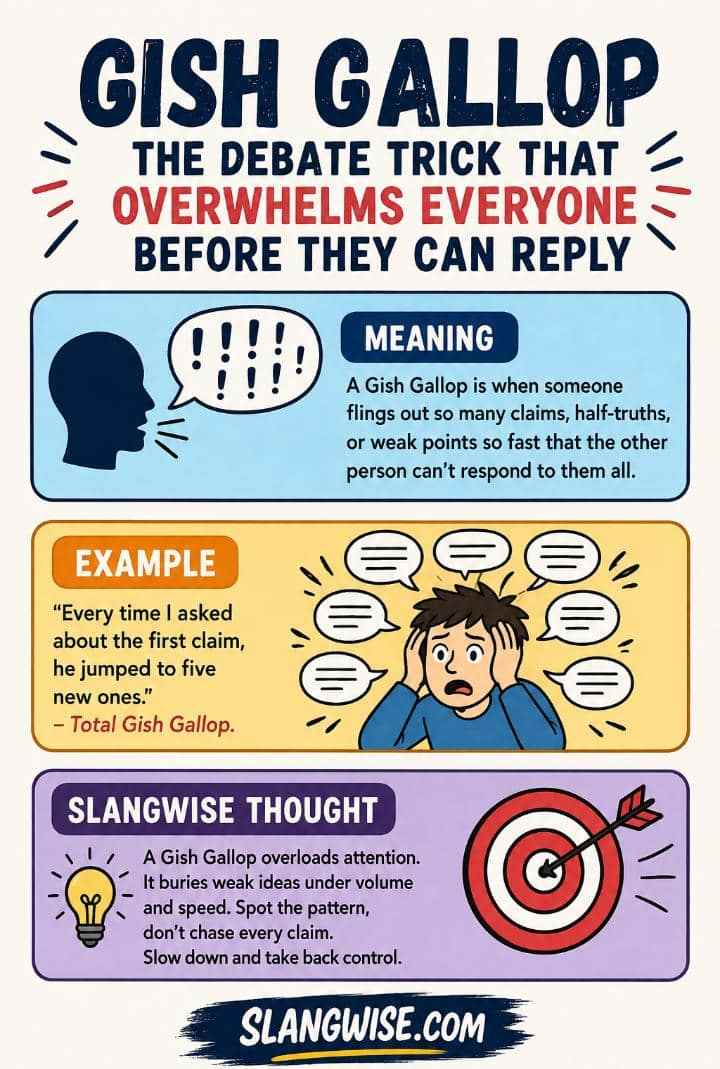
A Gish Gallop is when someone tries to win an argument by firing off a long stream of claims, half-truths, weak points, or misleading statements so quickly that the other person cannot respond to each one properly.
The tactic works because the person speaking has the advantage of speed, while the other side is stuck trying to untangle the mess one piece at a time.
In simple words, it is the “talk too fast, say too much, and overwhelm the room” strategy. The point is not always to prove something well. The point is often to make it feel like there are so many issues that nobody can keep up.
READ ALDO: What Does Zaddy Mean? The Stylish Slang Term Explained
Origin of Gish Gallop
The phrase was coined in 1994 by anthropologist Eugenie Scott, who named it after Duane Gish, a creationist debater known for using a rapid-fire style in debates. The name stuck because it perfectly captured what the tactic feels like: fast, heavy, and hard to stop once it gets going.
That origin matters because it shows the term was not invented to sound cute or trendy. It was created to describe a very specific kind of argumentative behavior that people were already noticing in public debates.
Over time, it spread beyond science debates and got used in politics, media commentary, and online arguments too.
Slangwise Thought
Here is the real tea: a Gish Gallop is not just about talking fast. It is about overloading attention. That is why it can feel so frustrating.
The listener starts chasing point number one, then point number two, then point number three, and suddenly the whole conversation is spinning.
A person using this tactic can make a weak argument look strong simply by burying it under volume. That is why knowing the term is so useful.
Once you can spot it, you stop getting emotionally dragged into every single claim. You start noticing the pattern instead. And that is where the power shifts back to you.
How People Use Gish Gallop Today
You will usually hear Gish Gallop in debates, online comment sections, political talk, and “fact-check” conversations.
It is often used as a criticism: when someone says, “That was a Gish Gallop,” they mean the speaker did not really engage in a fair back-and-forth. They just flooded the discussion with too many points to handle cleanly.
People also use it as a verb or adjective in casual writing, like “He started gish galloping” or “That was such a gish-galloping speech.” Dictionaries and dictionary-style references show this form is now common enough to be recognized in modern usage.
READ MORE: Are Keyboard Warriors Really Brave? The Slang Meaning, Psychology & How to Deal With Them
Examples of Gish Gallop in Conversations
Example 1:
“Every time I asked about the first claim, he jumped to five new ones. It felt like a total Gish Gallop.”
This is a classic case because the speaker keeps changing targets before any one point can be answered.
Example 2:
“In the group chat, she posted ten different accusations in one message, so nobody could reply properly. That was pure Gish Gallop.”
This shows how the tactic can happen online, not just in formal debates.
Example 3:
“The interview turned into a Gish Gallop when the guest kept throwing out claims faster than the host could fact-check them.”
This is why the term is so useful in media conversations too.
Why Gish Gallop Works
The tactic works because humans have limited attention. If one person throws out twelve claims in a row, the other person may only have time to answer two or three before the conversation moves on.
That creates a false impression that the speaker has “so much evidence,” even when the claims are weak, misleading, or flat-out wrong.
It also works because fast speech can sound confident. Confidence plus volume can trick people into thinking the argument is stronger than it really is.
That is why this tactic is often linked to misinformation, debate manipulation, and the kind of argument style that leaves audiences confused rather than informed.
How to Respond Without Getting Trapped
The best response is usually to pause the flood. Pick one claim, state that you are addressing it first, and do not let the speaker rush you into a dozen side quests.
If needed, say something like, “I am going to respond to one point at a time.” That keeps the discussion grounded and stops the conversation from turning into a blur.
You can also ask the person to slow down and prioritize their strongest claim. That forces the conversation back into order. Instead of reacting to noise, you are dealing with substance. That is usually the best way to beat a Gish Gallop without getting emotionally drained.
DISCOVER: 40 Popular 90s Slang Words Every 1990s Kid Still Uses Today
Concluding Thought
Gish Gallop is one of those phrases that feels funny at first, but it describes something very real. It gives a name to a debate trick people have seen for years: overwhelm the other side, talk faster than they can respond, and make confusion look like victory.
Once you know the term, you start spotting it everywhere. And once you spot it, it becomes much easier to refuse the trap. That is the power of language: one good phrase can turn a messy feeling into a clear idea.
FAQs
It is mainly a rhetorical and debate term, but people also use it informally online like slang when calling out someone who floods a conversation with too many claims.
Not always. It can include false claims, half-truths, weak arguments, or even too many loosely connected points. The key issue is the overwhelming speed and volume.
It was coined in 1994 and named after Duane Gish, a creationist debater whose style inspired the term.
Slow the pace, pick one point, and answer it clearly before moving on. Do not let the conversation become a race you did not agree to run.