
Internet language does not sit still. A phrase can move from a meme to TikTok comments, from TikTok to group chats, and from group chats into everyday conversation almost overnight.
That is exactly what makes internet catchphrases so interesting to study. They are not just random words thrown around for fun. They often reveal what people are laughing about, reacting to, celebrating, criticizing, or collectively experiencing at a particular moment.
After years of tracking online slang, one pattern becomes impossible to miss: context matters just as much as the phrase itself. A catchphrase can sound hilarious in one comment section and completely unnatural in another. Some phrases are playful, some are sarcastic, some are affectionate, and others are designed almost entirely for comedic exaggeration.
That is why this updated guide does more than give you dictionary-style definitions. Each phrase is explained with the meaning, the cultural feel behind it, a fresh example, and a practical Slangwise Tip showing how the expression actually works in digital conversation.
In 2026, the internet is blending older Gen Z expressions with newer Gen Alpha vocabulary, meme language, gaming culture, creator slang, and deliberately absurd phrases. Terms such as rage bait, aura farming, clock it, cooked, glazing, unc, AI slop, lock in, and 67 now appear alongside older staples like no cap, say less, touch grass, caught in 4K, and main character energy.
So whether you are trying to understand TikTok comments, decode a group chat, write more natural social captions, or simply keep up with the internet’s constantly changing vocabulary, this list gives you a practical snapshot of the phrases that matter.
In a Nutshell
- 50 Popular Catchphrases: This updated list covers 50 internet expressions ranging from established favorites such as No Cap and Say Less to newer 2026-era language such as 67, Unc, Rage Bait, AI Slop, Clock It, Cooked, Glazing, and Lock In.
- Meaning Depends on Context: Internet catchphrases are often flexible. The same expression can be sincere, sarcastic, funny, supportive, or insulting depending on the conversation, tone, and platform.
- Internet Culture Drives the Language: TikTok, memes, gaming communities, comment sections, fandoms, creators, and short-form video culture continue to push phrases into the mainstream.
- Old Slang Does Not Always Disappear: Expressions such as Glow Up, Throw Shade, Spill the Tea, Hit Different, and Catch Flights Not Feelings may be older than the newest viral terms, but they remain recognizable and useful.
- Natural Use Beats Forced Use: The easiest way to sound current is not to cram every phrase into a conversation. Learn the meaning, understand the vibe, and use a catchphrase only when it genuinely fits.
50 Most Popular Internet Catchphrases in 2026
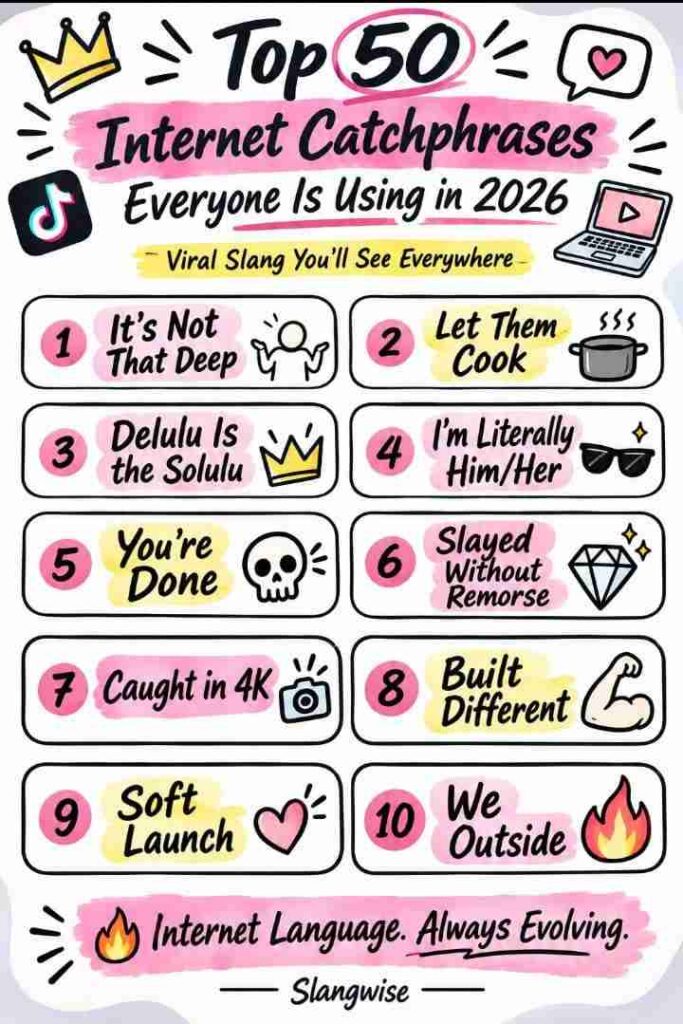
1. It’s Not That Deep
It’s Not That Deep is used when someone believes a situation is being analyzed, argued about, or emotionally amplified more than necessary. It is often a way of saying, “Relax, this is not as serious as you are making it sound.”
The important thing about this phrase is tone. Used gently, it can calm down a silly disagreement. Used dismissively, it can sound like someone is minimizing another person’s feelings. Internet users often rely on emojis, punctuation, or the surrounding conversation to show which meaning they intend.
Example: “The group chat has been debating the restaurant for 40 minutes. It’s not that deep 😭.”
Slangwise Tip: Use it when the situation is genuinely minor. It works best when the audience already understands that the tone is playful.
2. Let Them Cook
Let Them Cook means allowing someone to continue with an idea, performance, argument, creative project, or unusual approach before judging the result.
There is a subtle element of suspense in it. Sometimes the person really is about to produce something impressive. Other times, people say “let them cook” ironically because the idea sounds completely ridiculous but everyone wants to see where it goes.
Example: “The designer started with the weirdest color combination, but honestly, let them cook.”
Slangwise Tip: Use it when someone has not finished their idea yet. The phrase loses some of its charm once the “cooking” is already over.
3. Delulu Is the Solulu
Delulu Is the Solulu turns delusional into a deliberately playful form of optimism. Instead of treating unrealistic confidence as a flaw, the phrase jokes that a little “delulu” thinking might actually be the solution.
The expression is especially useful when someone knows their ambition is exaggerated and is laughing at their own unrealistic expectations. It is not usually meant as a serious psychological statement; it is internet humor built around self-awareness.
Example: “The job application went out five minutes ago and the dream office tour is already being planned. Delulu is the solulu.”
Slangwise Tip: It works best when the speaker is clearly in on the joke. Self-aware use makes the phrase feel natural instead of forced.
4. I’m Literally Him/Her
I’m Literally Him or I’m Literally Her is an exaggerated statement of confidence. It suggests that someone has just demonstrated the exact qualities associated with an admired character, celebrity, archetype, or idealized version of themselves.
The humor comes from the obvious exaggeration. Someone does not need to literally be the person being referenced. One successful moment is enough to trigger the claim.
Example: “Walked into the interview completely calm and answered everything perfectly. I’m literally her.”
Slangwise Tip: Save this one for a moment that genuinely feels like a victory. Overusing it makes the joke less effective.
5. You’re Done
You’re Done is a dramatic verdict delivered when someone has embarrassed themselves, lost an argument, exposed a contradiction, or made a move that is impossible to recover from.
It is usually more playful than genuinely hostile. In meme culture, declaring someone “done” creates the comic feeling that their social reputation has permanently collapsed over one small mistake.
Example: “She called the movie boring and then spent three hours explaining the entire plot. You’re done.”
Slangwise Tip: Use it as a humorous reaction rather than a literal threat. The dramatic exaggeration is the point.
6. Slayed Without Remorse
Slayed Without Remorse is an exaggerated compliment for someone who performed exceptionally well, looked incredible, delivered a strong comeback, or dominated a creative moment.
The word slay has a long history in expressive and queer communities before becoming widely adopted online. Modern internet users often build playful variations around it, turning “slayed” into a larger celebration of confidence and excellence.
Example: “That opening performance had the entire comment section screaming. Slayed without remorse.”
Slangwise Tip: Use it for a genuinely impressive moment. It sounds especially natural in fashion, performance, entertainment, and creative contexts.
Are you a gamer? or you’re hoping to be, check out this list of the top 50 gaming slangs of all time.
7. Caught in 4K
Caught in 4K means someone has been exposed with extremely clear evidence. The “4K” part is a joke about high-resolution video, but the expression has become a general way to describe undeniable proof.
A screenshot, old post, video clip, or contradictory comment can all become “4K evidence.” The phrase is especially common when online users catch someone saying one thing and doing another.
Example: “He said he never watches reality shows, then liked seventeen clips from the finale. Caught in 4K.”
Slangwise Tip: Use it when the evidence is genuinely obvious. Calling every tiny contradiction “caught in 4K” can make the phrase feel overused.
8. Built Different
Built Different describes someone or something that seems unusually capable, resilient, talented, fearless, or simply unlike the average person.
It can be serious praise, but internet users also apply it to funny situations. A person handling a strange inconvenience with complete calm may suddenly be declared “built different.”
Example: “Everyone panicked when the power went out. She lit a candle and kept working. Built different.”
Slangwise Tip: Use it for unusual composure, skill, endurance, or confidence rather than ordinary behavior.
9. Soft Launch
Soft Launch describes revealing something gradually instead of making a full announcement. It is commonly associated with relationships, new projects, businesses, trips, and personal changes.
The classic online soft launch is deliberately incomplete: perhaps a second coffee cup appears in a photo, a hand appears at the edge of a frame, or a new project is hinted at before the complete details are shared.
Example: “One mysterious photo of the new office and suddenly everyone is asking questions. That is a soft launch.”
Slangwise Tip: The less you reveal, the more curiosity the phrase usually creates. That tension is what makes the concept recognizable.
10. We Outside
We Outside celebrates being out, socializing, attending events, traveling, enjoying nightlife, or simply choosing to participate in real-world life instead of staying indoors.
It carries a communal feeling. “We” is important because the phrase often appears in captions, group posts, videos, and photos where several people are enjoying the same moment.
Example: “New city, fresh sneakers, weekend plans already booked. We outside.”
Slangwise Tip: It works naturally with event photos, travel content, concerts, festivals, dinners, and group outings.
11. Big Yikes
Big Yikes is a stronger version of “yikes,” usually reacting to something embarrassing, awkward, insensitive, uncomfortable, or seriously misguided.
The phrase does not always demand a long explanation. Sometimes two words are enough to communicate, “That situation is extremely uncomfortable and everyone knows it.”
Example: “He accidentally replied to the private complaint in the public group chat. Big yikes.”
Slangwise Tip: It is particularly effective as a short comment or reaction because brevity makes the response funnier.
12. It’s Giving…
It’s Giving… is a flexible expression used to identify the vibe, aesthetic, personality, or energy something resembles.
It works almost like a comparison engine. Instead of describing every visual detail, a person can say, “It’s giving old-money,” “It’s giving summer romance,” or “It’s giving chaotic roommate energy.”
Example: “The candles, books, rainy window, and oversized sweater? It’s giving cozy mystery.”
Slangwise Tip: The funniest versions are often highly specific. Avoid generic descriptions when a sharper comparison will create a clearer mental picture.
13. No Bones Day
No Bones Day comes from the viral Noodle the Pug phenomenon and is now used humorously to describe a day when motivation is low and taking things easy feels necessary.
The phrase became internet shorthand for giving yourself permission to have a slower day. Its cultural appeal came from how a simple pet routine was transformed into a shared online ritual.
Example: “The weather is gloomy, the inbox can wait, and the motivation is missing. Definitely a No Bones Day.”
Slangwise Tip: Keep the phrase playful. It works best as a humorous description of a low-energy day rather than an excuse for avoiding important responsibilities.
14. No Cap
No Cap means “seriously,” “for real,” or “I am not exaggerating.” It adds emphasis to a claim by signaling that the speaker believes what they are saying is completely genuine.
The expression is closely connected to African American Vernacular English and hip-hop culture, which is important to understand because much internet slang is borrowed from communities that have used these expressions long before they became mainstream online.
Example: “No cap, that was the best concert I’ve seen all year.”
Slangwise Tip: Use it to underline a strong opinion. It sounds natural before a statement you genuinely want to emphasize.
15. Main Character Energy
Main Character Energy describes a confident, cinematic, highly self-aware way of moving through life as though the person is the protagonist of a story.
It can describe confidence, personal style, dramatic presentation, or even something as simple as walking through the city while a favorite song plays.
Example: “Headphones on, coffee in hand, walking through the city before sunrise. Main character energy.”
Slangwise Tip: It is usually positive when the phrase celebrates confidence. It becomes negative when used to criticize someone for making everything about themselves.
🧠 Think You Know Your Internet Slang? Test your knowledge with our Ultimate Internet Slang Quiz featuring 25 easy questions! From popular Gen Z slang to everyday internet abbreviations, discover how well you understand the language of the internet.🎯 Can you answer all 20 questions correctly? [Take the Slang Quiz]
16. Canon Event
Canon Event refers to an experience that feels essential to someone’s personal development or “character arc.” The idea comes from fictional storytelling, where certain events are considered part of a character’s established story.
Online, people use it humorously when talking about mistakes, awkward phases, embarrassing choices, or life lessons that cannot really be prevented.
Example: “Everyone told him not to text back. He did it anyway. Canon event.”
Slangwise Tip: Use it when the experience feels like a recognizable lesson in someone’s life arc.
17. Girl Math / Boy Math / Human Math
Girl Math, Boy Math, and similar expressions turn questionable logic into a joke by pretending that irrational decisions can be justified through a special “mathematical” system.
The humor normally comes from exaggerating everyday reasoning about shopping, food, travel, money, relationships, or personal choices. The phrase is strongest when used self-mockingly rather than as a serious stereotype about a whole group.
Example: “The delivery fee disappeared after the discount, so technically the extra dessert was free. Girl math.”
Slangwise Tip: The self-aware version is usually the funniest. Use the phrase to joke about your own logic rather than stereotype other people.
18. Be So For Real
Be So For Real is a direct but conversational request for honesty. It is often used when somebody has made a claim that sounds exaggerated, unrealistic, or obviously questionable.
The phrase is stronger than simply saying “really?” but usually retains a casual internet tone. It can challenge someone without turning the exchange into a formal confrontation.
Example: “You watched the whole series in one night and still finished your assignment? Be so for real.”
Slangwise Tip: Use it when disbelief is part of the humor. It is perfect for replies, comments, and group chats.
19. He Thought He Ate
He Thought He Ate is used when someone believes they delivered an impressive comeback, joke, outfit, argument, or performance, but the audience strongly disagrees.
The phrase is humorous because it creates a sharp contrast between the person’s confidence and the audience’s judgment.
Example: “He posted a dramatic caption expecting applause. The comments immediately disagreed. He thought he ate.”
Slangwise Tip: This expression is naturally sarcastic. Use it when the confidence-to-result ratio is the joke.
20. Ate and Left No Crumbs
Ate and Left No Crumbs is the opposite of the previous phrase. It celebrates an exceptionally strong performance, look, creative piece, speech, dance, or comeback.
To “eat” in this slang sense means to perform extremely well. “Left no crumbs” intensifies the compliment by suggesting nothing was missing from the execution.
Example: “That presentation was polished from the first slide to the last. Ate and left no crumbs.”
Slangwise Tip: Reserve the full phrase for standout moments. Simple praise can be enough when something is merely good.
21. Touch Grass
Touch Grass tells someone they have become too consumed by the internet and need to step away from the screen and reconnect with ordinary offline life.
It can be directed at someone obsessing over a fandom argument, spending all day debating strangers, or reacting dramatically to a trivial online issue.
Example: “You have been arguing with strangers over this ranking for four hours. Please touch grass.”
Slangwise Tip: The phrase lands best when the situation is obviously exaggerated. Used too seriously, it can sound dismissive.
22. You Ate That
You Ate That is a compact compliment meaning someone did a good job. It can praise a hairstyle, outfit, presentation, joke, dance, drawing, recipe, performance, or clever response.
Compared with “ate and left no crumbs,” it usually feels slightly more casual. There is strong approval, but not necessarily the sense that the performance was flawless.
Example: “That answer shut down the whole debate. You ate that.”
Slangwise Tip: It is a good everyday compliment because it does not require a dramatic setup.
23. You Get It / They Don’t Get It
You Get It signals shared understanding. They Don’t Get It does the reverse by suggesting that outsiders cannot appreciate the reference, aesthetic, joke, feeling, or perspective being discussed.
These phrases create instant in-group identity, which is one of the most powerful functions of internet slang. A short sentence can communicate, “You understand the exact thing everyone else is missing.”
Example: “Anyone who understands why rainy bookstores are elite gets it.”
Slangwise Tip: Use it when you are building a sense of community around a niche interest or shared reference.
24. Real One / You’re Real For That
Calling someone a Real One means recognizing loyalty, sincerity, support, or authenticity. You’re Real For That is often used to thank or praise someone for doing the right thing.
Unlike phrases based entirely on humor, this one often carries genuine appreciation. Someone who shows up when it matters may be called a “real one.”
Example: “You remembered the deadline and sent the file before anyone asked. You’re real for that.”
Slangwise Tip: This phrase works especially well in friendly conversations because the meaning is warm and affirming.
25. That’s Wild
That’s Wild is one of the internet’s most adaptable reaction phrases. It can communicate surprise, disbelief, amusement, concern, or mild judgment without committing to a strong opinion.
That flexibility explains why it survives across different internet communities. Sometimes the smartest response is simply to acknowledge that something is unbelievable and let the other person continue talking.
Example: “She accidentally booked the wrong city for the trip. That’s wild.”
Slangwise Tip: Use it as a neutral reaction when a longer response is unnecessary.
26. Be FFR
FFR is commonly used online as an abbreviation for For Real, For Real, although related expansions and variations appear across different communities. In practice, it intensifies the demand for honesty or seriousness.
It often appears when someone is clearly exaggerating or making a claim that sounds impossible.
Example: “You finished that entire project before lunch? Be FFR.”
Slangwise Tip: Because abbreviations can vary across communities, context is especially important with short forms like FFR.
27. Throw Shade
Throw Shade means to criticize, insult, or express disapproval indirectly, often through a clever comment rather than an obvious confrontation.
The expression has deep roots in queer and drag culture, where “reading” and “shade” developed into distinctive forms of witty social commentary. Its widespread internet use should be understood within that cultural history.
Example: “She said the presentation was ‘interesting’ and then smiled. That was definitely shade.”
Slangwise Tip: Shade usually relies on implication. If the insult has to be explained immediately, the shade probably was not very subtle.
28. Spill the Tea
Spill the Tea means share the gossip, reveal the details, or tell the story everyone is waiting to hear.
It can be used for harmless friend-group gossip, celebrity news, surprising updates, or behind-the-scenes information. The phrase is essentially an invitation to stop being mysterious and explain what happened.
Example: “You posted that cryptic story and disappeared. Okay, spill the tea.”
Slangwise Tip: Keep the phrase focused on harmless conversation. Gossip becomes harmful when private information is shared without permission.
29. Say Less
Say Less means “I understand,” “I’m already convinced,” or “No further explanation is needed.” It can also signal that someone is ready to act.
It is one of the most efficient internet phrases because it compresses agreement, understanding, and enthusiasm into two words.
Example: “There is free pizza after the meeting.”
“Say less.”Slangwise Tip: It is ideal for quick replies when the context already makes the meaning obvious.
30. Slide Into DMs
Slide Into DMs means sending someone a private direct message, traditionally after noticing them publicly on a social platform.
The phrase often carries a romantic or flirtatious association, although it can also describe networking, collaboration, friendship, or an ordinary private conversation.
Example: “The illustrator loved the cover design and slid into the creator’s DMs to ask about collaboration.”
Slangwise Tip: A respectful message is always more effective than a generic copy-and-paste opener.
31. Glow Up
Glow Up describes a noticeable positive transformation in appearance, confidence, lifestyle, skills, presentation, or overall personal development.
Modern internet culture has expanded the expression beyond physical appearance. Someone can have a career glow up, confidence glow up, creative glow up, or lifestyle glow up.
Example: “The new portfolio, stronger writing, and better presentation skills are a serious career glow up.”
Slangwise Tip: Use “glow up” to recognize positive development rather than treating it as a competition between people.
32. Cancel Culture
Cancel Culture describes collective public backlash against a person, creator, organization, or brand after behavior that audiences consider unacceptable.
The expression is often used in debates about accountability, public criticism, boycotts, internet outrage, and whether consequences are proportionate to the original offense.
Example: “The company issued an apology after the campaign triggered a major online backlash and calls for a boycott.”
Slangwise Tip: Use the term carefully. Online backlash, accountability, criticism, and “cancel culture” are related concepts but are not always identical.
33. On Brand
On Brand means something matches a person’s established style, personality, values, aesthetic, or public image.
It originally belongs to marketing and branding language, but social media transformed it into casual shorthand. Friends can now say a choice is “so on brand” when it fits someone’s personality perfectly.
Example: “Another midnight redesign session? Honestly, that is very on brand for him.”
Slangwise Tip: It can be sincere or teasing. Tone decides whether the phrase is a compliment or playful criticism.
34. Hit Different
Hit Different describes something that creates a stronger, deeper, stranger, or more emotional reaction than expected.
People commonly use it for music, food, memories, conversations, weather, travel experiences, and situations that feel noticeably different because of timing or context.
Example: “That old playlist hit different after moving back to the city.”
Slangwise Tip: Explain what changed when you can. The contrast is usually what makes something “hit different.”
35. Catch Flights Not Feelings
Catch Flights Not Feelings is a lifestyle catchphrase centered on travel, independence, movement, and avoiding unnecessary romantic drama.
Its popularity grew alongside travel content and social media aesthetics that frame exploration as a symbol of freedom and self-direction.
Example: “The weekend plan changed from arguing about the situation to booking a trip. Catch flights not feelings.”
Slangwise Tip: It works especially well as a playful travel caption, even when the trip has nothing to do with romance.
36. Do It For The ‘Gram
Do It For The ‘Gram refers to doing something primarily because it will make good social-media content, especially on Instagram and visually driven platforms.
The expression can be admiring or critical. Sometimes it celebrates creativity. Other times it jokes about people staging an ordinary moment simply to make the resulting photo or video look better.
Example: “They rearranged the whole breakfast table before taking one photo. Definitely did it for the ‘Gram.”
Slangwise Tip: Use it when there is an obvious difference between the real moment and the social-media presentation.
37. Vagueposting
Vagueposting happens when someone deliberately posts an ambiguous statement without enough context for followers to know exactly what happened.
Typical vagueposts sound like “People really show their true colors eventually” or “What happened today was actually insane.” The missing details are what create curiosity, replies, and speculation.
Example: “Posting ‘Some people really need to learn manners’ and refusing to explain is classic vagueposting.”
Slangwise Tip: Mystery works best when there is a clear reason for the post. Too much vagueness can simply look like attention bait.
38. Admin Night
Admin Night turns boring life administration into a shared productivity ritual. Instead of doing emails, budgeting, planning, forms, calendars, or other small tasks alone, people create a dedicated session to get everything handled.
The charm of the phrase is that it makes ordinary responsibilities sound like an event. Internet culture has a habit of turning mundane routines into lifestyle concepts, and “admin night” is a good example.
Example: “Phone on silent, laptop open, snacks ready. Tonight is admin night.”
Slangwise Tip: The phrase is especially natural in productivity, organization, planning, and lifestyle content.
39. Aura Farming
Aura Farming means intentionally creating situations, looks, edits, or moments that make someone appear especially cool, mysterious, confident, stylish, or impressive.
Unlike ordinary confidence, aura farming carries an element of performance. The person is not simply cool; they are deliberately cultivating the appearance of being cool.
Example: “The slow walk, dramatic coat, perfect lighting, and no explanation? That is elite aura farming.”
Slangwise Tip: The phrase often works best when the effort to look effortless is obvious.
40. Pop Off
Pop Off means suddenly performing with unusual energy, intensity, confidence, or skill. It can describe music, sport, an argument, a presentation, a creative project, or a person suddenly dominating the moment.
It can also describe an emotional reaction, but in many internet conversations it functions as enthusiastic praise: someone has “popped off” because they delivered far more than expected.
Example: “She barely spoke during rehearsal and then absolutely popped off on stage.”
Slangwise Tip: Use it when there is a noticeable jump in energy or performance.
41. 67 / 6-7
67, often written or spoken as 6-7, is a newer meme-driven expression whose appeal comes partly from its randomness. It does not always carry a stable dictionary definition. On TikTok and other short-form platforms, it can function as a joke, a reply, a meme reference, or simply a way to signal that someone recognizes the trend.
This is an important lesson in studying modern slang: not every viral expression exists because it communicates a precise idea. Sometimes repetition, absurdity, and shared recognition are the entire point. Current slang references identify 67 as a prominent 2026 meme expression.
Example: “The comments stopped making sense three videos ago. Now it is just 6-7 everywhere.”
Slangwise Tip: Treat 67 as meme language rather than trying to force one permanent definition onto it.
42. Unc
Unc is short for uncle, but online it is commonly used playfully for someone perceived as older, old-fashioned, out of touch, or acting like the “older person” in the room.
One reason the term has spread is that it can be teasing rather than genuinely insulting. Someone can be called “unc” because they complain about new technology, make old-school references, or react dramatically to what younger users consider normal internet behavior.
Example: “He just discovered that the app has dark mode and is acting like he invented it. Okay, unc.”
Slangwise Tip: Context determines whether “unc” feels affectionate, teasing, or disrespectful. Pay attention to the relationship between the speakers.
43. Rage Bait
Rage Bait is content deliberately designed to make people angry so they will comment, argue, quote-post, share, or otherwise increase engagement.
This is one of the most useful internet terms to understand because outrage can create enormous visibility. A creator may intentionally make an exaggerated statement, present an obviously provocative opinion, or stage a ridiculous take because angry reactions drive attention.
The term became especially prominent in online discussions about attention-driven content, and Oxford selected “rage bait” as its 2025 Word of the Year.
Example: “That post says pineapple should be banned from every pizza. It feels like obvious rage bait.”
Slangwise Tip: Before reacting strongly to outrageous content, consider whether the reaction itself is exactly what the creator wanted.
44. Cooked
Cooked is an extremely flexible internet word. Depending on context, it can mean someone is finished, doomed, exhausted, trapped, overwhelmed, or clearly losing.
Someone who missed an important deadline might be “cooked.” Someone who has been awake all night may also be “cooked.” The meaning depends heavily on the situation.
Example: “The laptop died five minutes before the presentation and the backup file is missing. I’m cooked.”
Slangwise Tip: Context is everything. “Cooked” is usually a playful exaggeration, not a literal statement.
45. Glazing
Glazing means excessively praising, defending, or complimenting someone, especially when the praise becomes so intense that other people think it has gone too far.
It is commonly used when someone appears unable to say anything negative about a celebrity, athlete, creator, fictional character, or friend they admire.
Example: “You have spent ten comments explaining why every single decision he makes is genius. At this point, you’re glazing.”
Slangwise Tip: It is usually humorous teasing. Avoid using it automatically just because someone gives a sincere compliment.
46. Clock It
Clock It means noticing something correctly, identifying the truth, or calling attention to something that others may have missed.
When someone says “clocked it,” they often mean the person spotted the hidden detail, understood the situation, or accurately exposed what was happening beneath the surface.
The term has roots in queer and drag language, where “clocking” can relate to recognizing or exposing something accurately. Modern internet usage has broadened it into a general expression of sharp observation.
Example: “She noticed the brand changed the wording halfway through the campaign. Clock it.”
Slangwise Tip: Use it when someone has made a genuinely sharp observation. It pairs naturally with a strong point or revealing detail.
47. AI Slop
AI Slop refers to low-effort, repetitive, generic, or spammy AI-generated content that appears to have been produced mainly to attract clicks, views, or engagement.
The phrase is useful because it distinguishes the technology from the quality of the content. Not every AI-generated image or video is “slop.” The term usually expresses criticism of content that feels mass-produced, derivative, and lacking meaningful human editing or creative purpose.
Current 2026 slang references specifically use “AI slop” for repetitive AI-generated material designed primarily for attention.
Example: “The feed is full of identical voices reading the same fake stories over random images. This is pure AI slop.”
Slangwise Tip: Use the term to criticize the quality or intent of content, not simply the fact that AI was involved.
48. Lock In
Lock In means focus seriously, commit fully, eliminate distractions, and get the job done.
It is common in productivity, gaming, study culture, fitness conversations, creative work, and sports-related content. Someone saying “lock in” is essentially telling themselves or someone else that the time for distraction is over.
Example: “The exam is tomorrow and the notes are still untouched. Time to lock in.”
Slangwise Tip: The phrase works especially well as a motivational caption because it suggests a clear transition from casual mode to serious focus.
49. Brain Rot
Brain Rot is used in two related ways online. It can describe absurd, repetitive, chaotic content, or it can describe the mentally “fried” feeling that comes from consuming too much of that content.
The expression is often self-aware. People know the content is ridiculous, yet they keep watching it anyway. In that sense, calling something “brain rot” can be an acknowledgment that the entertainment is intentionally silly or intellectually empty.
Current 2026 slang references continue to use “brain rot” for both surreal online content and the overstimulated feeling associated with it.
Example: “I opened the app for five minutes and somehow watched 40 nonsense edits. Brain rot.”
Slangwise Tip: The phrase is strongest when the speaker knows the content is ridiculous and is joking about their own consumption.
50. Crash Out
Crash Out describes losing emotional control, reacting dramatically, or reaching a point where frustration leads to an intense reaction.
On the internet, the phrase is often used humorously to describe someone becoming extremely upset over something relatively small. It has also developed broader meanings around reaching a personal breaking point or making an impulsive reaction.
As with many modern slang terms, context determines whether it is being used literally, dramatically, or simply as meme language.
Example: “The Wi-Fi disconnected right before the final upload and he nearly crashed out.”
Slangwise Tip: Use it as exaggerated internet language for frustration, not as a diagnosis of someone’s actual emotional state.
What These 50 Catchphrases Reveal About Internet Language in 2026
Looking across these 50 expressions, one thing becomes clear: internet slang is not moving in one direction. Older phrases remain alive while new ones stack on top of them.
A phrase like Spill the Tea can coexist perfectly well with 67. Main Character Energy can sit beside Aura Farming. No Cap can appear in the same conversation as Be So For Real. The internet does not replace one generation of slang overnight. It creates layers.
Another major pattern is that internet slang increasingly depends on shared context. A person does not always need a dictionary definition to understand “you ate,” “you’re cooked,” or “clock it.” The surrounding video, reaction image, comment thread, or meme can supply half of the meaning.
That is why slang is better understood as a living communication system rather than a fixed vocabulary list. Meanings shift. Phrases become ironic. Irony becomes sincere. A term moves from a niche community into mainstream speech, then becomes intentionally exaggerated once too many people start using it.
The cycle is constant: new phrase → viral moment → mass adoption → overuse → irony → remix → new meaning.
And that is exactly why understanding slang requires more than memorizing definitions. The real skill is learning the social temperature of a phrase: when it sounds natural, when it sounds dated, when it is affectionate, when it is sarcastic, and when it is better left alone.
How to Use Internet Catchphrases Without Sounding Forced
The biggest mistake people make with slang is trying to use every new expression immediately. Internet language is highly sensitive to context, age group, platform, and community.
Start by noticing how people around you actually use a phrase. Watch the sentence structure, observe whether it appears in comments or captions, and pay attention to whether people use it sincerely or ironically.
It also helps to understand that some slang belongs to specific cultural communities. Expressions with roots in African American Vernacular English, queer culture, drag culture, fandoms, gaming communities, and other subcultures have histories that existed long before mainstream internet adoption. Knowing that background makes slang use more respectful and more accurate.
Most importantly, do not force a phrase simply because it is trending. The best slang is usually the slang that fits naturally into the sentence.
Concluding Thought
Internet catchphrases may look silly on the surface, but they reveal a lot about digital culture. They show what people find funny, what communities value, how online groups signal belonging, and how quickly language can change when millions of people communicate through short videos, comments, memes, and group chats.
The most interesting part of studying slang is not simply discovering the newest phrase. It is watching how a phrase changes once different communities start using it. A term may begin as niche language, become a viral meme, turn mainstream, and eventually develop an ironic meaning completely different from its original use.
That is why mastering internet slang is less about memorizing 50 definitions and more about learning to recognize tone, context, culture, and timing.
Use these expressions naturally. Pay attention to where they came from. Notice how their meanings shift. And above all, do not treat internet slang as a fixed dictionary that never changes.
The internet will create another phrase tomorrow. Then another one next week. That constant movement is what makes online language so fascinating to decode.
Want more? Grab the Free Slang Guide for 50 additional trend-setting lines and tips on using them naturally. Plus, explore the Slangwise Shop for merch that speaks internet.
Frequently Asked Questions About Internet Catchphrases
Internet catchphrases are memorable words or expressions that become widely recognized through social media, memes, videos, gaming communities, fandoms, online conversations, and popular culture. They are often short, highly repeatable, and easy to use in comments, captions, group chats, or reactions.
There is no single phrase that dominates every platform, because slang varies by community. However, expressions such as Rage Bait, Aura Farming, Unc, Cooked, Glazing, Clock It, Brain Rot, Lock In, AI Slop, and 67 are part of the newer wave of internet vocabulary being discussed in 2026, while older phrases such as No Cap, Say Less, Touch Grass, and Glow Up remain recognizable.
Internet slang changes quickly because digital communities communicate at enormous speed. A phrase from a viral video, meme, creator, fandom, gaming community, or comment thread can spread to millions of people within days. Once the original phrase becomes widely known, users often remix it, shorten it, exaggerate it, or turn it into a joke.
Absolutely. Context is one of the most important parts of internet slang. A word such as Cooked can mean exhausted, doomed, overwhelmed, or finished depending on the conversation. Similarly, Clock It can praise someone for noticing an important truth, while Unc can be affectionate teasing in one conversation and insulting in another.
Focus on understanding rather than trying to use every new phrase immediately. Watch how people use a term in real conversations, learn its cultural context, notice whether it is being used seriously or ironically, and then use it only when it naturally fits. Slang sounds most authentic when it supports the message instead of becoming the message.
Table of Contents