

What does simp really mean? I used to think it was just one of those internet words people threw around whenever someone had an obvious crush.
Then I watched a group chat turn one ordinary act of kindness into a full comedy session. One person typed, “Bro is simping,” and suddenly every nice thing that person had done became evidence against him.
That moment stayed with me because it showed me something I have noticed again and again while studying slang. Simp is not simply another word for being nice. It points to a particular kind of over the top attention, admiration, or effort, especially when the attention feels one sided.
I have followed the word across older slang, hip hop culture, forums, streaming spaces, and TikTok, and its meaning has shifted more than many people realize.
So let me decode it properly. By the end, you will know what simp means, where it came from, how simping is used today, and why the same word can sound funny in one conversation and insulting in another.
What does simp mean?
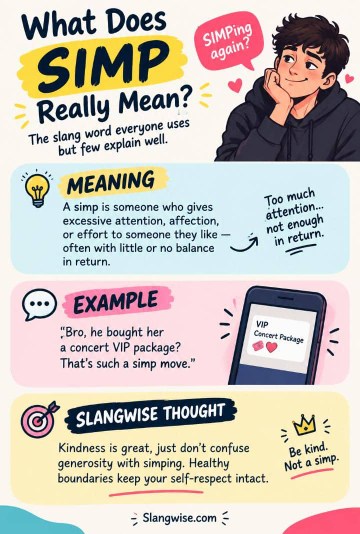
In everyday internet slang, a simp is a person who gives excessive attention, admiration, money, praise, or effort to someone they like, especially when the effort is not being returned in a similar way.
That last part matters. When I decode slang, I always look beyond the basic definition and ask what the speaker is trying to point out. With simp, the target is usually the imbalance.
Buying a birthday gift does not make someone a simp. Complimenting a crush does not make someone a simp either.
The label usually appears when people think someone is doing far too much, constantly chasing approval, or ignoring their own boundaries just to keep another person’s attention.
Simp is not limited to men. The slang developed with a strong focus on men pursuing women, but people now use simp and simping more broadly for anyone who seems excessively devoted to another person, celebrity, creator, or character.
Where did simp come from?
This is where the history gets more interesting. Simp did not begin with TikTok. The word appears in English as an old shortening of “simpleton,” meaning a foolish or easily fooled person, with printed evidence going back to the early twentieth century.
The romantic slang sense developed later. In West Coast hip hop during the 1980s and 1990s, simp became associated with men who were seen as overly submissive or too focused on women.
The exact slang etymology is still debated, which matters because the internet loves turning uncertain word origins into neat little stories.
One popular explanation treats SIMP as an acronym. I would not present that as settled history. The stronger evidence points to an older word developing new meanings across different communities.
The next major shift happened online. The term circulated through forums, gaming and streaming communities, and social media before exploding on TikTok.
In December 2019, the Simp Nation meme turned the word into a highly shareable joke. Know Your Meme documents that trend and its rapid spread while also noting that the slang itself was already older.
I recommend checking Know Your Meme’s breakdown of simp when you want the internet culture side of the story, because it tracks how slang moves through memes, communities, and platforms rather than treating a word as if it has only one frozen meaning.
Slangwise observation: A word can have an old origin and still feel completely new when a younger internet community gives it fresh energy.
Read Also: 68 Viral TikTok Slang Terms like Simp that are currently trending in 2026
How people use simp today
In my experience decoding social media language, people rarely stop to announce a formal definition. They use simp as a quick reaction to someone’s behavior.
1. Teasing a friend
- “You saved her seat, carried her bag, and brought her favorite snack. You are actually simping.”
- “One reply from your crush and you changed your whole weekend plan. Simp mode is active.”
Here, the word is usually exaggerated for comedy. Friends are not necessarily making a serious judgment. They are pointing out that someone is clearly putting extra effort into impressing a person they like.
2. Calling out one sided effort
- “He keeps showing up for her, but she never does the same. People are calling him a simp.”
- “She has ignored every message, but he still keeps trying to impress her. That is what they mean by simping.”
This use is more serious because the speaker is focusing on the imbalance. The slang suggests that the person is giving far more than they are receiving.
3. Joking about celebrity or creator admiration
- “You bought every version of the creator’s merch? The replies are going to call you a simp.”
- “You are defending that celebrity like you personally know them. The simp allegations are starting.”
This shows how flexible internet slang can become. The word can move beyond dating and describe intense admiration more generally.
What is the difference between liking someone and simping?
This is the distinction I think gets lost the most. Having a crush is normal. Being thoughtful is normal. Supporting someone you care about is normal. None of those things automatically equal simping.
When I explain the word, I usually tell people to look for three signals: excess, imbalance, and loss of perspective. Are you repeatedly doing more than you are comfortable with? Is the effort clearly one sided? Are you ignoring your own boundaries just to keep another person’s attention?
When those patterns appear, people are much more likely to use simp or simping. Without them, the word can become little more than a way of mocking someone for showing affection.
Slangwise Tip: Do not confuse kindness with simping. The slang is usually about excessive or unbalanced attention, not ordinary care.
Simp appears to be one of the 20 most offensive internet slang words of 2025 if used the wrong way. Check out the others.
Why do people say simp so much?
I think the word survived because it does a lot of work in very few letters. It is short, memorable, easy to turn into simping, and instantly understandable inside online conversation.
It also captures a behavior people love to joke about: the moment a person gets a crush and suddenly starts acting completely differently. That makes simp perfect for comments, memes, group chats, reaction posts, and playful callouts.
But simp is not always a serious insult. I have seen people use it jokingly about themselves too. A fan might say, “I am simping for this character,” simply to admit they are obsessed with a character they like. In a public comment aimed at a stranger, however, the same word can feel dismissive.
That is why context matters so much. Someone can be affectionate, generous, loyal, or excited without automatically deserving the label. Slang is not just vocabulary. Tone, relationship, platform, and intent all shape what a word means in the moment.
How to use simp naturally
If you are trying to use the word naturally, think of it as a playful way to point out exaggerated devotion.
- “He is simping over that singer again.”
- “That was a simp move, but I cannot even blame you.”
- “I am not simping. I just really like the show.”
Notice how each example depends on context. That is a big part of slang literacy. Knowing the word is only half the job. Knowing when the word will land naturally is the other half.
Take action
- Wear it boldly: Visit the Slang-Wear Store for “No Simps Allowed” merch and other statements.
- Master your lingo: Download our free Slang Mastery Guide for in depth breakdowns of today’s hottest terms.
In a nutshell
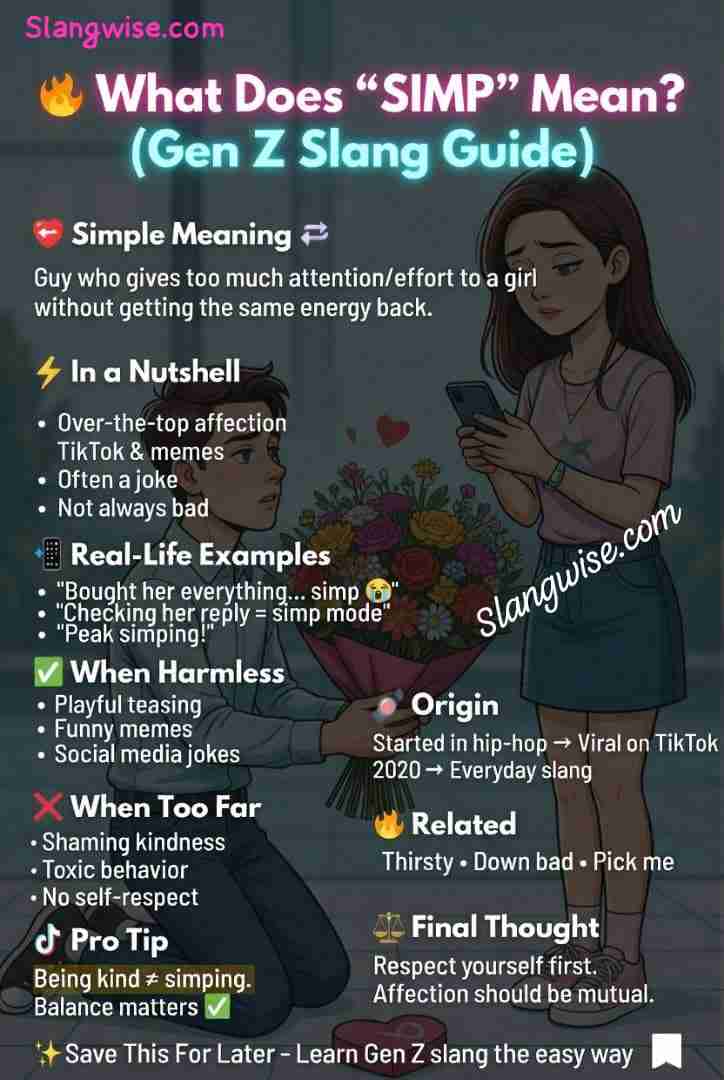
- Simp usually describes excessive attention, admiration, money, or effort directed toward someone a person likes.
- The key idea is usually an imbalance, especially when the effort is not returned.
- The word is older than TikTok, while the late 2019 Simp Nation trend helped make it mainstream internet slang.
- Simping can be used seriously, jokingly, or as self teasing depending on the community and context.
- Understanding the context matters because kindness, affection, and genuine interest are not automatically simping.
Conclusion
After following this word through different corners of internet culture, I think the biggest mistake is treating simp like a simple insult with one permanent meaning. It is much more interesting than that.
Its older history, its later use in hip hop, and its huge internet revival show how slang evolves. A word moves from one community to another, picks up new shades of meaning, and suddenly millions of people are using it differently.
So when someone says, “You are simping,” listen for what they are actually pointing at. Are they joking about a crush? Calling out one sided effort? Teasing someone for being deeply invested in a celebrity or creator?
That is the real skill behind understanding slang. You do not just memorize what a word means. You learn how people use it, what emotion it carries, and when the meaning changes.
And that is exactly why simp is still worth decoding.
FAQs
Yes. Simp can describe someone who gives excessive attention or effort to a crush, celebrity, creator, or another person even when they are not in a relationship.
No. Having a crush simply means you are attracted to or interested in someone. Simp usually suggests that the attention or effort has become excessive or unbalanced.
Simping on social media usually means showing unusually strong admiration or attention toward someone through comments, messages, gifts, posts, or other visible support.
Yes. People sometimes use simp playfully or even proudly to describe being a huge fan of someone or admitting they are very fond of a person, character, or creator.
The older English form is a shortening of simpleton, but the modern slang sense developed through later communities, including West Coast hip hop, before spreading through internet culture and becoming widely popular on TikTok around 2019 and 2020.
About the author
Agboola John is the founder of SlangWise.com and a dedicated explorer of evolving internet slang. John combines research, personal observation, and a touch of humor to help readers stay fluent and confident in modern language.
Table of Contents