When a Blank Look Becomes a Whole Conversation
You ask a simple question, make a joke, or offer a friendly greeting. Instead of getting a smile, a reply, or even a nod, you receive a completely blank stare. No explanation. No obvious emotion. Just silence.
And suddenly, you are wondering whether the person is confused, annoyed, unimpressed, or waiting for you to say something else.
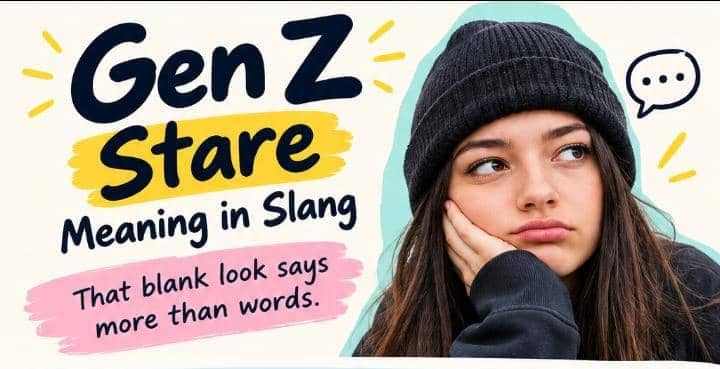
Welcome to what the internet calls the Gen Z stare. It is one of those modern expressions that has turned an ordinary facial reaction into a recognizable part of online culture.
As I explore internet slang, I find expressions like this particularly interesting because they show that communication is not always about the words we choose. Sometimes, the reaction is the message.
In this guide, I will explain what the Gen Z stare means, why people keep discussing it, and how to tell whether that silent look is awkwardness, disbelief, or something else entirely.
What Does Gen Z Stare Mean in Slang?

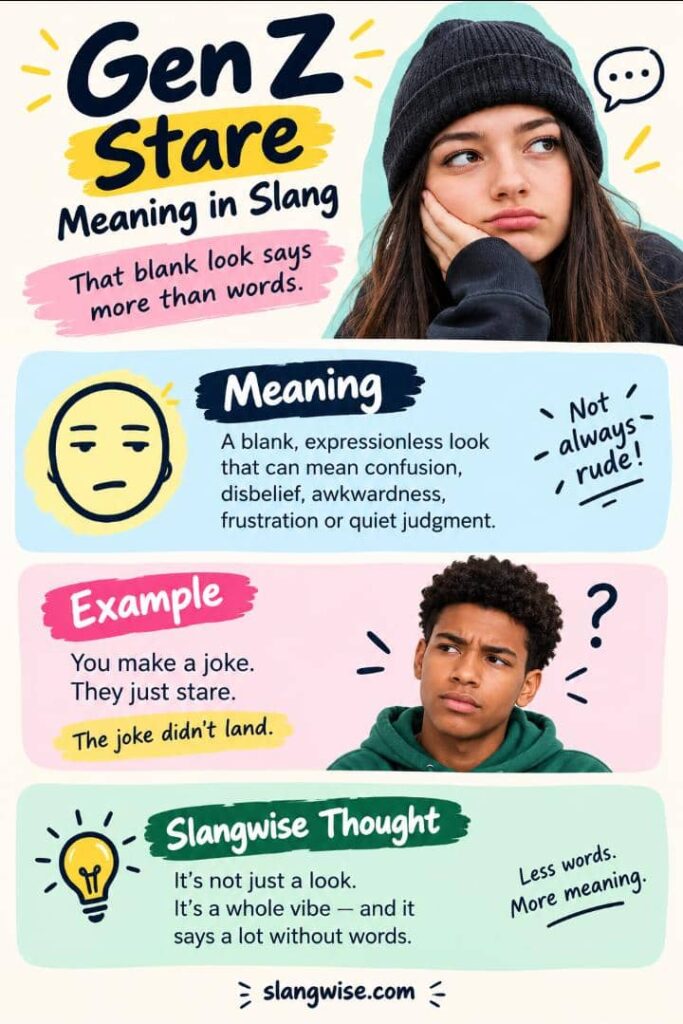
The Gen Z stare describes a blank, expressionless, or deadpan look that someone gives instead of responding in the way another person expects.
It is particularly associated with everyday conversations and customer service interactions, where a greeting or simple question might receive silence rather than a verbal response.
Depending on the situation, the look might communicate:
- “Wait, what did you just say?”
- “I genuinely do not know how to respond.”
- “Are you being serious right now?”
- “That was awkward, and we both know it.”
- “I heard you, but I am not impressed.”
One detail I always emphasize when explaining slang is that context matters. The Gen Z stare does not have one fixed meaning. The same expression might communicate disbelief in one conversation and simple confusion in another.
Think of it as a facial reaction that people interpret through the situation surrounding it. The expression might look identical, but the message behind it can be completely different.
READ LATER: Girlboss Meaning: How Gen Z Turned a Millennial Power Word Into Irony
Why Is Everyone Talking About the Gen Z Stare?
The phrase gained widespread attention through social media discussions about how younger people communicate, particularly during customer service encounters.
Know Your Meme traces an early mention to a TikTok post from July 2024, while the debate became much more visible online in 2025.
Some older customers described approaching a young worker and receiving a blank look instead of a greeting or friendly response.
Gen Z users pushed back, arguing that the expression could be a reasonable reaction to confusing questions, uncomfortable interactions, or customers behaving rudely.
I find this disagreement especially revealing. One person interprets silence as poor manners, while another sees it as an understandable response to an awkward situation. Both interpretations depend heavily on what happened before the stare.
Social media made the expression easy to recognize and recreate. People began using it to describe everything from uncomfortable classroom moments to conversations that suddenly became too strange to handle normally.
5 Examples of the Gen Z Stare in Everyday Conversations

Understanding the Gen Z stare becomes easier when you see how it works in everyday situations. Here are five fresh examples.
1. When Someone Asks an Unnecessarily Obvious Question
Example: Your friend watches you put on a raincoat and asks, “Are you planning to go outside in the rain?”
You turn and look at them without saying anything.
Meaning: You are probably wondering whether the question really needed an answer. The stare communicates disbelief without starting an argument.
2. When a Joke Completely Misses the Mark
Example: Someone tells a joke at lunch, waits for everyone to laugh, and receives nothing but a silent look from you.
Meaning: The joke did not land. Rather than explaining why it was not funny, your expression delivers the reaction on its own.
3. When a Conversation Becomes Painfully Awkward
Example: Two classmates are chatting normally when one suddenly reveals something so unexpected that the other person does not know what to say.
There is a pause, followed by a long, expressionless look.
Meaning: The person is caught off guard and needs a moment to process what they have heard. The stare may reflect genuine surprise rather than judgment.
4. When a Customer Says Something Ridiculous
Example: A customer complains that a shop is closed even though the closing time is clearly displayed on the door. The worker looks at the customer in silence.
Meaning: The expression might signal disbelief or frustration. In online discussions, this is the kind of customer service encounter people often associate with the Gen Z stare.
5. When Someone Says Something Completely Out of Pocket
Example: Your friend casually announces that they have decided to name their new pet after a celebrity they dislike. Everyone at the table turns to look at them in silence.
Meaning: Nobody knows how to respond to the unexpected announcement. The collective stare becomes the funniest part of the conversation.
Notice the pattern? In each example, the expression communicates something that could have been explained with several words. That is part of what makes the Gen Z stare so recognizable in internet humor.
READ ALSO: Rizz Meaning Explained: What Gen Z Really Means When They Say Someone Has Rizz
Is the Gen Z Stare Rude or Just Misunderstood?
My take is that the Gen Z stare is not automatically rude. It can be dismissive, but it can also be a natural response to confusion, fatigue, surprise, or an uncomfortable interaction.
Imagine greeting someone who is busy thinking about something else. They look at you without immediately speaking. You might interpret their silence as disrespect, even though they simply need a moment to respond.
This is why I am careful about treating the term as proof that an entire generation lacks social skills. The phrase became popular partly because it gave people a funny label for a behavior they believed they were noticing. That does not establish that everyone in Gen Z communicates this way.
There is also a difference between having a naturally neutral expression and deliberately using silence to embarrass someone. The surrounding conversation, the person’s tone, and what happens next all help you understand the situation.
How Should You Respond to a Gen Z Stare?
Here is the approach I recommend: do not immediately assume the worst.
If the person appears confused, clarify what you mean. If the moment feels awkward, a lighthearted comment may help. If your joke receives no reaction, you can laugh it off and move on.
In a professional setting, though, clear communication still matters. A simple greeting or polite verbal response can prevent misunderstandings, regardless of someone’s generation.
Most importantly, remember that you cannot reliably determine what someone thinks from one facial expression alone. A little conversation can tell you much more than guessing what a stare means.
Slangwise Thought
What makes the Gen Z stare interesting to me is how an ordinary human expression became a cultural talking point. The internet did not invent blank expressions, awkward silences, or the feeling of being speechless. It gave a familiar experience a catchy name.
I also see a useful lesson in the debate surrounding this phrase: communication is not just about what one person intends. It is also about how another person interprets it. A look that feels funny to one person may feel dismissive to someone else.
That is why I believe the best way to understand slang is to look beyond the label and examine how people actually use it. The Gen Z stare captures a recognizable social moment, but it does not tell the whole story about the person giving it.
DISCOVER: 77 Gen Z Slang Words You’ll See Everywhere — Rizz, Delulu, Skibidi, Aura & More Explained
Gen Z Stare Meaning: 5-Point Summary
- The Gen Z stare is a blank or deadpan look that replaces an expected verbal response.
- It can communicate confusion, disbelief, awkwardness, frustration, or quiet judgment.
- The phrase became widely discussed through social media debates about generational communication and customer service.
- The stare is not always rude, and it does not mean every member of Gen Z behaves the same way.
- Context matters. Consider the situation before deciding what someone’s expression means.
Conclusion
The Gen Z stare is a modern slang expression for a silent, expressionless reaction that can communicate more than words sometimes do. It might signal confusion, disbelief, awkwardness, or the feeling that a conversation has taken an unexpected turn.
From my perspective, its popularity says as much about how people interpret one another as it does about Gen Z itself. A blank look can be funny, uncomfortable, or frustrating depending on the circumstances.
So, the next time someone gives you that unmistakable stare, pause before assuming they are judging you. They might be confused, processing your words, or simply unsure how to respond. Sometimes, the real meaning becomes clear only when the conversation continues.
Frequently Asked Questions
The Gen Z stare is a blank or deadpan expression used instead of an expected verbal response. Depending on the context, it may communicate confusion, disbelief, awkwardness, frustration, or quiet judgment.
The name connects the expression to Generation Z and online discussions about how younger people communicate. The phrase became widely discussed on social media, particularly during debates about customer service and everyday interactions.
No. It can appear dismissive in some situations, but it may also reflect surprise, confusion, tiredness, or a need for time to process what someone has said. Context is essential when interpreting it.
A Gen Z stare is generally described as a blank, expressionless reaction. A death stare usually refers to an intense or hostile-looking gaze intended to show anger, displeasure, or strong disapproval.
Stay calm and consider the situation. Clarify your point if the person seems confused, use humor if the moment is awkward, or politely ask whether they understood your question. Avoid assuming their expression reveals exactly what they are thinking.
Further Reading
For more context on how the phrase emerged and spread through internet culture, read Know Your Meme’s explanation of the Gen Z stare. The site covers internet culture, viral trends, memes, and the slang conversations surrounding them.
About the Author
Agboola John is the author of SlangWise, where he explores internet slang, Gen Z expressions, viral phrases, and the cultural meanings behind everyday online language. His goal is to help readers understand not just what slang means, but how people use it in real conversations.
Table of Contents