
Have you ever seen someone type “You’re buggin’” in a group chat and wondered whether they were joking, arguing, or genuinely upset? The confusing part is that the same phrase can mean different things depending on the situation.
In casual conversations, a friend might say you are buggin’ because you made an unbelievable suggestion.
Someone else might use it when you are overreacting, while another person might say, “I was buggin’,” to describe how nervous they felt before an important moment.
I find that understanding slang requires more than memorizing definitions. You also need to understand the attitude and emotion behind the words.
In this guide, I will explain what buggin’ means in slang, explore its different uses, and share natural examples that will help you understand the phrase whenever it appears online or in conversation.
What Does Buggin’ Mean in Slang?
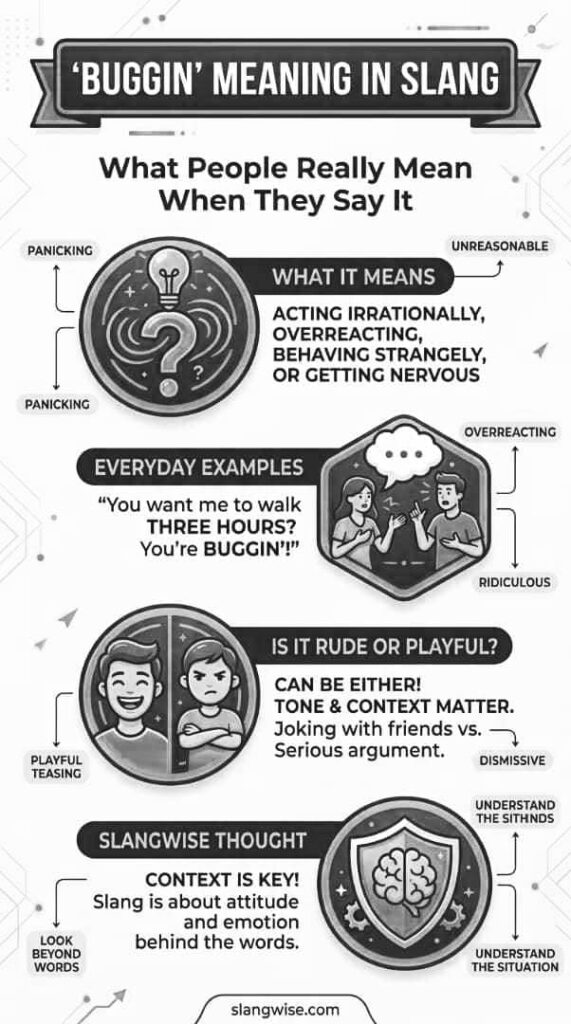
Buggin’ is informal slang that usually means acting irrationally, overreacting, behaving strangely, or saying something that sounds ridiculous.
Depending on the context, it can also describe someone who is panicking, getting worked up, or reacting with disbelief.
When someone tells you, “You’re buggin’,” they might mean:
- You are overreacting to something.
- You are behaving unreasonably.
- What you just said makes absolutely no sense to them.
- You are getting unnecessarily worked up.
- You are behaving in a way they find unbelievable.
For example, imagine telling your friends that you plan to finish an entire week’s worth of assignments in the last ten minutes before class.
Someone might respond, “Nah, you’re buggin’!” They are not talking about insects. They mean your plan sounds unrealistic.
When I explain slang like this, I always emphasize context. The words alone tell you part of the meaning, but the surrounding conversation helps you understand what the speaker actually intends.
Read Also: Midwest Nice Meaning in Slang: Is That Sweet Smile Hiding Something?
How People Use Buggin’ in Everyday Conversation
One reason buggin’ remains useful in casual speech is its flexibility. Here are four common situations where you might encounter it.
1. When Someone Is Being Unreasonable
This is one of the most recognizable uses. You say someone is buggin’ when their suggestion, decision, or behavior seems completely unreasonable.
Example: “You want me to travel three hours just to return a borrowed pen? You’re buggin’!”
The speaker thinks the request is excessive. Depending on their delivery, the response might be playful teasing or a serious disagreement.
2. When Someone Is Overreacting
Sometimes, people use the phrase when they believe someone is making a bigger deal out of something than necessary.
Example: “Why are you buggin’ because I replied to your message ten minutes late?”
Here, the speaker believes the other person’s reaction is excessive. However, remember that calling someone out does not automatically mean their feelings are unreasonable. Slang communicates the speaker’s opinion, not necessarily the whole truth.
3. When Someone Is Nervous or Panicking
Buggin’ can also describe becoming unusually anxious or worked up before something important happens.
Example: “I was buggin’ before my driving test, but I felt better once I got started.”
In this situation, the person is talking about their own reaction. They are describing how nervous they felt rather than accusing somebody else of behaving badly.
4. When Something Sounds Impossible
Another common use expresses disbelief. You might hear it when somebody shares a surprising story, makes an unbelievable claim, or suggests something that seems absurd.
Example: “He claims he watched an entire television series in one night? That dude is buggin’!”
The speaker is expressing surprise and disbelief. Depending on the delivery, the response could also suggest that they simply do not believe the story.
A Simple Way to Understand the Feeling Behind Buggin’
Imagine a group chat where everyone is discussing plans for the weekend. One friend suggests spending an unrealistic amount of money on a simple outing. Another replies, “You’re buggin’ if you think I’m paying that much!”
Now imagine that the same friend starts worrying excessively about a small misunderstanding and someone asks, “Why are you buggin’?” The expression is similar, but the meaning has shifted from disbelief about a suggestion to criticism of someone’s reaction.
This is why I encourage readers to consider three things: what happened, how the speaker said it, and the relationship between the people involved. Together, those clues make slang much easier to interpret.
DISCOVER: 77 Gen Z Slang Words You’ll See Everywhere in 2026 — Rizz, Delulu, Skibidi, Aura & More Explained
Where Did Buggin’ Come From?
The slang is associated with Black American speech, particularly New York vernacular, and became widely recognizable through hip-hop and 1990s popular culture. Rap music and films helped bring the expression to broader audiences.
The word also connects naturally with the older idea of being bothered, irritated, or acting strangely. However, it would be misleading to attribute its entire history to one song, artist, or film.
What matters for everyday understanding is that buggin’ developed into a flexible expression for irrational behavior, disbelief, and heightened reactions. Its precise meaning still depends on how people use it in conversation.
Is Buggin’ Rude or Playful?
It can be either. Between friends, “You’re buggin’” might be an amusing way to challenge an exaggerated statement. During an argument, the same words can sound dismissive or insulting.
For instance, laughing while saying, “You’re buggin’ if you think I’m waking up at four in the morning on Saturday,” sounds relatively playful. Saying it angrily during a disagreement carries a different message.
I would avoid using it in formal emails, professional discussions, or sensitive conversations where your words could be misunderstood. Slang works best when your audience understands the tone you intend.
Buggin’ vs. Trippin’: What’s the Difference?
Buggin’ and trippin’ overlap in meaning. Both can describe overreacting, behaving irrationally, or getting worked up about something.
However, buggin’ can emphasize behavior that seems strange or unreasonable, while trippin’ is often used to suggest that someone is mistaken, overreacting, or making an issue out of something unnecessarily.
Neither distinction is absolute. In everyday conversation, speakers sometimes use the two expressions almost interchangeably.
In a Nutshell: What You Should Remember About Buggin’
- Buggin’ usually means acting irrationally, overreacting, or behaving unreasonably.
- It can express disbelief when someone says or does something unbelievable.
- People can use it to describe their own nervousness or heightened reaction.
- Its tone may be playful, critical, or dismissive depending on the situation.
- Understanding the surrounding conversation is the best way to identify its intended meaning.
EXPLORE: 250+ Common Internet Abbreviations and Their Meanings
Conclusion
So, what does buggin’ mean in slang? It generally describes someone acting irrationally, overreacting, panicking, or saying something that sounds ridiculous.
What I find interesting about this expression is how much meaning it can carry in just one word. Sometimes it challenges someone’s judgment. Other times, it communicates surprise or describes your own reaction to a stressful situation.
The next time you see “You’re buggin’” in a message or social media comment, look beyond the phrase itself. Pay attention to the situation and the speaker’s tone. Once you understand those clues, the meaning becomes much clearer.
Further Reading
For another look at how context shapes the meaning of this expression, read VICE’s cultural discussion, “We Asked VICE What ‘Buggin’ Means to Help the Hernandez Trial Prosecutor.” It explores how people interpret the phrase in real conversation and why its meaning can be difficult to pin down without context.
Table of Contents