
- Content farming means producing a lot of online content fast, usually with little care for quality.
- The phrase is often used in a negative way to describe spammy posts, clickbait, or empty articles made for traffic.
- People use it for websites, channels, pages, and even creators who seem more focused on volume than value.
- It is closely related to ideas like engagement farming, SEO spam, and AI slop.
- Take the Slang Quiz and download our free 270 plus Internet Slang Dictionary to keep your slang game sharp.
Table of Contents
What does content farming mean?
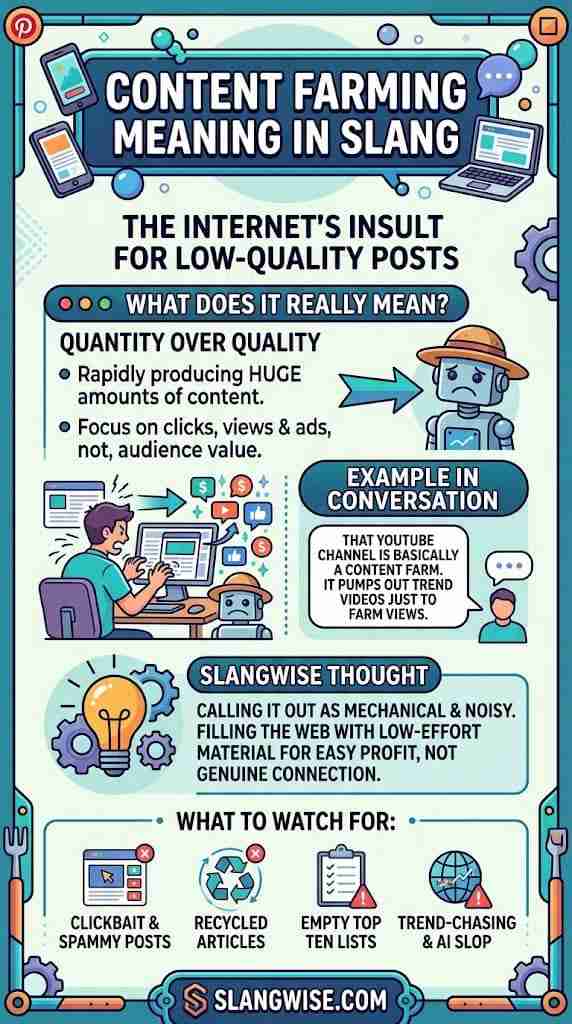
In slang, content farming is the habit of churning out loads of online content mainly to chase attention, clicks, views, and ad money, not necessarily to help the audience.
The core idea is quantity over quality. People usually say it with a side eye, because it suggests the creator is pushing material that is rushed, repetitive, thin, or made just to feed an algorithm.
A content farm can be a website, a YouTube channel, a social page, or any online space that feels like it exists to keep publishing, not to say something meaningful. In practice, the term often covers clickbait, recycled posts, generic listicles, trend chasing, and even mass produced AI content.
READ ALSO: Algo Farmer Meaning: The New Internet Slang for People Who Chase the Algorithm
Slangwise Thought on Content Farming
Here is the honest vibe of the term: when people say content farming, they are usually not praising consistency. They are calling out a pattern that feels mechanical. It is the online version of filling a room with noise and hoping some of it turns into money.
Sometimes, creators fall into it by accident. Other times they lean into it because the platform rewards speed, volume, and repetition. That is why the phrase carries criticism, not admiration.
Why people use Content Farming
People use content farming when they want to describe content that feels mass produced, shallow, or suspiciously optimized for performance.
It shows up in complaints about low quality blogs, fast paced YouTube channels, endless repost pages, and social media accounts that seem designed to bait engagement instead of offer real value.
Engagement farming is a close cousin, where the goal is to provoke comments, likes, and shares rather than genuine conversation.
There is also a bigger internet culture angle here. As AI tools have made it easier to generate content quickly, people have started using terms like content farming and AI slop to talk about huge piles of low effort material spreading across search results and feeds. That is part of why the phrase feels more relevant now than ever.
Examples of content farming in conversations
Example 1:
“Every article on that site feels like content farming. They post ten listicles a day and none of them say much.”
Example 2:
“That YouTube channel is basically a content farm. It keeps pumping out trend videos just to farm views.”
Example 3:
“Her feed used to feel personal, but now it looks like content farming because every post is made to chase engagement.”
RESD MORE: Copaganda Meaning: The Internet Slang That’s Calling Out Pro Police Media Everywhere
How to use it naturally
You would usually use content farming when you are criticizing a page, creator, or site that feels overly automated or desperate for traffic. It works best in casual conversation, online commentary, or posts where people are already discussing bad internet behavior.
Here are the kinds of moments where it fits naturally:
- When someone is repeating the same topic in different formats just to stay visible.
- When a page posts a flood of shallow content with little originality.
- When a creator seems more interested in the algorithm than the audience.
- When AI generated or recycled posts are flooding a space and making it harder to find real value.
What it does not mean
Content farming does not simply mean “posting content regularly.” That is an important difference. A consistent creator can publish often without being spammy.
Content farming is more about the attitude and the result: mass production, weak substance, and a strong focus on monetization or traffic.
So if someone uploads frequently but still gives value, teaches something useful, or stays original, that is not automatically content farming. The slang only really sticks when the content feels empty or overly engineered.
Conclusion
Content farming is one of those internet phrases that sounds simple, but it carries a lot of attitude. At its heart, it describes the race to make more and more content without much care for quality, originality, or usefulness. That is why people use it as a critique.
It is not just about posting a lot. It is about posting a lot for the sake of clicks, traffic, and money, even when the audience gets very little in return.
And honestly, that is why the term has stayed relevant. The internet keeps rewarding speed, volume, and virality. So whenever people feel overwhelmed by repetitive posts, thin articles, or AI generated noise, “content farming” is the phrase they reach for.
DISCOVER: 50 Popular Internet Catchphrases of 2026 – Viral Phrases You’ll See Everywhere
FAQs on Content Farming
Usually, yes in slang. The phrase is almost always used as criticism because it suggests low effort and weak quality.
No. Content creation is broad and neutral. Content farming is the negative label people use when content feels mass produced and shallow.
Very often now, yes. Many people use it to describe AI driven pages or channels that publish huge volumes of material with little human oversight.
Content farming focuses on pumping out lots of content. Engagement farming focuses on triggering likes, comments, and shares. They overlap, but the target is slightly different.