- GMFU stands for “Got Me F*cked Up,” a slang expression used to show strong disbelief, frustration, or feeling disrespected.
- It is popular in texting, TikTok, Snapchat, Instagram, and X, especially among Gen Z.
- Depending on the situation, it can express shock, anger, confusion, or even playful exaggeration.
- Since it contains implied profanity, it’s best reserved for casual conversations with friends.
- Understanding the context is key because GMFU can sound humorous in one conversation and very serious in another.
What Does GMFU Mean in Slang?
If you’ve been scrolling through TikTok comments or reading text messages lately, you’ve probably seen someone type “GMFU.” At first glance, it looks like another random internet abbreviation. But once you understand it, you’ll start noticing it everywhere.
GMFU is one of those slang terms that packs a lot of emotion into just four letters. Whether someone is annoyed, shocked, offended, or simply can’t believe what just happened, GMFU helps them express those feelings instantly.
Let’s break it down.
READ ALSO: TGIF Meaning Explained: Why This Friday Slang Still Feels So Good
What Does GMFU Mean?
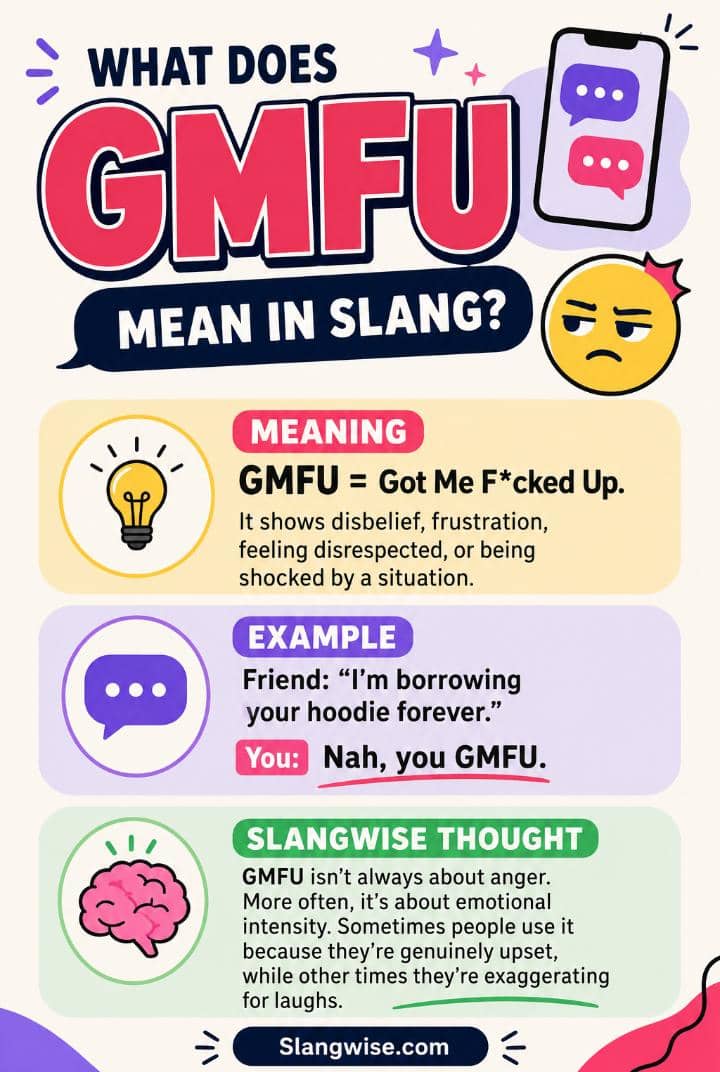
GMFU stands for “Got Me F*cked Up.”
Despite the strong wording, people don’t always use it literally. In everyday slang, it’s usually a dramatic way of saying:
- “You’ve got me confused.”
- “You’ve got me messed up.”
- “There’s no way that’s happening.”
- “I can’t believe you just said that.”
- “That’s completely unfair.”
The phrase usually shows that someone feels surprised, frustrated, offended, or caught completely off guard.
For example:
Friend: “I’m borrowing your hoodie forever.”
You: “Nah, you GMFU.”
Here, you’re saying, “You’ve got me completely wrong if you think that’s happening.”
Another example:
“The restaurant charged me twice. GMFU.”
This simply expresses frustration and disbelief.
Slangwise Thought
One thing I’ve noticed is that GMFU isn’t always about anger. More often, it’s about emotional intensity. Sometimes people use it because they’re genuinely upset, while other times they’re exaggerating for laughs. The tone, emojis, and conversation usually tell you which meaning is intended.
Where Did GMFU Come From?
GMFU didn’t suddenly appear on TikTok.
The full expression “got me f*cked up” had already been part of everyday urban slang and hip hop culture for years before people shortened it into an acronym. As texting became faster and social media favored shorter messages, abbreviations like GMFU became much more common.
Its popularity exploded through platforms like Twitter, Instagram, TikTok, Snapchat, and online gaming communities. Viral songs and internet culture also helped introduce the acronym to millions of younger users.
Today, it’s considered one of many emotional reaction acronyms used online.
EXPLORE: 250 Most Popular Internet Abbreviations of 2026 Explained for Easy Texting
How People Use GMFU
The meaning changes slightly depending on the situation.
1. Expressing disbelief
“You expect me to work on my birthday? GMFU.”
The speaker thinks the request is unreasonable.
2. Feeling disrespected
“He blamed me for something he did. GMFU.”
The person feels wrongly accused.
3. Showing frustration
“My package got delayed again. GMFU.”
Here, it simply expresses annoyance.
4. Joking with friends
Friend: “I ate your fries.”
You: “Bro, GMFU 😂”
No real anger here. It’s playful exaggeration.
GMFU on TikTok and Social Media
On TikTok, GMFU often appears in captions, reaction videos, memes, and comment sections.
Someone might post:
“When the teacher says there’s another assignment… GMFU.”
Or:
“They really thought I wasn’t gonna notice 😂 GMFU.”
Because social media thrives on exaggerated reactions, GMFU fits perfectly. It communicates strong emotion without needing a long explanation.
READ MORE: ASAP Meaning: What ASAP Mean in Text, Chats, and Professional Communication?
Is GMFU Offensive?
Technically, yes.
Since GMFU represents a phrase containing profanity, it isn’t appropriate for every audience.
It’s generally fine among close friends who already use casual slang, but it’s definitely not suitable for:
- School assignments
- Workplace emails
- Professional meetings
- Speaking with teachers
- Conversations with people who dislike profanity
When in doubt, choose a cleaner alternative.
Slang Similar to GMFU
If you understand GMFU, you’ll probably recognize these similar expressions:
- SMH – Showing disappointment.
- WTF – Expressing surprise.
- FR – Meaning “for real.”
- NGL – Short for “Not gonna lie.”
- LMAO – Reacting with laughter.
While all of these express emotion, GMFU specifically focuses on feeling shocked, frustrated, or disrespected.
Should You Use GMFU?
That depends on your audience.
If you’re chatting with friends who regularly use internet slang, GMFU feels natural.
If you’re speaking with coworkers, clients, family members, or anyone in a formal setting, it’s better to avoid it because many people still view the phrase as offensive.
Like most internet slang, context matters just as much as the word itself.
READ ALSO: Unc Meaning in Slang: The Tiny Word Gen Alpha Uses to Roast, Respect, and Call Out “Older Energy”
Conclusion
GMFU has become one of the internet’s favorite ways to express disbelief, frustration, and emotional shock in just four letters. Whether someone is reacting to bad news, an unreasonable request, or a hilarious situation, the acronym instantly communicates, “You’ve got to be kidding me.”
The next time you see GMFU in a text, TikTok comment, or Snapchat message, you’ll know exactly what the person is trying to say; and whether they’re seriously upset or simply being dramatic for fun.
Frequently Asked Questions
GMFU stands for “Got Me F*cked Up.” It expresses disbelief, frustration, feeling disrespected, or being shocked by a situation.
The acronym itself isn’t a swear word, but it represents a phrase that contains profanity. It’s best used only in informal conversations.
Yes. GMFU is widely used on TikTok, Instagram, Snapchat, X, and in text messages, especially among Gen Z users.
Absolutely. Many people use GMFU playfully with friends to exaggerate a funny or ridiculous situation rather than expressing genuine anger.
Table of Contents