
- “On God” means you are being completely serious. It is a slang way to stress that you are telling the truth or truly mean what you said.
- People also use it for strong agreement. In a reply, it can mean something like “for real,” “exactly,” or “I totally agree.”
- It is often shortened to “ONG.” That version shows up a lot in texts, comments, and social posts.
- The phrase is casual and expressive. It works best in relaxed conversation, not in formal writing or professional settings.
- Take the Slang Quiz to see how well you’re versed in today’s internet slang and see how many terms you can guess correctly.
- Download the free 270+ Internet Slang Ebook to get a bigger slang dictionary packed with meanings, examples, and more popular terms.
If you have been seeing “on God” everywhere online and wondering why people say it so confidently, the short answer is simple: it is a slang phrase people use when they want to sound very serious, very honest, or very certain.
It can carry the energy of “I swear,” “I promise,” or “for real,” depending on the sentence and the vibe.
On God Meaning in Slang
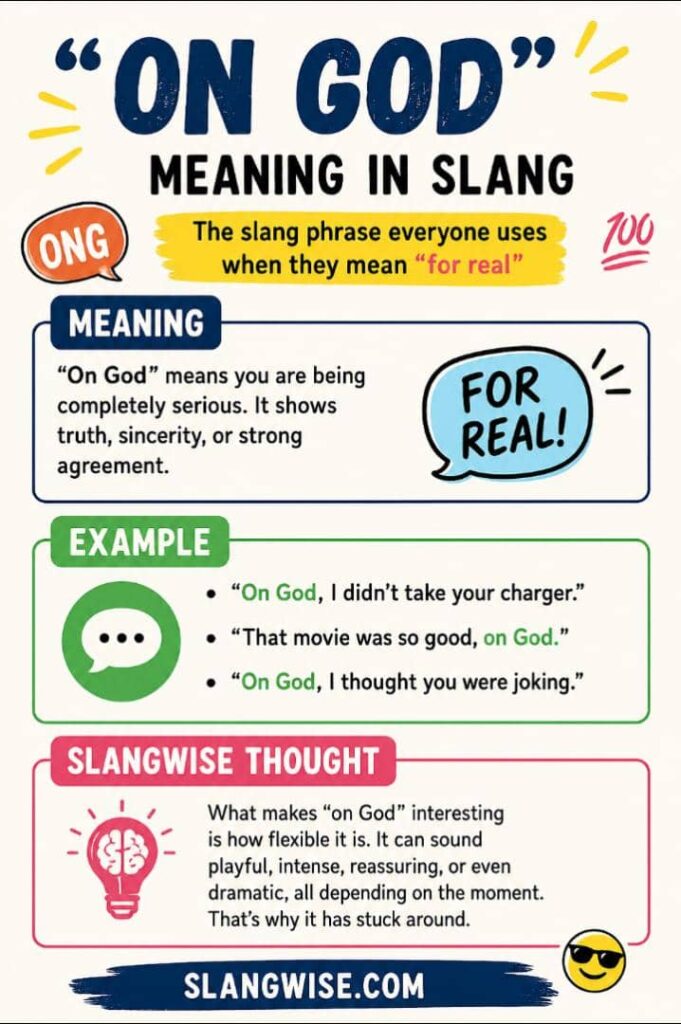
In everyday slang, “on God” is a strong emphasis phrase. People use it when they want to underline that what they are saying is true, genuine, or deeply felt.
You will hear it in sentences like, “On God, I did not take your charger,” or “That was the best meal I have had all week, on God.” The phrase works a little like a verbal highlighter. It does not change the core meaning of the sentence; it just makes the sentence hit harder.
It can also show strong agreement. If someone says, “That song is actually amazing,” a reply like “On God” means “I agree completely” or “Exactly.”
In that sense, it is not just about truthfulness. It is also about alignment, enthusiasm, and a shared emotional reaction.
READ ALSO: Standing on Business: Discover What This Slang Phrase Actually Means
Slangwise Thought
What makes “on God” interesting is how flexible it is. It can sound playful, intense, reassuring, or even dramatic, all depending on the moment.
That is why it has stuck around: it is short, punchy, and instantly understandable in casual conversation.
Where It Came From
This phrase has roots in African American Vernacular English (AAVE) and became more visible through hip-hop culture and social media.
Over time, it moved from spoken casual speech into texting and internet language, where people also began shortening it to “ONG.”
That history matters because slang does not appear out of nowhere. It grows in communities, gets repeated in music, spreads through online platforms, and eventually becomes part of wider everyday speech. “On God” followed that exact kind of path.
How People Use It in Real Life
The best way to understand “on God” is to look at how it sounds in real conversation. It is often used when someone wants to insist they are not lying, when they are making a strong promise, or when they want to back up a statement with extra weight.
Examples:
“On God, I finished the assignment before midnight.”
Here, the speaker is stressing honesty and pride in what they did.
“That movie was so good, on God.”
Here, it means strong agreement and emphasis.
“On God, I thought you were joking.”
Here, it sounds like a sincere reaction, almost like saying “for real, I believed you.”
In texting, the shortened form “ONG” is common, especially in fast, informal chats. It means the same thing, but it is quicker to type and looks more internet-native.
DISCOVER: 72 Most Popular Gen Z Slang Words of 2026 – Rizz, Delulu, Skibidi etc., And What They Secretly Mean Online
When to Use It and When to Skip It
“On God” works best with friends, classmates, social media captions, replies, and casual conversations. It has a confident, conversational tone that feels natural in informal settings.
You probably would not use it in a job application, school essay, business email, or any place where a more polished tone is expected. The phrase is expressive and modern, but it is still slang. In formal situations, plain language is usually better.
Is “On God” the Same as “I Swear to God”?
They are similar, but not exactly identical in feel. “I swear to God” can sound more forceful, more serious, or even more emotional.
“On God” often feels shorter, smoother, and more casual. In many situations, people use them almost interchangeably, but “on God” usually sounds more like modern slang.
Final Take
If you hear someone say “on God,” they are usually not being mysterious at all. They are simply emphasizing truth, sincerity, or agreement in a way that sounds current and confident.
It is one of those phrases that packs a lot of feeling into just two words. And that is exactly why it has become such a popular part of online and spoken slang.
READ ALSO: Twin Meaning in Slang: Why This Tiny Word Suddenly Became Everyone’s Favorite Compliment
FAQs
It means the speaker is strongly emphasizing that they are telling the truth, being sincere, or fully agreeing with something.
Yes. “ONG” is a shortened internet version of “on God.” It is commonly used in texts and social media.
Not always. It can mean “I swear,” but it is also used to show strong agreement or emotional emphasis.
It is better to avoid it in formal writing. It works best in casual speech, texting, and social media.
Table of Contents