
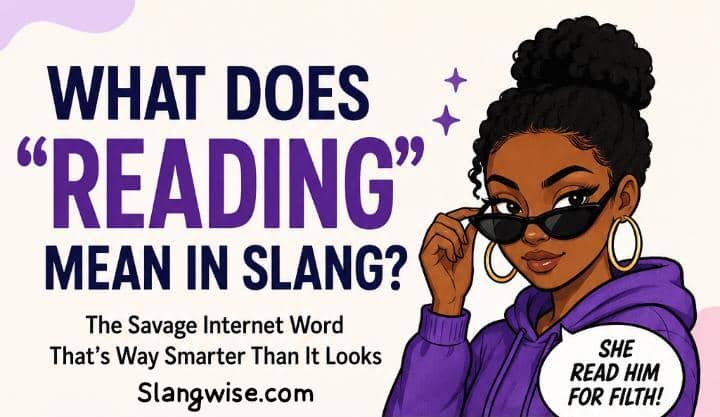
- “Reading” in slang means pointing out someone’s flaws in a sharp, witty, usually funny way. It is less about random meanness and more about clever verbal skill.
- The word grew out of Black queer and ballroom culture, where language, style, and wit were part of performance.
- A good “read” can sting, but it is often delivered with humor and timing. The crowd is usually part of the fun.
- Context matters. In some conversations, “reading” can also mean “understanding,” but in slang the roast-like meaning is the one people are usually talking about.
Table of Contents
What Does Reading Mean in Slang?
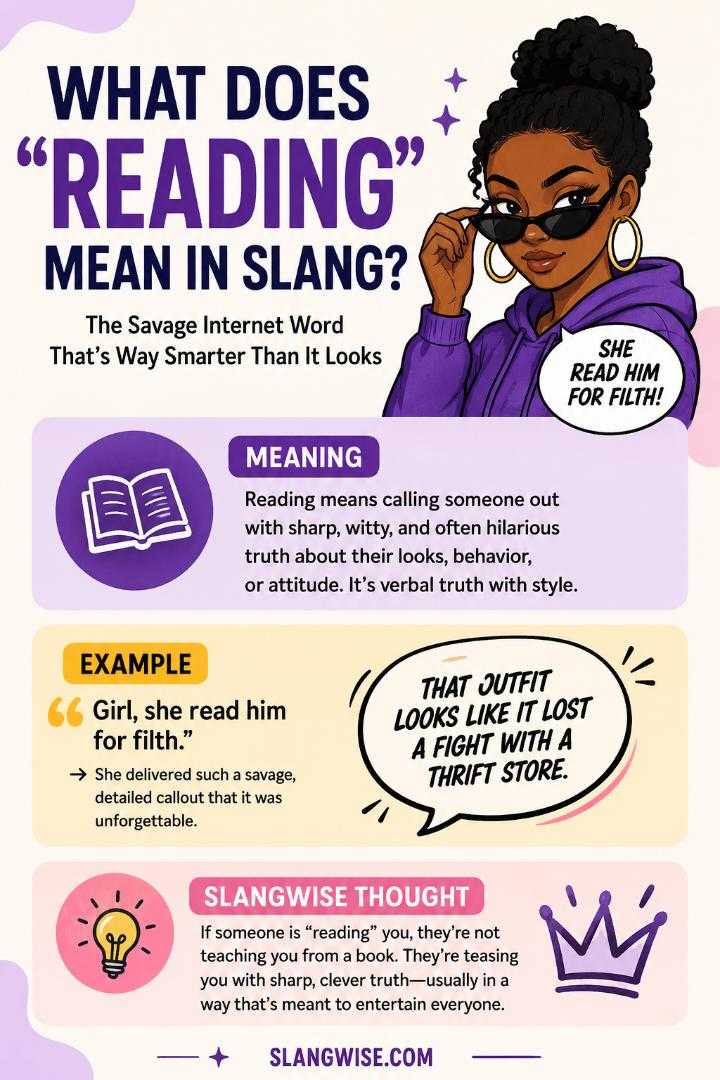
If somebody says, “She read him,” they are not talking about books. In slang, reading means looking at a person closely and then saying something brutally honest, witty, and often hilarious about their appearance, behavior, or attitude. It is basically verbal calling-out with style.
The key thing to understand is that reading is not just plain insulting. It usually has a performance edge to it. The best reads land because they are clever, well-timed, and painfully accurate. That is why people often describe it as a battle of wit rather than a simple argument.
READ ALSO: Kreygasm Meaning in Slang: The Twitch Reaction That Says “Wow” Without Saying a Word
Where Did It Come From?
This slang comes from ballroom culture and Black queer culture, where language has always been expressive, competitive, and creative. In that world, words like reading, shade, and legendary picked up special meanings that later spread much wider into pop culture.
Ballroom culture has long used language as part of the show. Reading became a way to roast someone’s look, pose, makeup, clothes, or attitude in front of other people, often in a way that made the audience laugh. That is a big reason the word survived: it was funny, memorable, and full of personality.
What Makes a “Read” Different From an Insult?
This is where people get it wrong. A regular insult is just mean. A read is sharper than that, but it usually has wit, timing, and a little artistry behind it. The goal is not just to hurt feelings. The goal is to land the joke so cleanly that everyone else feels the impact too.
Think of it like this: if somebody says, “Your outfit is a crime,” that is an insult. But if somebody says, “That outfit looks like it lost a fight with a thrift store,” that is more in the reading lane because it is vivid, funny, and extra. The humor is part of the whole point.
READ ALSO: Out of Pocket Meaning in Slang: Why This Phrase Can Sound So Wild So Fast
Reading Usage
You will often hear it in sentences like:
“Girl, she read him for filth.”
That phrase means the person delivered such a savage, detailed callout that it felt unforgettable. Even though the wording sounds dramatic, it is basically a very intense version of a roast.
People also use reading more casually to mean any sharp truth-telling moment. For example, if someone tells a friend, “You really are reading me today,” they mean the friend is being brutally honest in a way that feels a little too accurate. The tone decides whether the moment feels playful or too serious.
Slangwise Thought on Reading
If someone is “reading” you, they are not teaching you anything from a book. They are teasing you with sharp, clever truth, usually in a way that is meant to entertain other people too.
Well, my honest understanding is that reading is one of the smartest slang words to ever travel from a subculture into the mainstream. It works because it captures something very human: the ability to notice someone’s flaws and say them out loud in a way that is funny, quick, and unforgettable.
That is also why the word still matters online. People love language that feels sharp but stylish. Reading gives them a way to describe that perfect roast moment when somebody says exactly what everyone was thinking, only better.
DISCOVER: The Ultimate List of 250 Most Popular Internet Slang Words of 2026
How to Use It Naturally
Use reading when you want to describe a witty roast, a pointed callout, or a brutal but funny truth. It works best when the moment has attitude and personality. In other words, the word is about delivery as much as content.
A few easy examples:
“Stop reading me like that, I already know I am wrong.”
“She read the whole room in one sentence.”
“He was not arguing, he was reading.”
The important thing is not to force it. Reading sounds best when the moment is genuinely funny, harsh, or stylishly blunt. If the tone is flat, the word loses its power.
Conclusion
So, what does reading mean in slang? It means calling someone out with sharp, witty, often hilarious honesty. It came from Black queer and ballroom culture, where language was never just language; it was performance, competition, and social intelligence all rolled into one.
That is why the word still feels so alive. A read can be playful, savage, or borderline brutal, but when it is done well, it lands with style. If you understand the context, you will catch the meaning instantly.
If you do not, it can sound harmless until the joke hits you a second later. That is the magic of slang at its best.
FIND OUT: 35 New Slang Words Taking Over the Internet Right Now (2026 Watchlist)
FAQs
Not exactly. It means pointing out flaws or truth in a sharp, witty, often funny way. It can feel insulting, but the style and timing matter a lot.
They are related, but not the same. Reading is usually more direct and obvious, while shade is more subtle and backhanded.
It developed in Black queer and ballroom culture, where verbal competition and creative language were a major part of social life.
Yes. In many cases, that is exactly the point. A read often works because it is funny, clever, and delivered with confidence.