
- Dry texting means sending very short, low effort replies that do not keep the conversation going.
- It often looks like one word answers, tiny reactions, or messages that feel emotionally flat.
- People usually read it as a sign of boredom, disinterest, or low energy, even though that is not always the real reason.
- The phrase is common in texting, dating chats, and social media conversations because that is where tone gets interpreted fast.
- Sometimes dry texting is just someone being busy, tired, or naturally brief, not necessarily someone trying to be rude.
Dry Texting Meaning in Slang
Have you ever sent a message that felt warm, thoughtful, and maybe even a little funny, only to get back a tiny “ok,” “lol,” or “yeah” that made the whole conversation feel like it hit a wall?
That experience is exactly where dry texting comes in. In slang, it usually means replying with short, plain, and low energy messages that do not really add much to the conversation. The replies may be brief enough to feel cold, flat, or uninterested, even if that was not the sender’s intention.
In simple words, dry texting means texting in a way that feels boring, unenthusiastic, or hard to keep up.
And yes, it can be very annoying. One person feels like they are trying to build a real conversation, while the other person seems to be sending replies that barely keep the chat alive. That mismatch is why the phrase has become so popular online.
READ ALSO: Mood Meaning in Slang: Why One Tiny Word Became the Internet’s Favorite Way to Say “Same”
Table of Contents
The Part That Makes It Feel So Cold
Dry texting is not just about short messages. It is about how the message feels. A very short reply can sometimes be totally fine, but when the replies are consistently short and do not invite any follow up, the conversation starts feeling one sided.
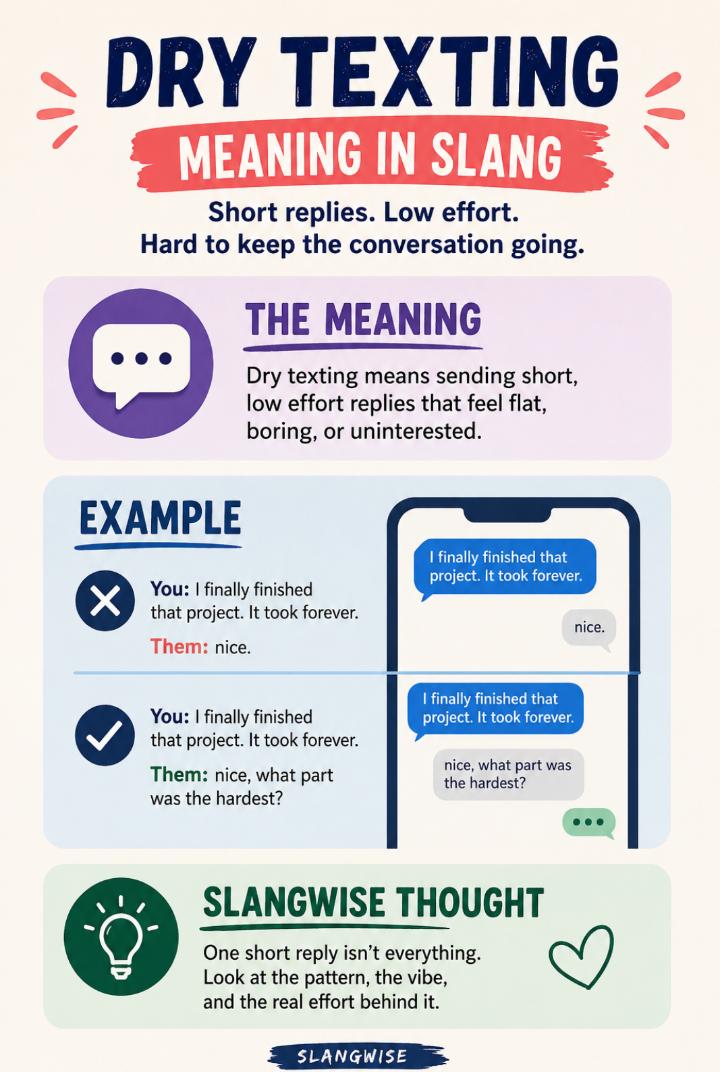
Think about the difference between these two chats.
You: I finally finished that project. It took forever.
Them: nice.
You: I finally finished that project. It took forever.
Them: nice, what part was the hardest?
The first one feels dry because it stops the momentum. The second one feels alive because it adds interest and keeps the conversation moving. That difference is what people usually mean when they talk about dry texting.
So the real issue is not only the length of the message. It is the lack of energy, detail, and curiosity behind it.
Why People Take It Personally
Dry texting can feel personal because text messages do not carry tone the way face to face conversation does. Without facial expression, voice, or body language, a short reply can easily look colder than it was meant to be.
That is why a person may read “k” and instantly think, “Did I do something wrong?” Sometimes the answer is yes, but sometimes it is just the other person being tired, distracted, or simply not a big texter.
This is also why dry texting shows up so often in dating conversations. People often use texting as a clue for interest, so when replies are short and flat, they may assume the other person is not invested.
Still, the smarter reading is not always “they do not like me.” Sometimes it is simply “this is how they text.” That nuance matters a lot.
READ ALSO: Mood Meaning in Slang: Why One Tiny Word Became the Internet’s Favorite Way to Say “Same”
When a Short Reply Is Just a Short Reply
Not every brief text is dry texting. A short reply can be normal when someone is busy, multitasking, tired, or simply not in the mood for a long chat. Recent explanations of the term point out that these messages are often about limited energy or a communication style, not always rejection.
That is one reason the phrase is tricky. Two people can send the same message, but the meaning can feel very different depending on context, timing, and the usual way they talk.
For example, a person who is normally warm and chatty but suddenly starts giving tiny replies may make the other person worry. On the other hand, someone who has always been brief may just be texting in their normal style.
That is why dry texting is less about one message and more about a pattern. A single “ok” is not always the problem. A string of flat replies with no effort to keep the conversation moving is what usually gives people that dry feeling.
The Everyday Signs People Notice
When people complain about dry texting, they usually mean a mix of these signs: one word answers, no follow up questions, very little emotion, and replies that feel like they are ending the conversation instead of building it.
It often looks like this:
- “yeah”
- “cool”
- “lol”
- “ok”
- “haha”
By themselves, these are not always bad. But when they keep showing up without any warmth or curiosity, people start calling the chat dry.
That is also why dry texting can feel so frustrating. It does not always say “I do not care,” but it often feels like “I am not really engaging here.” And in conversation, feeling heard matters.
READ MORE: 41 Meaning in Slang: Why Everyone Keeps Saying a Random Number Like It Means Something
So, Is Dry Texting Always a Red Flag?
No, not always. That is the part people often miss. Some people text dryly because they are overwhelmed, prefer short messages, or simply find constant texting draining. One recent discussion even points out that dry texting can be a way of managing mental load while still staying connected.
There is also a difference between texting style and actual relationship interest. A person can be warm, funny, and attentive in real life, yet still sound brief over text. That does not automatically mean they are uninterested.
At the same time, a pattern of dry replies can still matter. If someone only gives short answers, never asks anything back, and consistently makes the chat feel one sided, it is fair to notice that the energy is not matching.
So the balanced view is this: dry texting is not always a sign of rejection, but it is often a sign that the conversation needs more effort from one side or a better way to communicate.
A Better Way to Read the Vibe
If you are trying to figure out whether someone is dry texting you, the best move is to look at the full pattern, not just one message. Think about whether they usually reply like this, whether they ask questions back, and whether they seem engaged in other ways.
That keeps you from overreacting to one short message. It also helps you avoid assuming the worst when the problem might just be timing, energy, or texting style.
And if the dry vibe keeps happening, the clearest fix is often a direct conversation, not a guessing game. Texting can be messy, and people are much easier to understand when the conversation becomes more honest.
That is the real lesson here. Dry texting may look small, but it can carry a lot of meaning, or at least a lot of feeling. The trick is not to panic every time you get a short reply, but also not to ignore a pattern that clearly feels one sided.
DISCOVER: 27 New Gen Alpha Slangs and Catchphrases That Blew Up in the Last 4 Months
Final Thoughts
Dry texting is slang for sending short, low effort messages that feel flat or uninterested. It is a phrase that has become popular because it names a very common modern communication problem: one person wants conversation, and the other gives very little back.
At the same time, it is not always fair to assume the worst. A dry text can mean someone is busy, tired, distracted, or simply a naturally brief texter. Context matters a lot, and the same message can mean different things depending on the person and the situation.
So the next time you see a one word reply, do not rush to a conclusion. Look at the pattern, the vibe, and the relationship itself. That is usually where the real meaning lives.
Frequently Asked Questions
Dry texting means sending short, low effort replies that feel flat, boring, or uninterested.
No. Sometimes people are busy, tired, or naturally brief texters, so a short reply does not always mean rejection.
Examples include replies like ok, lol, yep, cool, or k when they are repeated without follow up or conversation.
Look for patterns. A busy person may still be warm, consistent, and engaged overall, while dry texting usually feels like repeated low effort with little conversation.
DISCOVER: 72 Most Popular Gen Z Slang Words of 2026 – Rizz, Delulu, Skibidi etc., And What They Secretly Mean Online