Table of Contents
W and WW Meaning in Slang: Why Everyone Keeps Typing Them
Internet slang has a funny way of turning the smallest things into full conversations. Sometimes one single letter can carry an entire mood, reaction, or opinion.
That is exactly what happens with W and WW.
You have probably seen people type things like:
“Common W”
“That is a WW situation”
“Bro really did that ww”
Initially, it can look confusing because the same letters can mean completely different things depending on where you see them.
And honestly, that is what makes online slang so interesting.
In this post, I will be breaking down what W and WW mean in slang, how people use them, and why context changes everything.
In a Nutshell
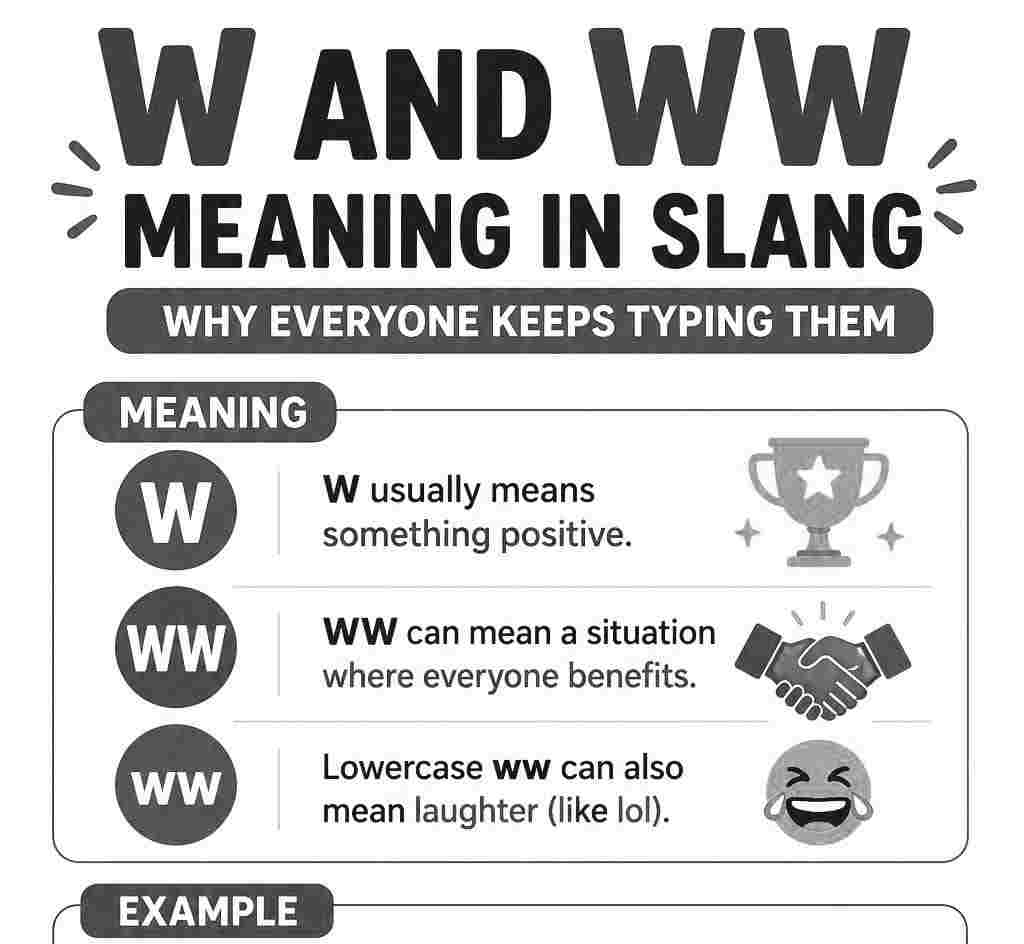
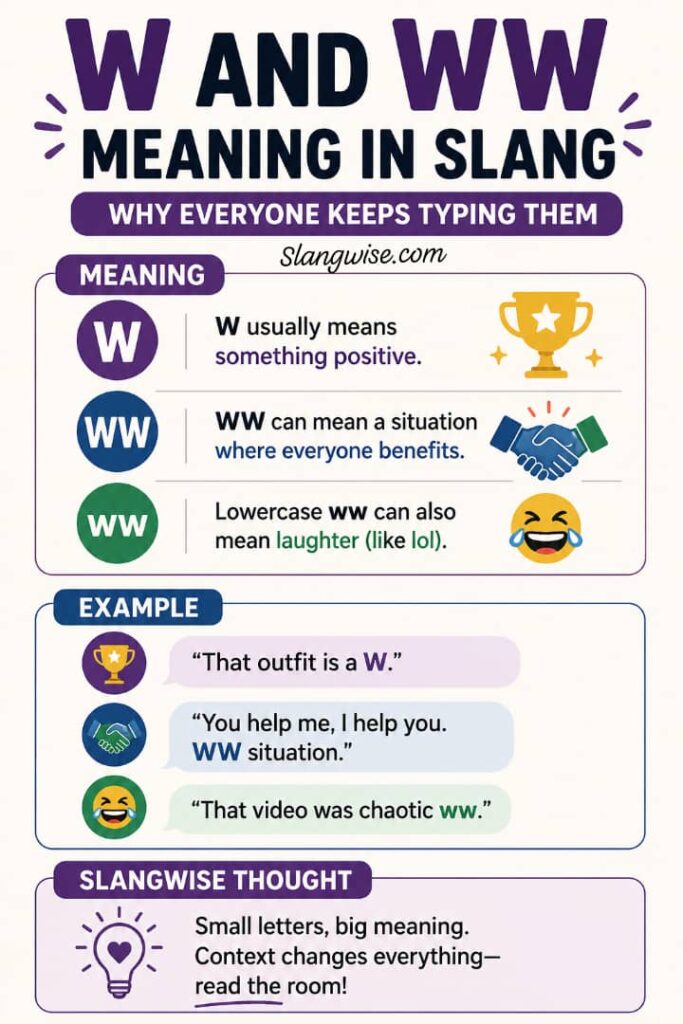
W usually means “win” or something positive.
WW can mean “win win,” especially when everybody benefits.
In some online communities, lowercase ww can also mean laughter, similar to “lol.”
The meaning depends on the platform, tone, and conversation.
250 Most Popular Internet Abbreviations of 2026 Explained for Easy Texting
What Does W Mean in Slang?
The most popular meaning of W in modern slang is win.
When somebody says “W,” they are basically saying:
“That is good.”
“That is a success.”
“That deserves respect.”
“That was smart.”
It is used heavily on social media, gaming platforms, livestreams, sports discussions, and TikTok comments.
Examples of W in Slang:
“Getting free food is always a W.”
“He apologized instead of arguing. W move.”
“That outfit is a W.”
“You passed the test? Massive W.”
The vibe is positive, supportive, and approving.
Why People Use W Instead of “Win”
Online slang loves speed. Shorter words feel quicker, cooler, and more natural in fast conversations.
Instead of saying:
“That is a big win.”
People simply type:
“Big W.”
It hits faster and feels more internet native.
Over time, the single letter became its own slang expression.
READ ALSO: The Ultimate List of 250 Most Popular Internet Slang Words of 2026
What Does WW Mean in Slang?
WW usually means win win.
A win win situation is when both sides benefit or everybody comes out happy.
For example:
“You help me study and I help you edit your videos. WW.”
“Working from home saves time and money. Total WW.”
In this sense, WW is basically shorthand for:
“Everybody wins.”
It is commonly used in texting, casual chats, business conversations, and social media comments.
WW Can Also Mean Laughter
Here is where things get interesting.
In some internet spaces, especially those influenced by Japanese online slang, lowercase ww can mean laughter.
That version comes from the Japanese word warau, which means “to laugh.” Because of that, people started using w like “lol,” and repeating it for stronger laughter.
So:
w = haha
ww = lol
wwww = hahaha
Example:
“That video was chaotic ww”
In that sentence, the person is laughing, not talking about winning.
SEE ALSO: GOLF Meaning in Slang: The Viral Compliment That Says Your Real Life Is Actually Amazing
Why Context Matters So Much
One thing I’ve learned from internet slang is that context changes everything.
The same letters can mean totally different things depending on the conversation.
For example:
“That was a W”
Clearly means a win.
“That clip got me crying ww”
Clearly means laughter.
“Sounds like a WW situation”
Means win win.
Without context, internet slang would honestly be a mess.
The Difference Between Uppercase and Lowercase
A simple trick that helps:
Uppercase W or WW usually relates to winning.
Lowercase w or ww often relates to laughter in Japanese style internet slang.
So:
W = win
WW = win win
ww = lol/laughter
Not everybody follows this perfectly, but it is a useful pattern to remember.
How W Became So Popular
The rise of gaming culture and reaction based social media pushed W into mainstream slang.
Gamers started calling successful plays a “W.” Streamers used it during live reactions. Then TikTok and X users spread it everywhere.
Soon people were saying:
“W friend”
“W music taste”
“W decision”
“W comeback”
Now it is part of everyday internet vocabulary.
READ MORE: NSFW Meaning: The Simple Tag That Can Save You From Big Trouble. Here’s What It Actually Means
Common Phrases With W
Common W
A normal but respectable success.
Example:
“Helping your mom with chores is a common W.”
Massive W
A huge success.
Example:
“Winning tickets for free is a massive W.”
Rare W
Used when someone who usually fails finally does something good.
Example:
“He finally replied politely. Rare W.”
Big W Energy
Confident, successful, positive vibes.
Example:
“She walked into the interview with big W energy.”
READ ALSO: Wwww Meaning in Slang: How wwww, wwwww and wwwwww Show Laughter and Exhaustion
Common Phrases With WW
WW Situation
A situation where everybody benefits.
Example:
“You gain experience and they get help. WW situation.”
Double W
Another way of saying something is extra successful.
Example:
“Free pizza and no homework? Double W.”
Is W Positive or Negative?
Almost always positive.
Calling something a W is basically praise. It means approval, success, respect, or support.
The opposite slang term is L, which means loss, failure, or disappointment.
Example:
“Missing the train was an L.”
“Passing the exam was a W.”
That W vs L format is now one of the biggest parts of modern internet slang.
Should You Use W and WW?
Absolutely, especially in casual conversations online.
They work best in:
- Group chats
- TikTok comments
- Gaming communities
- Social media replies
- Meme culture
But they are usually too informal for professional writing or serious conversations.
READ: KKK Meaning: Why Is Everyone Typing kkk, kkkk, and kkkkkkk? The Weird Slang That Turns Out to Mean Laughing
Final Thoughts
W and WW may look simple, but they carry a lot of meaning online.
Most of the time:
- W means win
- WW means win win
- Lowercase ww can also mean laughter in certain internet communities
That is the fun part about slang. Tiny expressions can hold entire emotions, reactions, and social vibes inside just one or two letters.
So the next time somebody says:
“Common W”
or
“ww that was funny”
you will know exactly what they mean.