
Have you ever clicked a link at your desk, only to realize a few seconds later that you probably should have waited until you were home? That awkward little moment is exactly why NSFW exists. It is one of those tiny internet labels that can save you from embarrassment, confusion, or a very unwanted surprise in the wrong place.
NSFW stands for Not Safe For Work. It is a warning tag people use when content may not be suitable for a public setting, a school setting, a workplace, or anywhere else where privacy matters.
That content might include nudity, sexual material, graphic violence, strong language, or anything else that could make someone uncomfortable if they opened it at the wrong time.
What makes NSFW interesting is that it started as a simple courtesy, but over time it became part of everyday internet language. People use it in social media posts, message threads, comment sections, group chats, and even in jokes.
In some spaces it is serious, and in other spaces it is playful. The meaning stays the same, but the tone can change depending on who is using it and where it appears.
Meanwhile, creators and artists sometimes use tools like an NSFW art generator to create adult themed artwork, especially in spaces where that kind of content is already expected.
The main job of NSFW is simple. It gives people a quick heads up so they can decide whether to open something now or save it for later. That small warning can make a big difference, especially when someone is scrolling fast and may not realize what is behind the link.
At the same time, the way people use NSFW has changed over the years. In workplaces, it can still carry real consequences because company devices, office networks, and shared screens are not private.
Among younger users, especially Gen Z, it is sometimes used with irony or meme energy, which makes it feel lighter, but the original meaning is still there underneath the joke.
In this article, I will walk you through what NSFW means, where it came from, how people use it today, why it matters in professional spaces, and how to use it responsibly without overthinking it.
In short: NSFW helps people decide whether to open something now or save it for a more private moment.
Table of Contents
In a Nutshell
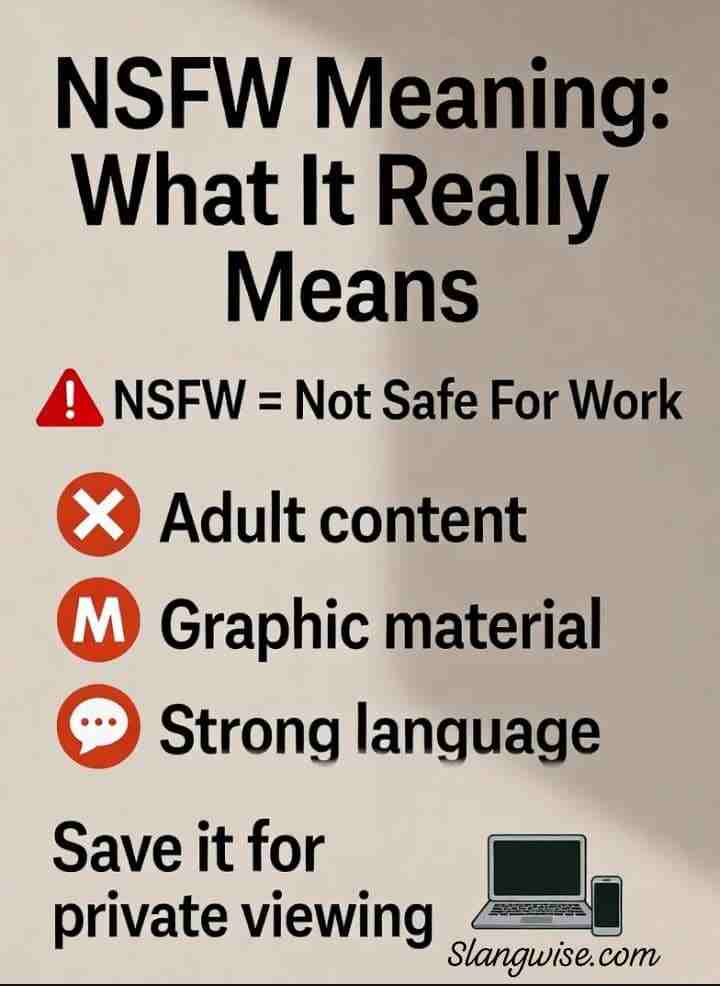
- NSFW means Not Safe For Work, and it is a warning that content may be inappropriate in public or professional settings.
- The tag is used for more than sexual content. It can also cover graphic violence, strong language, or anything likely to make someone uncomfortable.
- It began as a practical internet courtesy, then grew into a widely recognized shorthand across social media and messaging apps.
- In some online communities, NSFW is used seriously. In others, it is used ironically as part of a joke or meme.
Slangwise Thought
I pay close attention to how labels like NSFW move from serious warning to casual internet shorthand. That shift tells us a lot about how people communicate online. The label began as a simple act of respect, and honestly, that purpose still matters most.
In my opinion, the smartest way to use NSFW is to think about the person on the other side of the screen. If the content could surprise, embarrass, or disturb them in the wrong setting, the tag is doing its job. If the label is only being used for shock value or a joke, that is a different kind of use entirely, and it depends on context.
The real takeaway is this: clarity first, humor second. When safety matters, be clear. When you are joking, make sure the audience will understand the joke.
NSFW Meaning, and what it really says
NSFW means Not Safe For Work. That phrase may sound a little old school now, but the idea behind it is still very useful. It is a quick label that tells you the content may not be a good idea to open around coworkers, teachers, classmates, family members, or anyone else who should not unexpectedly see it.
Think of it like a digital warning sign. The message is not always that the content is illegal or forbidden. Often it simply means the content is sensitive, explicit, graphic, or likely to cause an awkward moment if someone else glances at your screen.
Read Also: You may have been using NSFW wrong – Here are 7 surprising ways to use It the right way to
How NSFW became such a common internet tag
NSFW started out as a practical label on forums, email threads, and early online communities. People wanted a fast way to warn others before they clicked something that could cause trouble at work or in public. That simple need turned into a widely shared internet habit.
As more people began using social media, the tag spread with them. It moved from message boards to memes, from comments to captions, and from quiet internet corners into everyday conversation. Today, even people who do not spend much time online usually recognize the term right away.
Why people use NSFW as a warning
There are a few very practical reasons people tag something NSFW. It is not just internet habit. It solves a real communication problem.
- Respect: It gives other people a chance to choose what they want to see. That matters because nobody likes being caught off guard by content they did not ask for.
- Speed: On a fast moving feed, people do not have time to inspect every link before opening it. NSFW acts like a one second alert.
- Protection: It helps reduce awkward situations, workplace trouble, and accidental exposure in public spaces where privacy is limited.
That is why the tag has lasted so long. It is short, familiar, and easy to understand. Even people who do not use slang every day usually know what it means the moment they see it.
What kind of content gets labeled NSFW?
The label usually appears on content that someone may not want to open in front of other people. That can include several different kinds of material, not just one type.
- Sexual content or nudity.
- Graphic violence or disturbing imagery.
- Very strong or offensive language.
- Content that could be embarrassing in a shared space.
- Anything likely to clash with workplace, school, or public expectations.
Sometimes the label is used very literally. Other times it is used more loosely. A post might be tagged NSFW simply because it is edgy, bold, or likely to spark a reaction. That flexibility is part of why the term stayed popular, although it also means people should pay attention to context.
READ MORE: 68 Most Popular TikTok Slang Words of 2026 – Quick Meaning and Examples
How Gen Z uses NSFW in a different way
Gen Z often uses online language with humor, irony, and speed. Because of that, NSFW can show up in two very different ways. Sometimes it is completely literal. Other times it is part of the joke.
In the original sense, NSFW is a real warning. It tells you a piece of content may be inappropriate in a public or professional setting. In the ironic sense, the tag is used to create contrast. A harmless photo, a goofy clip, or even a totally ordinary object might get the NSFW label for comedic effect.
That playful use works best when the audience already understands the tone. In a private meme chat, the joke may land instantly. In a mixed public comment section, though, people may take it literally and become confused. That is why context matters so much with slang.
When ironic use works well:
- In close friend groups where everyone shares the same sense of humor.
- In meme spaces where the audience expects exaggeration.
- When the joke is obvious and nobody is likely to feel misled.
When it can backfire:
- In public spaces with mixed ages and mixed expectations.
- When moderation systems read the label more literally than the user intended.
- When people start overusing the tag and real warnings begin to lose meaning.
How to use NSFW the right way
If you are posting online and want to be thoughtful, NSFW is not hard to use. A little care goes a long way, and honestly, people usually appreciate it when someone takes the time to warn them.
- Tag it when the content could surprise someone. If there is a decent chance the material would feel out of place at work or in a public setting, tag it.
- Place the warning where people will actually see it. Put it in the title, caption, or first line, not buried in a comment thread.
- Add a short note when needed. A clearer label like “NSFW, strong language” or “NSFW, graphic scene” helps people decide faster.
- Follow the platform rules too. A tag does not cancel the rules of a website or app. If a platform bans certain content, the label is not a loophole.
- Do not use it for everything. If every post is marked NSFW, the warning stops feeling useful.
Read More: What does ggg mean in slang – A brief overview.
NSFW in the workplace: why it matters so much
Outside the internet, NSFW becomes a much more serious issue. In a workplace, the wrong content can create awkwardness, complaints, policy problems, or even formal investigations. What feels like a casual click on your phone can become a much bigger issue once it is viewed through the lens of workplace rules.
That is because most workplaces care about three things: professional behavior, employee comfort, and legal risk. If explicit material is opened on a shared device, a company network, or in a space where others can see the screen, it can quickly turn into an HR matter.
Common outcomes can include warnings, disciplinary action, or more serious consequences if the behavior is repeated. Even if someone did not mean to cause trouble, the setting still matters. Intent is important, but context often matters just as much.
There is also a practical side to this. Company systems are often monitored, logged, or audited. That means people may assume they are browsing privately when they are not. Once content appears on a work device or work account, privacy is much less guaranteed than many people think.
Unspoken workplace rules people forget
Most office handbooks do not spell everything out in a dramatic way, but a few expectations are usually understood.
- Work devices are not really private.
- Shared spaces make accidental exposure more serious.
- Repeated behavior matters more than one honest mistake.
- Personal online habits can affect professional reputation.
That is why the NSFW label still has real value. It is not only about protecting yourself. It is also about being considerate to other people who did not agree to see that content in the first place.
Mistakes people make with NSFW
Like many internet terms, NSFW is easy to say but surprisingly easy to misuse. Here are the most common mistakes people make.
- Overusing it: If harmless posts are tagged NSFW, the warning starts to feel meaningless.
- Skipping it when needed: If a post clearly contains sensitive material, leaving out the tag can create a bad experience for viewers.
- Assuming every platform treats it the same way: Different apps and communities have different rules.
- Using it only for shock value: That can confuse people and weaken trust over time.
A good rule is simple. If someone could reasonably feel uncomfortable opening the content in public, the warning makes sense. That does not mean every post needs dramatic labeling. It just means the tag should be used with intention.
A short checklist before you post
Before you share something, ask yourself a few quick questions.
- Would this be awkward to open around other people?
- Could it be considered explicit, graphic, or offensive?
- Does the platform have stricter rules than the label suggests?
- Would a simple warning help the audience make a better choice?
If the answer to any of those is yes, NSFW probably belongs there. That is the whole point of the tag. It is not meant to be complicated. It is meant to be helpful.
Final thought
From my own observation, NSFW has lasted because it solves a very human problem. People want to share content, but they also want to respect boundaries. That is a pretty simple idea, yet it matters a lot in a world where everyone is always connected.
Whether the tag is being used seriously or playfully, its core purpose has not really changed. It gives people a chance to pause, think, and choose. That is why NSFW is still one of the most useful shorthand labels on the internet.
READ ALSO: Why Is Everyone Saying Six Seven? The TikTok Phrase That Sounded Random Until It Took Over
FAQs on NSFW
No. NSFW can refer to sexual content, but it can also cover graphic violence, strong language, or anything that may be inappropriate in a professional or public setting.
That is usually done for irony or meme humor. The mismatch between the warning and the actual content is what makes the joke work, but it only makes sense when the audience understands the tone.
It can help as a warning, but it is not a shield. The safest move is to avoid opening sensitive content on work devices or in shared spaces in the first place.
NSFW means Not Safe For Work and usually signals material that is not appropriate in public or professional spaces. CW means Content Warning and is often used more broadly for sensitive topics.
Yes, if there is a real chance it could make someone uncomfortable in public or at work, tagging it is the safer and more respectful choice.
No. NSFW only means the content is not suitable for work or a public setting. Something can be NSFW without being illegal.
Yes. The label is only a warning. It does not override platform rules, age restrictions, or content policies.
Use it only when it genuinely helps people avoid an awkward or inappropriate moment. If the content is sensitive, be clear, be honest, and place the warning where people can easily see it.