
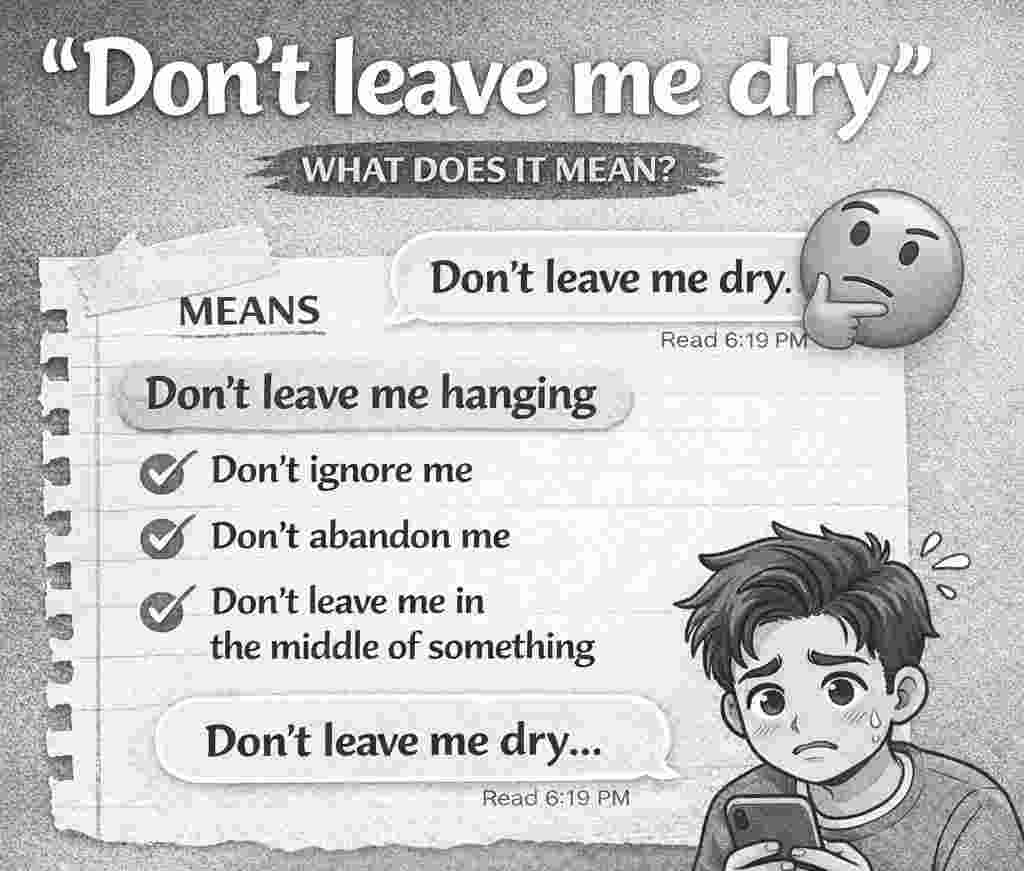
Have you ever seen someone text, “don’t leave me dry,” and paused for a second because it sounds familiar, but not fully clear?
That is one of those phrases that lives somewhere between slang, casual speech, and internet language. It is short, expressive, and a little mysterious if you have not heard it in context before.
In most cases, when people say “don’t leave me dry,” they mean don’t leave me hanging, don’t ignore me, or don’t abandon me in the middle of something. It can sound playful, dramatic, or even slightly needy depending on how it is used.
Let’s break it down properly.
In a Nutshell
- “Don’t leave me dry” usually means do not leave me hanging or unsupported.
- It is often used in casual chats, messages, or jokes.
- The phrase can sound playful, desperate, or frustrated depending on tone.
- It is not the most formal expression, so context matters.
What Don’t Leave Me Dry Means
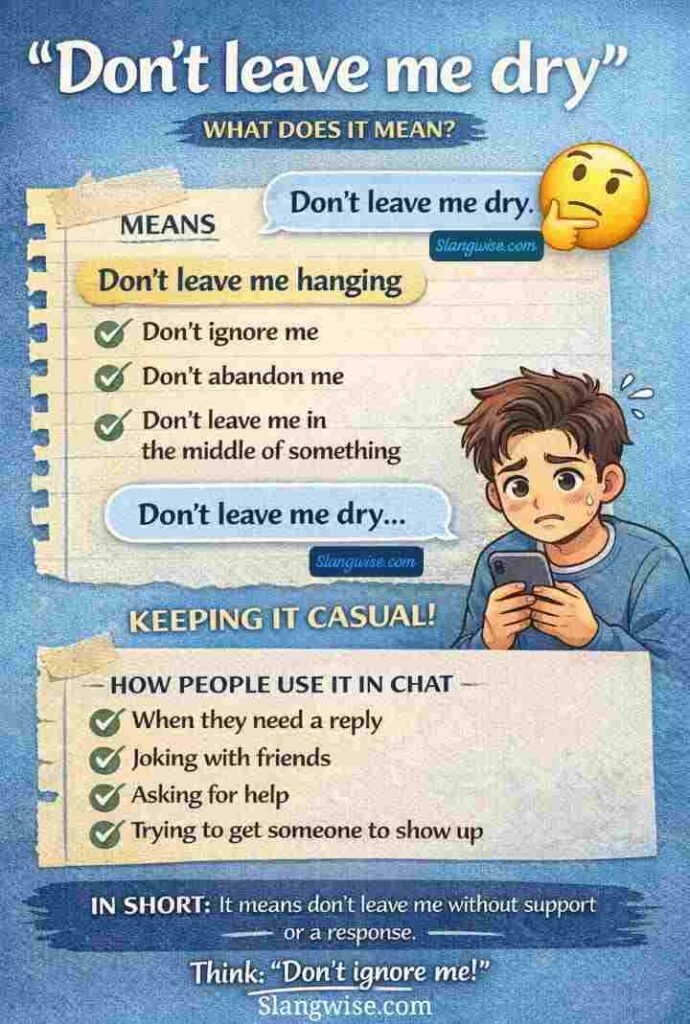
Simply, don’t leave me dry means do not leave me without help, response, or backup.
In everyday conversation, it can mean:
- Do not ignore me
- Do not ghost me
- Do not abandon me
- Do not leave me to deal with this alone
A lot of the time, people are using it as a loose way of saying, “do not leave me hanging.”
For instance:
“Please don’t leave me dry when I ask this question.”
“Bro said he would help and then left me dry.”
“You cannot leave me dry on game night like that.”
The meaning changes a little depending on the situation, but the general idea stays the same. Someone wants support, attention, or a reply.
READ ALSO: Rich in Life Meaning. The Slang Meaning People Use When Money Is Not the Main Point
Slangwise Note
I found don’t leave me dry to be very natural in online and casual speech and that’s because it sounds emotional without being too serious. It gives people a way to say, “I need you to show up,” without writing a long explanation.
That is probably why it sticks. It is short, easy to remember, and flexible enough to work in jokes, messages, and everyday conversation.
How People Use Don’t Leave Me Dry in Conversation
You will most often hear this phrase in informal settings. It shows up in texts, comments, group chats, and casual conversations when someone wants to keep things light but still get a point across.
Here are a few natural examples:
- Don’t leave me dry when I need an answer.
- She left me dry after saying she would come through.
- Make sure you do not leave me dry in front of everybody.
- I’m counting on you, do not leave me dry.
Sometimes it is used as a joke. Other times, it sounds like mild frustration. The tone matters a lot.
Where It Comes From
This phrase is not a super old, fixed slang term in the way some internet slang is. It feels more like a casual, spoken expression that picked up life online.
It is closely related to older expressions like:
- leave me hanging
- hang me out to dry
- leave me stranded
Over time, people started using “dry” in a more emotional, conversational way to mean left unsupported, ignored, or stuck without help.
So while it may not always be a strict dictionary slang phrase, people still use it like one in everyday speech.
DISCOVER: The Strange 200 Year Old Slang Word Teens Made Cool Again
When to Use Don’t Leave Me Dry in Conversation
Use don’t leave me dry when you want to speak casually and keep the tone relaxed.
It works well when you are:
- Asking for a reply
- Asking someone to show up for you
- Joking with friends
- Talking about being left out or ignored
It sounds especially natural in texting or social media because the phrase has a personal, conversational feel.
When Not to Use It
This phrase is not ideal in formal writing or serious situations.
Avoid it when:
- You are writing professionally
- You need to sound clear and polished
- The situation is sensitive or emotional
- The person may not understand the slang tone
In formal settings, it is better to say:
- “Please do not leave me without support.”
- “Please do not ignore my message.”
- “Please do not leave me to handle this alone.”
Simple and direct usually works better there.
A Simple Way to Understand It
Think of it like this.
If you are standing in the middle of something important and the other person disappears, that is the feeling behind “don’t leave me dry.”
It is the same kind of energy as saying, “I need you to stay with me on this” or “do not disappear when I need you.”
That is why the phrase feels so relatable. Everybody knows what it is like to wait for help, a reply, or backup and get nothing.
READ MORE: Brainrot Meaning Explained: The Obsession Trend Quietly Taking Over TikTok
Conclusion
Don’t leave me dry is a casual phrase people use when they want to say they do not want to be ignored, abandoned, or left unsupported.
It is not the most formal expression, but in the right context, it gets the point across fast. The phrase feels very internet friendly because it is short, expressive, and easy to use in everyday conversation.
In my understanding, that is what makes slang like this interesting. It captures a real feeling in just a few words, and that is usually why people keep repeating it.
Frequently Asked Questions
It usually means do not leave me hanging, do not ignore me, or do not abandon me in a situation.
Yes, in many cases it carries a very similar meaning, especially in casual conversation.
No, it sounds informal and is best used in casual chats, jokes, or relaxed conversation.
It can, depending on tone. Sometimes it sounds playful, but in some contexts it may come off as needy or frustrated.
Table of Contents