
Have you ever stopped mid sentence and thought about how some words just feel normal, even though they sound a little playful or informal?
Here is something interesting. A lot of the words we use every single day were once considered slang. Yes, the same way people today say things like “lit,” “vibe,” or “no cap,” people in the past had their own “slang words” too.
The difference is this: over time, some of those slang words became so popular, so widely accepted, and so useful that they slowly lost their “slang” label and became part of standard English.
The point I am really trying to make here is simple. Language is always evolving. Today’s slang can easily become tomorrow’s dictionary word.
So let us explore 25 words that started as slang but are now completely normal English, along with meanings and examples you will instantly recognize.
In a Nutshell
- Some everyday English words were once informal slang used by small groups of people.
- Over time, these words spread, became widely accepted, and are now part of standard vocabulary.
- Words like fake, fan, kid, and cool were once considered slang.
- Language constantly evolves, and modern slang could follow the same path.
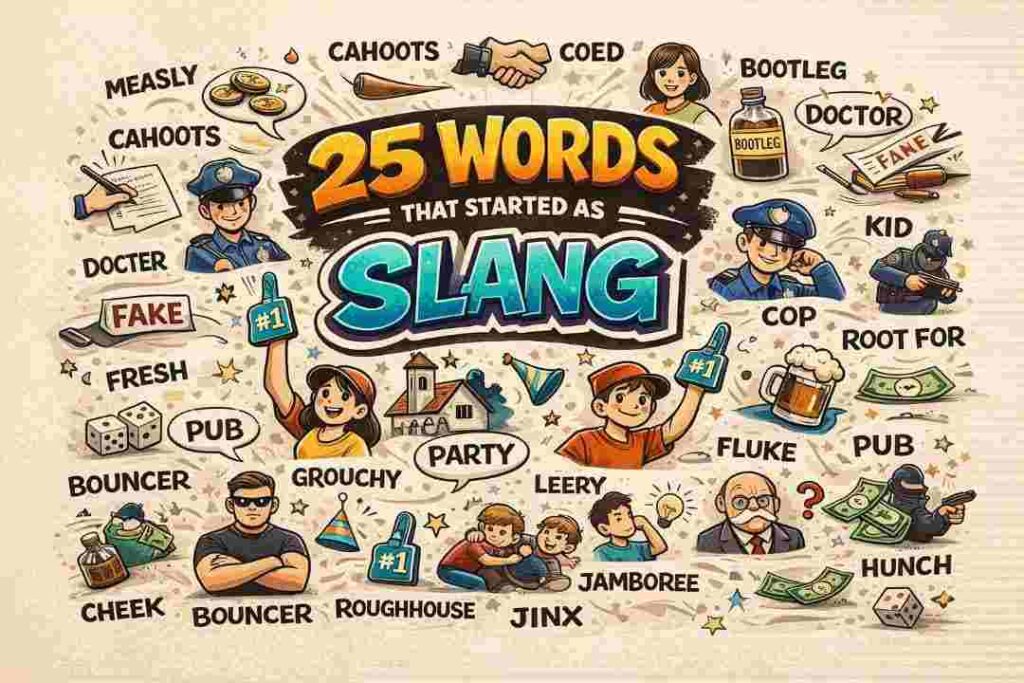
1. Awful
Originally, awful meant something inspiring awe or wonder. Over time, people began using it informally to describe things that were extremely bad or unpleasant. That slang usage gradually replaced the original meaning, and today awful is commonly used to describe something negative or disappointing.
Meaning today: Very bad or unpleasant
Example:That movie was awful.
2. Belt
Belt started as slang meaning to hit or strike something with force. It was often used informally in sports or fights. Over time, the expression became widely accepted, and now it is a normal verb used to describe hitting something hard, especially in everyday speech.
Meaning today: To hit or strike
Example:He belted the ball across the field.
3. Bootleg
The word bootleg began as slang for illegally smuggling goods, especially alcohol hidden in boots during prohibition. As usage spread, it came to describe anything made or distributed illegally. Today, it commonly refers to pirated movies, music, or unofficial versions of products.
Meaning today: Illegal or unofficial copy
Example:That is a bootleg version of the film.
4. Bouncer
Bouncer was once informal slang for a strong person hired to throw troublemakers out of bars or events. Over time, the word became standardized. Today, it is widely used as a proper job title for someone responsible for maintaining order at entrances.
Meaning today: A person who controls entry at a club or event
Example:The bouncer checked everyone at the door.
5. Cahoots
Cahoots started as playful slang for a secret partnership or collaboration, often involving something sneaky. As it gained popularity, it became part of everyday English. Today, people use it casually and even in formal contexts to describe people working together secretly.
Meaning today: Secret partnership
Example:They were in cahoots the whole time.
READ MORE: 35 Old School Slang Words Parents Still Say in 2026: Cool, Dope, and My Bad etc.
6. Cheek
In slang, cheek referred to bold, rude, or disrespectful behavior. It described someone who spoke or acted with improper confidence. Over time, this informal usage became standard, and today cheek commonly refers to impudence or audacity in both casual and formal speech.
Meaning today: Rude boldness
Example:He had the cheek to say that out loud.
7. Coed
Coed began as campus slang referring to female students attending coeducational institutions. Initially informal, it gradually became widely accepted. Today, although its usage has declined in some contexts, it is still recognized as a standard term for a female student in mixed-gender schools.
Meaning today: Female student in a mixed school
Example:She is a coed at the university.
8. Cop
Cop originated as slang for a police officer, possibly from the idea of “capturing” or “seizing.” It was once considered informal but became widely accepted through everyday use. Today, it is commonly used in both casual and media contexts to refer to police officers.
Meaning today: Police officer
Example:A cop stopped the car.
9. Doctor (verb)
Using doctor as a verb began as slang meaning to alter or tamper with something secretly. Over time, this usage became standard. Today, it is commonly used to describe modifying documents, images, or objects, especially when changes are made to mislead or improve appearance.
Meaning today: To alter or tamper with something
Example:He doctored the photo.
DISCOVER: 35 Iconic 80s Slang Words That Instantly Bring Back the Neon Decade
10. Fake
Fake started as slang describing something false or counterfeit. It gradually replaced more formal terms due to its simplicity and clarity. Today, it is one of the most commonly used words to describe anything not genuine, from products to behavior or identity.
Meaning today: Not real
Example:That watch is fake.
11. Fan
Short for “fanatic,” fan began as slang to describe an enthusiastic supporter of sports, music, or entertainment. Over time, the shorter form became widely accepted. Today, fan is a standard word used across all areas to describe someone who strongly admires something.
Meaning today: Someone who admires something
Example:I am a fan of that artist.
12. Fluke
Fluke began as slang for an unexpected or lucky accident. Its informal tone made it popular in everyday speech. Over time, it became fully accepted into standard English. Today, it is commonly used to describe success that happens by chance rather than skill.
Meaning today: A lucky accident
Example:Winning that match was a fluke.
13. Fresh
In slang, fresh originally described someone being overly bold, disrespectful, or forward. While still informal in some contexts, it has become widely understood. Today, it can describe both cheeky behavior and, in modern slang, something new, stylish, or impressive.
Meaning today: Bold or disrespectful
Example:Do not get fresh with me.
SEE ALSO: The 50 most Iconic Slang Words of The Past 50 Years (Updated)
14. Grouchy
Grouchy started as slang to describe someone who is irritable or easily annoyed. Its expressive sound helped it gain popularity. Over time, it became part of everyday vocabulary and is now a standard, widely accepted word for describing a bad or moody temperament.
Meaning today: Easily annoyed
Example:He is feeling grouchy today.
15. Holdup
Holdup began as slang referring to a robbery, especially one involving threats. It later expanded to mean any delay or interruption. Today, both meanings are standard. People use it to describe anything from crime situations to simple everyday delays in plans or processes.
Meaning today: Delay or robbery
Example:Sorry for the holdup.
16. Hunch
Hunch originated as slang for a feeling or intuition without clear evidence. Its simplicity made it easy to adopt. Over time, it became standard English. Today, it is widely used to describe a gut feeling or instinct about something that may or may not be correct.
Meaning today: A feeling or intuition
Example:I have a hunch something is wrong.
17. Jamboree
Jamboree started as lively slang for a noisy or cheerful gathering. It became especially popular through youth organizations and events. Over time, it gained formal acceptance. Today, it refers to large celebrations, festivals, or gatherings filled with excitement and group participation.
Meaning today: A lively gathering
Example:They hosted a music jamboree.
READ ALSO: 7 Popular Slangs with Royal Backstories That Still Rule The Room
18. Jinx
Jinx began as slang referring to bad luck or a person who causes it. It was commonly used in playful or superstitious contexts. Over time, it became a standard word. Today, people use it casually when talking about luck or avoiding tempting fate.
Meaning today: Bad luck
Example: Do not jinx it.
19. Kid
Kid was originally slang for a child, possibly derived from a term for a young goat. It was once considered informal, but widespread usage made it standard. Today, it is one of the most common and accepted words used to refer to children in everyday language.
Meaning today: A child
Example:The kids are playing outside.
20. Leery
Leery began as slang meaning cautious, suspicious, or wary. It was often used to describe distrust in uncertain situations. Over time, it became accepted into standard English. Today, it is commonly used to express hesitation or concern about something that feels risky.
Meaning today: Suspicious
Example:I am leery of that deal.
21. Measly
Measly started as slang to describe something small, weak, or disappointing. Its expressive tone made it popular in casual speech. Over time, it became widely accepted. Today, it is commonly used to emphasize how insignificant or inadequate something seems.
Meaning today: Very small or disappointing
Example:He offered a measly amount.
FIND OUT: 7 Slang Words That Were banned in the past (and the shocking reason why)
22. Party
Party originally had formal meanings, but its slang use referred to an individual or group involved in a situation. Over time, this usage became standard, especially in legal and formal language. Today, it is commonly used to describe participants in agreements or events.
Meaning today: A person in a situation
Example:The involved parties agreed.
23. Pub
Pub began as a shortened slang form of “public house.” Its convenience made it widely used in everyday conversation. Over time, it became standard English. Today, pub is the normal word used, especially in British English, to describe a bar or drinking establishment.
Meaning today: A bar or public house
Example:Let us meet at the pub.
24. Root for
The phrase root for started as slang meaning to support or cheer for someone, especially in sports. It gradually became widely accepted. Today, it is a standard expression used in both casual and formal contexts to show encouragement or backing for a person or team.
Meaning today: To support
Example:I root for my team.
25. Roughhouse
Roughhouse began as slang describing noisy, energetic, or physical play. It often referred to children playing in a slightly wild manner. Over time, it became a standard term. Today, it is commonly used to describe playful but physically active behavior, especially among kids.
Meaning today: Play roughly
Example:The kids were roughhousing.
DISCOVER: 45 Popular Gen X Slang Words That Will Take You Straight Back to the 80s and 90s
Why Do Slang Words Become Normal?
Here is the interesting part.
Not all slang survives. Some disappear quickly. Others stick around and slowly become part of everyday language.
From my experience, words usually become standard when:
- They are easy to say
- They fill a gap in language
- They spread across different groups
- They appear in media, books, and conversations
One unique thing I learnt from studies is that language does not change because of rules. It changes because people keep using what works.
What This Means for Modern Slang
Think about the slang we use today:
Vibe
Ghosting
Flex
Salty
Lowkey
Some of these might sound informal right now, but give them enough time and usage, and they could easily become part of standard English.
That is how language evolves.
Slangwise Thought
Here is the thing.
If there is one thing I have learned, it is that slang is not “bad English.” It is actually future English in progress.
Words like kid and fan were once seen as informal or even improper. Today, nobody questions them.
So the next time you hear a new slang word, do not dismiss it too quickly. You might be watching the early stages of a word that will become completely normal in the future.
Quick Recap
Here is what we covered:
- Many everyday words started as slang
- Over time, they became widely accepted
- Now they are part of standard English
- Language is constantly evolving
- Today’s slang could become tomorrow’s normal
SEE ALSO: 70 Most Popular Millennial Slang Words and What They Really Mean (From Adulting to YOLO)
Conclusion
Language is alive. It grows, shifts, and adapts based on how people actually speak.
The real takeaway here is simple. Words do not need official approval to become “real.” If people use them enough, they eventually become part of everyday language.
So whether it is gagged, boujee, or dripped out, do not be surprised if one day those words sound just as normal as kid or fan.
That is just how language works.
FAQ
Slang is informal language used by specific groups, often for fun, creativity, or identity.
Yes. Many words that were once slang are now part of standard English because they became widely used.
They are often catchy, expressive, and easy to use, which helps them spread quickly.
No. Slang is a natural part of language evolution and communication.
Words like vibe, flex, ghosting, and lowkey could become standard English over time.
Table of Contents