
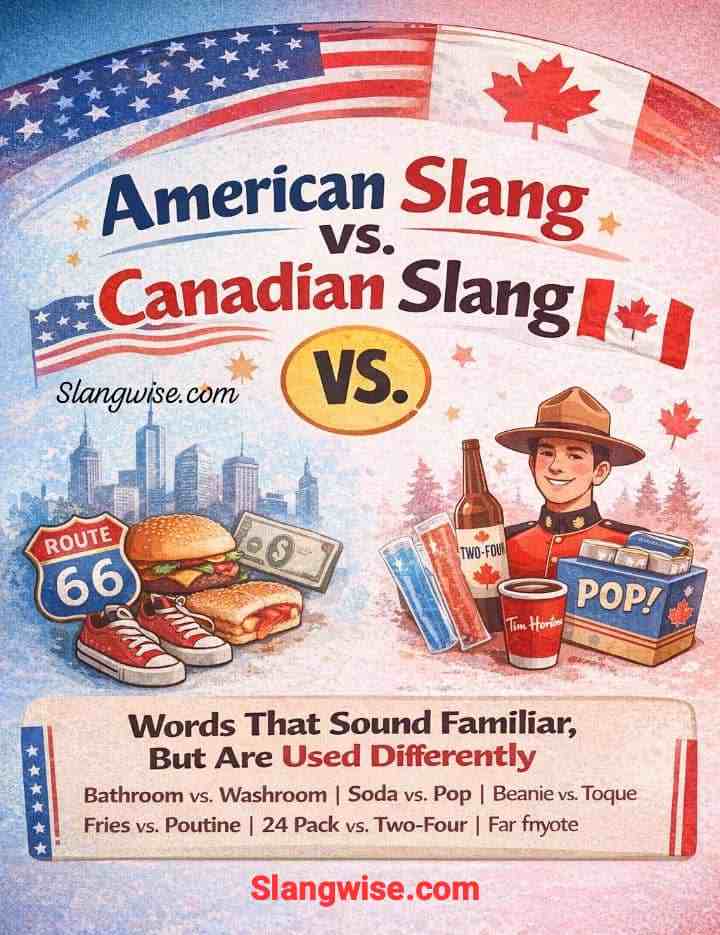
American and Canadian English are closely related, but they are not identical. Cambridge describes Canadian English as the English used in Canada, while Britannica notes that Canadian speech is strongly influenced by U.S. English, with British influence still visible in some places.
In other words, Canada sits in a very interesting middle space. It sounds familiar to Americans, but it still has its own local flavor.
That is exactly why American slang vs Canadian slang is such a fun comparison. Some words are shared, some are slightly different, and some are so Canadian that they instantly give away where the speaker is from.
Canadian slang also changes by region, which means people in Ontario, Saskatchewan, Newfoundland, or Alberta may not sound exactly the same. The University of Toronto and TIES both show that Canadian localisms are very real, very lively, and often deeply tied to place.
The easiest way to think about it is this: American slang tends to feel broader and more globally familiar, while Canadian slang often feels more local, more playful, and sometimes more regional.
One thing I always find interesting is how a word can sound normal in Canada and slightly unusual to an American ear, even though both speakers are still using English. That small difference is where the fun starts.
Briefly
- American and Canadian slang overlap a lot, but Canada has its own local words and habits.
- Canadian slang often feels more regional, more playful, and more tied to everyday life.
- Many Canadian terms are easy to spot because they are about food, weather, money, and daily routines.
- The same idea can be said in two different ways, and that is exactly what makes the comparison so interesting.
45 American Slang and Canadian Slang Words Compared
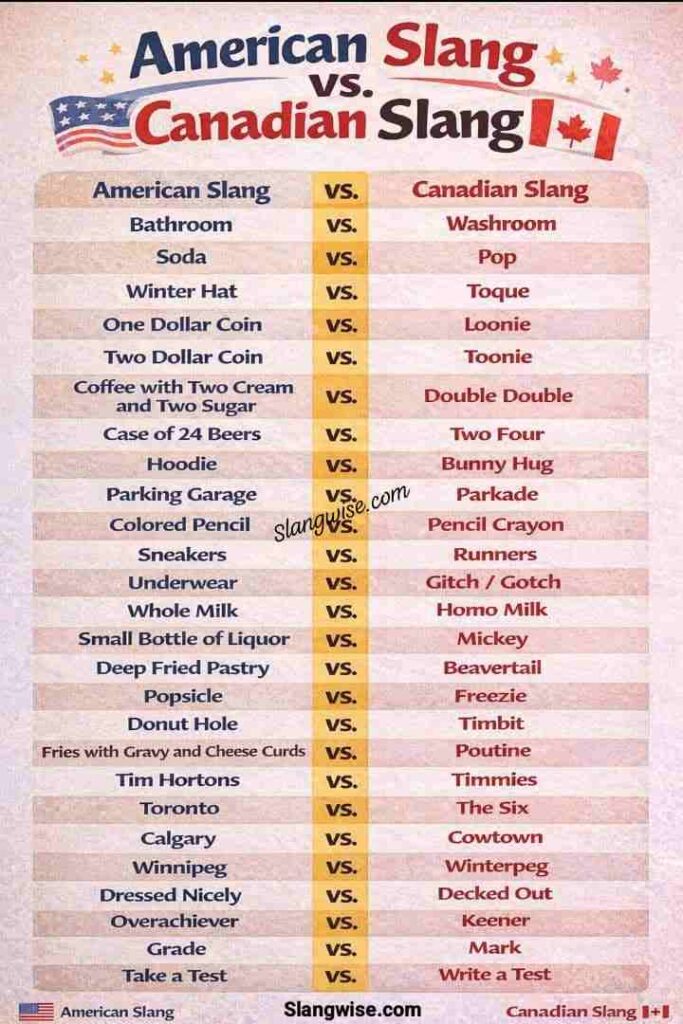
| # | American Slang | Canadian Slang | What It Means | Examples (Both in One Box) | Slangwise Remark |
|---|---|---|---|---|---|
| 1 | Bathroom | Washroom | A room with a toilet and sink | American: “Where is the bathroom?” • Canadian: “Where is the washroom?” | Same place, different standard word choice. |
| 2 | Soda | Pop | A carbonated soft drink | American: “Get me a soda.” • Canadian: “Get me a pop.” | A clear everyday vocabulary split. |
| 3 | Winter hat | Toque | A knitted hat for cold weather | American: “Grab your winter hat.” • Canadian: “Grab your toque.” | Common object, strongly regional label. |
| 4 | One dollar coin | Loonie | Canada’s one dollar coin | American: “I need a dollar coin.” • Canadian: “I need a loonie.” | Currency talk often reveals local slang fast. |
| 5 | Two dollar coin | Toonie | Canada’s two dollar coin | American: “I need a two dollar coin.” • Canadian: “I need a toonie.” | Built from the loonie, so the pattern is easy to remember. |
| 6 | Coffee with two cream and two sugar | Double double | A common coffee order | American: “I will take coffee with two cream and two sugar.” • Canadian: “I will take a double double.” | A short phrase that compresses a full order. |
| 7 | Case of 24 beers | Two four | A case of twenty four beers | American: “Grab a case of beer.” • Canadian: “Grab a two four.” | Quantity slang is a useful sign of local speech. |
| 8 | Hoodie | Bunny hug | A hooded sweatshirt | American: “Put on your hoodie.” • Canadian: “Put on your bunny hug.” | A local term that stands out immediately. |
| 9 | Parking garage | Parkade | An indoor parking structure | American: “The parking garage is full.” • Canadian: “The parkade is full.” | A practical city word with a regional edge. |
| 10 | Colored pencil | Pencil crayon | A colouring pencil | American: “Pass the colored pencils.” • Canadian: “Pass the pencil crayons.” | School language often shows regional identity. |
| 11 | Sneakers | Runners | Lace up shoes or sports shoes | American: “I bought new sneakers.” • Canadian: “I bought new runners.” | A common fashion and sports term difference. |
| 12 | Underwear | Gitch / Gotch | Men’s underwear | American: “I packed extra underwear.” • Canadian: “I packed extra gitch.” | Informal speech can shift a lot by region. |
| 13 | Whole milk | Homo milk | Homogenized milk, about 3.25 percent fat | American: “Do you have whole milk?” • Canadian: “Do you have homo milk?” | A normal Canadian grocery term that can surprise outsiders. |
| 14 | Small bottle of liquor | Mickey | A small liquor bottle, about 375 ml | American: “Pick up a small bottle.” • Canadian: “Pick up a mickey.” | Package size words are often highly local. |
| 15 | Deep fried pastry | Beavertail | A deep fried dessert pastry | American: “Let’s get a fried pastry.” • Canadian: “Let’s get a beavertail.” | Food slang often becomes part of cultural identity. |
| 16 | Popsicle | Freezie | A frozen sugary snack in a plastic tube | American: “Kids want popsicles.” • Canadian: “Kids want freezies.” | Summer snack words can vary more than people expect. |
| 17 | Donut hole | Timbit | A small fried donut bite from Tim Hortons | American: “I bought donut holes.” • Canadian: “I bought Timbits.” | Brand names sometimes become everyday vocabulary. |
| 18 | Fries with gravy and cheese curds | Poutine | A popular Canadian comfort food | American: “Get fries with gravy and cheese curds.” • Canadian: “Get poutine.” | Food terms often carry the strongest regional identity. |
| 19 | Tim Hortons | Timmies | The Tim Hortons coffee chain | American: “Meet me at Tim Hortons.” • Canadian: “Meet me at Timmies.” | Nicknames like this show natural local familiarity. |
| 20 | Toronto | The Six | A nickname for Toronto | American: “I am going to Toronto.” • Canadian: “I am going to The Six.” | City nicknames are a big part of casual speech. |
| 21 | Calgary | Cowtown | A nickname for Calgary | American: “I am from Calgary.” • Canadian: “I am from Cowtown.” | Nicknames can reflect local history and image. |
| 22 | Winnipeg | Winterpeg | A nickname for Winnipeg | American: “I am from Winnipeg.” • Canadian: “I am from Winterpeg.” | Humor and weather often show up in local slang. |
| 23 | Dressed nicely | Decked out | Dressed formally or stylishly | American: “She is dressed nicely.” • Canadian: “She is decked out.” | Casual praise can sound different across regions. |
| 24 | Overachiever | Keener | Someone eager to do well at school or work | American: “He is such an overachiever.” • Canadian: “He is such a keener.” | School and work slang often carries attitude. |
| 25 | Grade | Mark | A score on a test or assignment | American: “What grade did you get?” • Canadian: “What mark did you get?” | Education vocabulary is one of the easiest places to spot the difference. |
| 26 | Take a test | Write a test | To sit for an exam | American: “We take a test today.” • Canadian: “We write a test today.” | Small wording differences can sound very natural locally. |
| 27 | RCMP officer | Mountie | A member of the Royal Canadian Mounted Police | American: “A police officer came.” • Canadian: “A Mountie came.” | Some words are strongly tied to national identity. |
| 28 | Bachelor party | Stag | An all male pre wedding party | American: “We planned a bachelor party.” • Canadian: “We planned a stag.” | Social event vocabulary can be very regional. |
| 29 | Bachelorette party | Stagette | An all female pre wedding party | American: “She had a bachelorette party.” • Canadian: “She had a stagette.” | Wedding slang often shows local custom. |
| 30 | Canadian | Canuck | A nickname for a Canadian | American: “He is Canadian.” • Canadian: “He is a Canuck.” | Nicknames can sound casual, proud, or playful. |
| 31 | Toilet | Biffy | A toilet, especially in casual Canadian speech | American: “Where is the toilet?” • Canadian: “Where is the biffy?” | Informal bathroom words are often highly regional. |
| 32 | Jelly doughnut | Jambuster | A jelly filled doughnut | American: “I bought a jelly doughnut.” • Canadian: “I bought a jambuster.” | Food slang can be very local and memorable. |
| 33 | Wet feet from a puddle | Soaker | A sudden wet foot experience | American: “I got wet feet.” • Canadian: “I got a soaker.” | Weather and puddles inspire useful local words. |
| 34 | Go for it | Give’r | Put in effort or go all out | American: “Go for it.” • Canadian: “Give’r.” | Short phrases often carry strong action energy. |
| 35 | Male underwear | Gonch | Men’s underwear | American: “I need underwear.” • Canadian: “I need gonch.” | Informal terms can be highly specific by region. |
| 36 | Garbage disposal | Garburator | A kitchen waste disposal unit | American: “The garbage disposal is broken.” • Canadian: “The garburator is broken.” | House and kitchen terms are common region markers. |
| 37 | Gutters | Eaves troughs | Roof gutters that carry water away | American: “Clean the gutters.” • Canadian: “Clean the eaves troughs.” | Home maintenance words often differ by local usage. |
| 38 | Electricity service | Hydro | Hydro electricity or electricity utility | American: “The electric bill is high.” • Canadian: “The hydro bill is high.” | Utility language often becomes part of everyday speech. |
| 39 | Autumn | Fall | The season after summer | American: “I love fall.” • Canadian: “I love fall too.” | Some words are shared, but still worth noting in comparison. |
| 40 | Trash | Garbage | Household waste | American: “Take out the trash.” • Canadian: “Take out the garbage.” | Common, simple, and everyday. |
| 41 | Napkin | Serviette | A paper or cloth cloth for eating | American: “Pass me a napkin.” • Canadian: “Pass me a serviette.” | One of those words that sounds more formal to some speakers. |
| 42 | Canadian bacon | Peameal bacon | A type of Canadian bacon rolled in cornmeal | American: “I want Canadian bacon.” • Canadian: “I want peameal bacon.” | Food terminology often reflects local tradition. |
| 43 | Unemployment benefit | Pogie | Employment insurance or benefit payment | American: “He filed for unemployment.” • Canadian: “He is on pogie.” | Informal money and benefit words can be very local. |
| 44 | First and last month’s rent | First and last’s | The security deposit often requested for rentals | American: “They asked for first month’s rent.” • Canadian: “They asked for first and last’s.” | Rental language can sound different even when the meaning is clear. |
| 45 | Three day weekend | Long weekend | A weekend made longer by a holiday | American: “We have a three day weekend.” • Canadian: “We have a long weekend.” | A simple phrase, but very natural in Canadian speech. |
The Canadian terms in the table above are drawn from Canadian glossary sources such as the TIES guide, the Northwestern Ontario glossary, the University of Toronto’s Canadian words quiz, and Canadian Encyclopedia entries for Canadian nicknames and slang.
The broader US and Canadian language contrast is also consistent with Cambridge and Britannica’s descriptions of Canadian English as its own variety with strong U.S. influence and some British influence.
READ ALSO: American Slang vs British Slang in 2026: 55 Words That Sound Similar Until You Cross the Pond.
What makes Canadian slang sound different
Canadian slang often feels more local than American slang. A lot of it is tied to weather, food, money, school, housing, and daily routines.
That is why words like toque, loonie, toonie, double double, two four, parkade, and washroom feel so natural in Canadian speech. These are not random words. They are practical words that grew out of real Canadian life.
Another thing that stands out is how many Canadian slang words come from ordinary life and then become almost iconic. Timmies is not just a cute nickname, it is part of how Canadians talk about coffee culture.
The Six is not just a city nickname, it is part of how people talk about Toronto. Winterpeg is not just a joke, it is a local identity move that says, “Yes, it is cold here, and we know it.” The U of T quiz and TIES guide both show how strongly these words are tied to place.
Canadian slang also has a slightly softer feel in some cases. Words like keener, decked out, long weekend, and serviette are easy to understand once you hear them, but they still carry a local tone that Americans may not use as often.
That is one reason Canadian English feels familiar but still distinct. It is close enough to follow, yet different enough to notice.
Where American slang and Canadian slang overlap
The overlap is bigger than people think. A lot of everyday English is shared across the border, and some words are used almost the same way in both countries. That is why Canadians and Americans can usually understand each other with very little trouble.
The big differences are often in local terms, regional nicknames, and a handful of everyday words that show national identity. Britannica makes the same general point about English varieties: the differences exist, but they do not stop communication.
That said, some Canadian words feel so rooted in local culture that they immediately signal where the speaker is from. Canuck, Mountie, homo milk, poutine, mickey, and garburator are good examples. Even if an American can guess the meaning, the words themselves have a Canadian sound. They act like little language flags.
READ ALSO: 40 Most Popular Canadian Slang Words – 2026 Guide
Why this comparison is useful
This kind of comparison is not just for fun. It helps readers, travelers, students, writers, and curious language lovers hear the difference between two closely related versions of English.
If you are reading a Canadian article, watching a Canadian video, or speaking with Canadians online, knowing these words makes everything easier. It also makes the language feel more human and less like a dictionary exercise.
It is also useful because slang is never only about words. It is about culture, tone, and belonging. When a Canadian says “grab a double double at Timmies” or “the hydro bill is high”, the words are doing more than naming things. They are carrying culture with them. That is the real fun of language.
Quick tips for using Canadian slang naturally
A simple rule helps a lot. Use the word that matches the people around you. If you are speaking with Canadians, terms like washroom, pop, toque, loonie, runners, and long weekend will usually sound natural. If you are speaking with Americans, those same ideas might be said in a different way, and both versions can still be correct.
Another good tip is to watch the setting. Some Canadian terms are very casual, like give’r, biffy, or gonch. Others are normal everyday words, like parkade, serviette, or mark. The context tells you whether the word sounds playful, regional, or simply normal.
Conclusion
American slang and Canadian slang are close cousins, not twins. They share a lot, but the details matter. American slang tends to feel broader and more globally familiar, while Canadian slang often feels more local, more regionally flavored, and sometimes more playful.
That is why words like toque, loonie, toonie, double double, Timmies, The Six, and Mountie stand out so clearly.
The real takeaway is simple: the two versions of English are close enough to understand, but different enough to make comparison fun. Once you start noticing the little shifts, you begin to hear the culture behind the words too. That is what makes slang such a good window into how people live and speak.
READ MORE: 40 Most Popular American Slang Words of 2026
Frequently Asked Questions
Washroom is a very common Canadian term for a room with a toilet and sink. It is one of the easiest ways to spot Canadian everyday speech.
Not much directly. Those are more Gen Z terms than Canadian terms. Canadian slang is more tied to local words like pop, toque, parkade, and loonie.
No. Canadian slang is regional, so someone in Saskatchewan may sound different from someone in Newfoundland, Ontario, or Alberta. The University of Toronto and TIES both show that Canadian localisms vary by place.
No. The two overlap a lot, but Canadian slang has its own local words and expressions, especially around food, weather, housing, school, and money.
Words like toque, loonie, toonie, double double, and Timmies are some of the most recognizable Canadian terms.
In a Nutshell
- American and Canadian slang overlap, but Canadian slang has a strong local identity.
- Canadian speech often includes words tied to food, weather, money, school, and everyday life.
- Some of the most iconic Canadian terms are toque, loonie, toonie, double double, Timmies, and Mountie.
- The differences are small enough to understand, but big enough to be interesting.
Table of Contents