
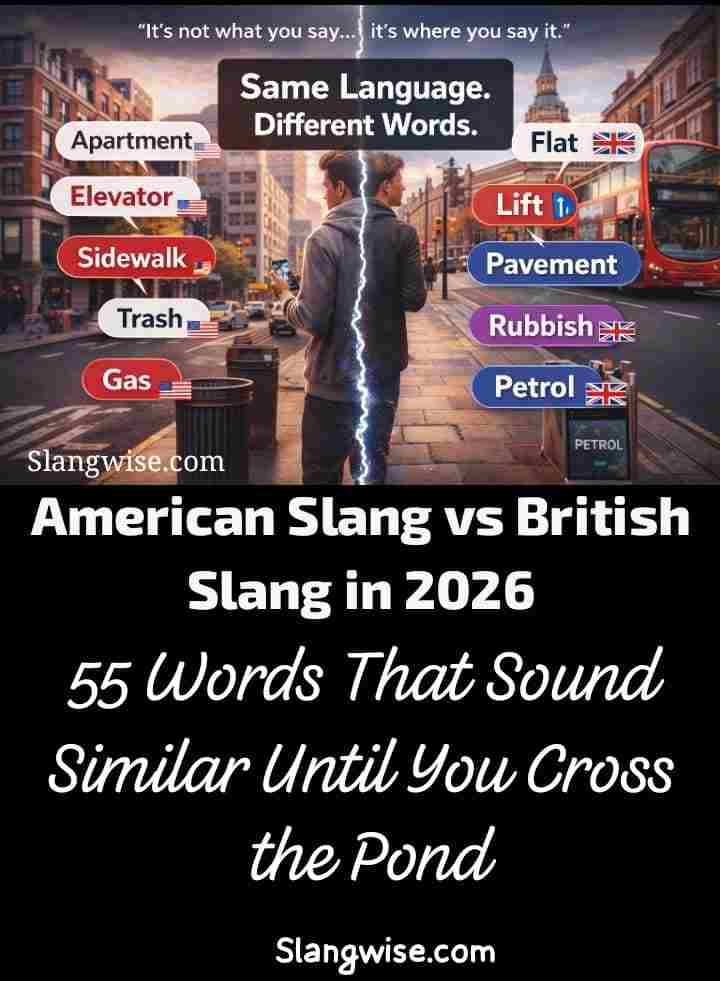
American English and British English are much closer than people sometimes think, but vocabulary is where the biggest differences show up. Cambridge, Britannica, and the British Council all note that the two varieties mainly differ in vocabulary, pronunciation, and spelling, with vocabulary being one of the easiest places to spot the gap.
That is why slang and informal everyday words are so interesting. A person in the United States might say apartment, elevator, or sidewalk, while a person in the United Kingdom might naturally say flat, lift, or pavement.
In real conversation, the two systems overlap a lot, so this post includes both true slang and very casual everyday words. That is how people actually speak.
One thing I always find fascinating is that the same idea can sound completely different just because of the word choice. Sometimes the meaning stays the same and only the label changes.
Other times, a word means something a little different on each side of the Atlantic, which is where the real confusion begins.
Briefly
- American and British English use many different everyday words, especially for places, objects, food, and travel. Examples include apartment and flat, vacation and holiday, and hood and bonnet.
- British slang often sounds cheekier, drier, or more understated, with words like bloke, mate, knackered, chuffed, dodgy, and posh.
- Some words change meaning across the Atlantic, like pissed, which can mean angry in American English but drunk in British English.
- Context usually saves the day. Even when the wording is different, speakers in both countries usually understand each other through the surrounding sentence.
Comparing: 36 American Slang and British Slang Words
| # | American Slang | British Slang | What It Means | Examples (Both in One Box) | Slangwise Remark |
|---|---|---|---|---|---|
| 1 | Apartment | Flat | A home in a building | American: “I live in an apartment.” • British: “I live in a flat.” | Same idea, different everyday word |
| 2 | Vacation | Holiday | Time off from work or school | American: “I am on vacation.” • British: “I am on holiday.” | One of the easiest swaps to spot |
| 3 | Movie | Film | A motion picture | American: “That movie was great.” • British: “That film was great.” | British English sounds a bit more formal here |
| 4 | Hood | Bonnet | The front cover of a car | American: “Open the hood.” • British: “Open the bonnet.” | A classic car word mismatch |
| 5 | Elevator | Lift | A machine that carries people between floors | American: “Take the elevator.” • British: “Take the lift.” | Simple word, big regional difference |
| 6 | Sidewalk | Pavement | The walking path beside a road | American: “Walk on the sidewalk.” • British: “Walk on the pavement.” | Easy once you know it |
| 7 | Pants | Trousers | Clothing for the lower body | American: “I need new pants.” • British: “I need new trousers.” | This one causes a lot of confusion |
| 8 | Chips | Crisps | Thin fried potato snacks | American: “I bought chips.” • British: “I bought crisps.” | Same snack, totally different name |
| 9 | French fries | Chips | Fried potato sticks | American: “I want fries.” • British: “I want chips.” | The word chips changes meaning here |
| 10 | Soda | Fizzy drink | A carbonated soft drink | American: “Do you want soda?” • British: “Do you want a fizzy drink?” | British wording sounds more descriptive |
| 11 | Bag of chips | Packet of crisps | A packaged snack | American: “A bag of chips.” • British: “A packet of crisps.” | Very common in daily speech |
| 12 | Cell phone | Mobile phone | A portable phone | American: “My cell phone rang.” • British: “My mobile phone rang.” | Mobile is the standard British choice |
| 13 | Cookie | Biscuit | A small sweet baked snack | American: “I ate a cookie.” • British: “I ate a biscuit.” | One of the most famous differences |
| 14 | Candy | Sweets | Sweet treats | American: “Kids love candy.” • British: “Kids love sweets.” | Simple and very common |
| 15 | Sweater | Jumper | A warm top worn over the body | American: “Wear a sweater.” • British: “Wear a jumper.” | Great example of clothing vocabulary |
| 16 | Flashlight | Torch | A handheld light | American: “Grab a flashlight.” • British: “Grab a torch.” | Same object, very different word |
| 17 | Faucet | Tap | The part that controls water flow | American: “Turn off the faucet.” • British: “Turn off the tap.” | Very normal in home conversation |
| 18 | Trash | Rubbish | Unwanted waste | American: “Take out the trash.” • British: “Take out the rubbish.” | British English sounds a bit softer |
| 19 | Zip code | Postcode | The code used in mailing addresses | American: “Enter your zip code.” • British: “Enter your postcode.” | Important in forms and shipping |
| 20 | Gas | Petrol | Fuel for cars | American: “I need gas.” • British: “I need petrol.” | One of the most useful travel words |
| 21 | Subway | Underground or Tube | A city train system below ground | American: “Take the subway.” • British: “Take the Underground.” | Tube is also very common in London |
| 22 | Diaper | Nappy | A baby’s absorbent garment | American: “Change the diaper.” • British: “Change the nappy.” | Definitely one to know if you have kids around |
| 23 | Restroom | Loo | A toilet or bathroom | American: “Where is the restroom?” • British: “Where is the loo?” | Loo is very normal in Britain |
| 24 | Dude | Bloke | A man or guy | American: “That dude is cool.” • British: “That bloke is cool.” | Bloke sounds very British and casual |
| 25 | Buddy | Mate | Friend | American: “Hey buddy.” • British: “Hey mate.” | Mate is one of the most iconic UK words |
| 26 | Broke | Skint | Having little or no money | American: “I am broke.” • British: “I am skint.” | Very useful slang in real life |
| 27 | Exhausted | Knackered | Very tired | American: “I am exhausted.” • British: “I am knackered.” | Sounds natural and very British |
| 28 | Pleased | Chuffed | Very happy or satisfied | American: “I am pleased.” • British: “I am chuffed.” | Chuffed has a warm, cheerful tone |
| 29 | Shady | Dodgy | Suspicious or questionable | American: “That seems shady.” • British: “That seems dodgy.” | Both carry a warning tone |
| 30 | Sassy | Cheeky | Boldly rude in a playful way | American: “She is sassy.” • British: “She is cheeky.” | Cheeky is often lighter and funnier |
| 31 | Fancy | Posh | Stylish or upper class | American: “That looks fancy.” • British: “That looks posh.” | Posh can sound a little judgey |
| 32 | Attractive | Fit | Good looking | American: “He is attractive.” • British: “He is fit.” | In Britain, fit can mean very attractive |
| 33 | Crazy | Bonkers | Wild, odd, or extreme | American: “That is crazy.” • British: “That is bonkers.” | Bonkers has a playful energy |
| 34 | Angry or drunk | Pissed | Angry in American English, drunk in British English | American: “He is pissed.” • British: “He is pissed.” | One word, two very different meanings |
| 35 | Garage sale | Car boot sale | A sale of unwanted items from a car | American: “We had a garage sale.” • British: “We had a car boot sale.” | Very common for second hand selling |
| 36 | Line | Queue | A row of people waiting | American: “Stand in line.” • British: “Stand in a queue.” | Queue is one of the most recognizable UK words |
| 37 | Truck | Lorry | A large vehicle for carrying goods | American: “A big truck.” • British: “A big lorry.” | Often heard on roads and deliveries |
| 38 | Eraser | Rubber | A tool used to remove pencil marks | American: “Pass me an eraser.” • British: “Pass me a rubber.” | This one can sound funny to Americans |
| 39 | Downtown | City centre | The main business area of a city | American: “Let us go downtown.” • British: “Let us go to the city centre.” | Very normal in urban conversation |
| 40 | Takeout | Takeaway | Food bought to eat elsewhere | American: “Let us get takeout.” • British: “Let us get takeaway.” | Useful for food orders |
| 41 | Mall | Shopping centre | A large indoor shopping area | American: “Meet me at the mall.” • British: “Meet me at the shopping centre.” | Same place, different label |
| 42 | ATM | Cash machine | A machine for withdrawing money | American: “Use the ATM.” • British: “Use the cash machine.” | Very practical travel vocabulary |
| 43 | Trunk | Boot | The storage area at the back of a car | American: “Put it in the trunk.” • British: “Put it in the boot.” | Another classic car word |
| 44 | Sneakers | Trainers | Casual sports shoes | American: “I bought new sneakers.” • British: “I bought new trainers.” | Very common in fashion talk |
| 45 | Parking lot | Car park | An area for parking vehicles | American: “The parking lot is full.” • British: “The car park is full.” | A very useful location phrase |
| 46 | Lineup | Queue | A group of people waiting or arranged in order | American: “The lineup is huge.” • British: “The queue is huge.” | Same idea, different common word |
| 47 | Movie theater | Cinema | A place where films are shown | American: “Let us go to the movie theater.” • British: “Let us go to the cinema.” | Cinema is the standard UK term |
| 48 | First floor | Ground floor | The floor at street level in the UK | American: “The shop is on the first floor.” • British: “The shop is on the ground floor.” | Floor numbering is a big travel trap |
| 49 | Second floor | First floor | The floor above ground level in the UK | American: “My office is on the second floor.” • British: “My office is on the first floor.” | Another easy one to mix up |
| 50 | Soccer | Football | The sport played with a round ball | American: “I watch soccer.” • British: “I watch football.” | One of the most famous differences |
| 51 | Math | Maths | The school subject about numbers | American: “I am bad at math.” • British: “I am bad at maths.” | British English often keeps the s |
| 52 | Garbage can | Bin | A container for waste | American: “Throw it in the garbage can.” • British: “Throw it in the bin.” | Simple and very everyday |
| 53 | Post | Letters and parcels sent by a postal service | American: “Check the mail.” • British: “Check the post.” | Useful in daily life and online shopping | |
| 54 | Truck stop | Services | A roadside stop with fuel, food, and facilities | American: “We stopped at a truck stop.” • British: “We stopped at the services.” | Common on long road trips |
| 55 | Grandma / Grandpa | Nan / Grandad | Informal family terms | American: “I called Grandma.” • British: “I called Nan.” | Family wording can sound very local |
DISCOVER: 40 Most Popular American Slang Words of 2026.
What American slang sounds like
American slang often feels a little more direct and a little more obvious in tone. Even when it is casual or playful, it tends to move quickly toward the point.
That is why words like apartment, cell phone, flashlight, and trash feel so natural in American English, while their British matches, flat, mobile phone, torch, and rubbish, feel more local to the UK. The split is very much about everyday vocabulary, not just flashy slang.
American slang also likes short, efficient words that work well in fast conversation. Think of buddy, dude, broke, or shady. Those are easy to say, easy to understand, and easy to move into a sentence without slowing anything down.
British English has its own fast words, of course, but the overall flavor often feels a bit more playful, especially when words like bloke, mate, skint, and chuffed come into the mix.
What British slang sounds like
British slang often sounds more cheeky, dry, and slightly more layered. A word like dodgy can mean suspicious or tricky, but it also carries a relaxed, almost humorous tone.
Chuffed sounds upbeat without sounding overly dramatic. Knackered feels wonderfully blunt. Posh sounds a bit judgmental in a very British way. These are not just replacement words. They carry attitude.
That is one reason British slang can sound funny or charming to American ears. It often mixes politeness with bite, or humor with understatement. Cheeky is a great example because it can mean rude, but in a playful or appealing way.
Bonkers is another one, since it can describe something wild, insane, or just delightfully over the top. British slang often sounds like it knows exactly what it is doing, but it is not in a hurry to say it straight.
READ MORE: 50 Popular British Slang Words That Will Make Your UK Chats Sound Local
Words that can trip people up
The trickiest words are the ones that look normal but behave differently. Pissed is the classic example. In American English, it usually means angry or irritated.
In British English, it usually means drunk. That kind of split is why context matters so much. A sentence like “He was pissed at the party” can send two very different messages depending on where the speaker is from.
There are also words that seem simple until you hear them in daily speech. Loo is one. To an American ear, it can sound unusually casual, but in Britain it is a normal informal word for toilet.
Skint is another one, because it means broke in a very British, very everyday way. Fit is another good example, since British slang can use it to mean attractive, while Americans usually hear fit as healthy or in good shape.
Why the differences matter
This stuff matters because language is not only about meaning. It is about belonging, tone, and social ease. If you are in the US and say queue when everyone else says line, people will still understand you, but it will sound marked.
The same goes for saying lift, flat, or takeaway in the wrong setting. None of those words are wrong. They are just strongly tied to a region.
The good news is that context does most of the work. VOA points out that Americans and Brits can usually guess the meaning of different words from context, and that is exactly what happens in real life.
Most of the time, slang does not block communication. It just adds color, local flavor, and sometimes a little confusion that makes the conversation more interesting.
DISCOVER: 40 Most Popular Canadian Slang Words – 2026 Guide
Quick tips for using the words naturally
One simple rule helps a lot. Use the version that matches the people around you. If you are writing for a US audience, apartment, vacation, and cell phone will sound natural.
If you are writing for a UK audience, flat, holiday, and mobile phone will feel more normal. That is not about right or wrong. It is about sounding like you belong in the room.
Another useful tip is to remember that some words are more region locked than others. Flat and apartment are easy. Pissed, chuffed, skint, and cheeky carry much stronger regional identity.
If you are using those words, it helps to know the tone first. That is usually the difference between sounding natural and sounding like you copied a phrase from a list.
Final thoughts
American slang and British slang are like cousins who grew up in different neighborhoods. They share a lot, but they do not speak in exactly the same way. Sometimes the difference is a simple word swap, like sidewalk and pavement.
Sometimes it is a tone change, like cheeky or chuffed. Sometimes it is a full meaning shift, like pissed. That is what makes the comparison so fun.
The real takeaway is that both varieties are rich, flexible, and full of personality. Once you start noticing the differences, you will see them everywhere, in movies, music, comments, travel, and everyday conversation. And honestly, that is part of the joy of English. It can sound familiar and completely new at the same time.
READ ALSO: 35 Old School Slang Words Parents Still Say in 2026: Cool, Dope, and My Bad etc.
Frequently Asked Questions
No. They overlap a lot, but many everyday words and slang terms are different. The biggest differences are in vocabulary, pronunciation, and spelling.
That is just one of the standard vocabulary differences between the two varieties of English. British Council and VOA both use it as a classic example.
Mobile phone is the common British term, and Cambridge marks cell phone as mainly US.
In British English, it usually means drunk. In American English, it usually means angry or irritated.
Yes, usually very well. VOA notes that context helps a lot, and most people can usually figure out the intended meaning without much trouble.
In a Nutshell
- American slang and British slang often differ more in wording than in meaning.
- British slang words like bloke, mate, knackered, chuffed, dodgy, cheeky, posh, and fit carry a very local tone.
- Some words change meaning across the Atlantic, especially pissed.
- Most of the time, context makes everything understandable.
READ ALSO: American Slang vs Canadian Slang in 2026: 45 Words That Sound Familiar Until You Cross the Border
Table of Contents