Have you ever been in a comment section or group chat and seen a word that made you pause for a second? Maybe somebody said “you ate”, “that is so basic”, or “you are such a clown”, and your first thought was, Wait, is that rude?
That is exactly what makes this kind of slang so interesting. A lot of words that sound like shade, teasing, or even straight up insults are not always negative anymore. On TikTok, Instagram, Snapchat, X, and in DMs, people use them to hype each other up, joke around, flirt lightly, or show affectionate banter.
From my observation, this is one of the biggest reasons slang keeps changing so fast. A word can start out sounding harsh, then later become playful, ironic, or even complimentary depending on the tone, the emoji, and the people using it.
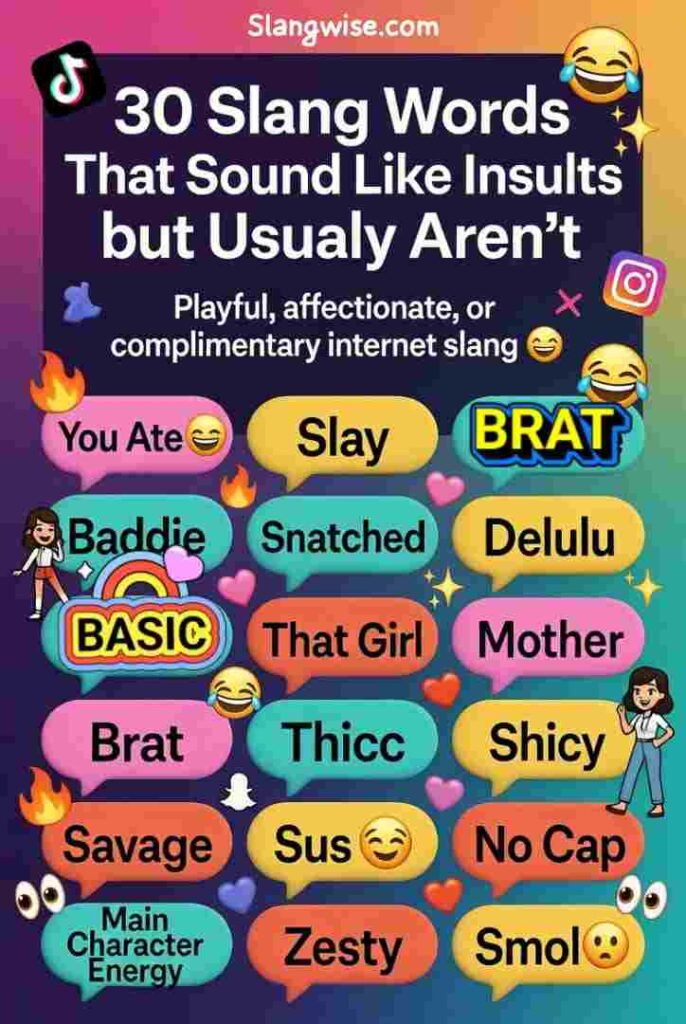
Below, I will walk you through 30 slang words and phrases that often sound insulting at first, but are not always meant that way.
Table of Contents
In a nutshell
- These slang words often sound negative because they come from language that used to mean criticism, disrespect, or judgment.
- But social media has flipped many of them into compliments, jokes, or playful banter. The real clue is context.
- A sentence with a laughing emoji, a fire emoji, or a close friend’s name can mean something very different from the same word used in an argument.
- One thing I have noticed is that the same word can mean praise in one chat and shade in another. That is why understanding the vibe matters just as much as knowing the definition.
Why these words sound like insults in the first place
Most of these slang terms sound insulting because they still carry some of their original meaning. Words like basic, clown, sus, mid, or cap usually sound negative if you hear them in an old school context. But social media has a habit of softening, flipping, or remixing meanings until the word becomes part of everyday banter.
What nobody tells you is that tone does most of the work. A word that looks rude on paper can feel friendly in a group chat, especially when it is paired with “lol,” “fr,” “no cap,” “😭,” “😂,” or “🔥.”
1. Ate / You ate
Meaning: You did something extremely well, especially when it comes to style, performance, makeup, dancing, or a confident public moment.
Why it sounds insulting: At face value, “ate” sounds like someone literally devoured something. Without context, it can sound odd or even messy. But online, it means you absolutely nailed it.
Variants: “She ate,” “you ate that,” “ate and left no crumbs.”
Example: “You ate that dance routine 🔥”
2. It is giving
Meaning: Something strongly evokes a particular vibe, energy, aesthetic, or mood.
Why it sounds insulting: It sounds unfinished or vague if you do not know the slang pattern. It can also feel slightly judgmental because the speaker is comparing the thing to a vibe instead of saying it directly.
Variants: “It is giving main character energy,” “it gives,” “this is giving.”
Example: “This outfit is giving rich auntie energy.”
3. Basic
Meaning: Ordinary, mainstream, or familiar. Interestingly, this can be used negatively or affectionately depending on the tone.
Why it sounds insulting: For years, “basic” meant boring, predictable, or lacking originality. That meaning still exists, so the word can sound harsh very quickly.
Variants: “Basic but cute,” “so basic,” “comfortably basic.”
Example: “This playlist is so basic and I am obsessed.”
4. Mother / She is mother
Meaning: An icon, a standard, or someone who sets the bar very high. It is a way of saying somebody is serving excellence.
Why it sounds insulting: If you hear it literally, it sounds like a strange family reference. In slang, though, it is usually a praise term tied to admiration, especially online and in pop culture spaces.
Variants: “Mothered that,” “she is mother,” “mother energy.”
Example: “You mothered that red carpet look.”
5. Delulu
Meaning: Playfully delusional, unrealistic in a cute way, or stubbornly hopeful even when the odds are not looking great.
Why it sounds insulting: It comes from “delusional,” which is obviously a strong word. That is why it sounds rude at first.
Variants: “I am delulu,” “delulu is the solulu,” “a little delulu.”
Example: “I know he has not texted back, but I am still delulu about this crush 😭”
6. So real for that
Meaning: Very relatable, honest, or admirable in a low key way.
Why it sounds insulting: It has a slight judgment sound when you first hear it, almost like someone is evaluating your behavior.
Variants: “That is so real,” “real for that,” “so valid.”
Example: “Choosing sleep over the party? So real for that.”
7. That girl / You are that girl
Meaning: A confident, glowing, put together person who seems to have her life in order.
Why it sounds insulting: If you hear it without context, “that girl” can sound like somebody is being singled out or talked about behind their back.
Variants: “You are that girl,” “that girl energy,” “main girl energy.”
Example: “Early gym, clean breakfast, skincare routine? You are that girl.”
8. Baddie
Meaning: A confident, stylish, attractive person, usually someone who knows how to own their look and energy.
Why it sounds insulting: The word “bad” usually sounds negative, so the term can feel backwards unless you already know the slang meaning.
Variants: “Baddie vibes,” “full baddie,” “serving baddie energy.”
Example: “She showed up looking like a complete baddie.”
9. Brat
Meaning: Bold, playful, dramatic, and unapologetically confident. It can be used in a fun or affectionate way.
Why it sounds insulting: Traditionally, a brat is a spoiled, rude child. That is why it still sounds like criticism on first hearing.
Variants: “Little brat,” “brat energy,” “such a brat.”
Example: “You are such a brat and I love it 😂”
20 Bad Internet Slangs Parents Should Never Ignore (And What They Really Mean)
10. Thicc
Meaning: Curvy, full, or visually attractive in a way that feels confident and appealing.
Why it sounds insulting: The spelling and sound can suggest something heavy or clumsy, but internet slang turned it into a compliment.
Variants: “Thick,” “very thicc,” “thicc build.”
Example: “That outfit is making the whole look thicc and amazing 🔥”
11. Snatched
Meaning: Looking extremely sharp, polished, flawless, or perfectly styled.
Why it sounds insulting: Literally, “snatched” sounds like something was taken away forcefully. But in beauty and fashion slang, it means absolutely on point.
Variants: “Face snatched,” “waist snatched,” “snatched look.”
Example: “Your makeup is snatched today.”
12. Savage
Meaning: Fierce, bold, fearless, or hilariously blunt in a way people admire.
Why it sounds insulting: Savage normally means cruel or wild, so it can sound negative until you catch the playful tone.
Variants: “Savage reply,” “that was savage,” “savage mode.”
Example: “Your comeback was savage, but funny.”
13. Slay / Slayed
Meaning: To do something amazingly well, especially when it comes to appearance, presentation, performance, or confidence.
Why it sounds insulting: The literal meaning is violent, which is exactly why it can sound strange outside slang.
Variants: “Slay,” “slayed that,” “slaying.”
Example: “You slayed that presentation.”
14. Extra
Meaning: Over the top, dramatic, expressive, or highly energetic. Sometimes that is a criticism, but sometimes it is exactly what makes someone lovable.
Why it sounds insulting: It can mean too much, too loud, or too dramatic in ordinary conversation.
Variants: “So extra,” “extra in the best way,” “extra energy.”
Example: “Your reaction was extra and I loved every second of it.”
READ ALSO: 27 Hustle Slang Words Everyone Is Using in 2026, and What They Really Mean
15. Bougie / Boujee
Meaning: Fancy, polished, expensive looking, or someone with a taste for luxurious things.
Why it sounds insulting: It can sound snobby, pretentious, or like someone is trying too hard to look upper class.
Variants: “Bougie vibes,” “boujee lifestyle,” “a little bougie.”
Example: “That coffee order is so bougie, but I respect it.”
16. Main character
Meaning: Someone acting like the star of their own story, often in a confident, stylish, or cinematic way.
Why it sounds insulting: In everyday speech, calling someone the main character can sound like they think the world revolves around them.
Variants: “Main character energy,” “main character moment,” “main character vibes.”
Example: “Walking through the rain with headphones on? Pure main character energy.”
17. Sus
Meaning: Suspicious, questionable, or slightly shady in a joking way.
Why it sounds insulting: It literally suggests someone may be lying or acting weird, so it can sound accusatory.
Variants: “So sus,” “kinda sus,” “that is sus.”
Example: “You are sus for hiding the snacks 👀”
18. Mid
Meaning: Average, okay, or not especially impressive.
Why it sounds insulting: It is basically a blunt way of saying something is nothing special.
Variants: “Kind of mid,” “mid at best,” “just mid.”
Example: “The movie was mid, but the popcorn was great.”
19. Cap / Cappin
Meaning: A lie, exaggeration, or false claim. “No cap” means no lie, seriously, for real.
Why it sounds insulting: Calling someone a liar is never going to sound soft by default.
Variants: “No cap,” “capping,” “stop cappin.”
Example: “Stop cappin, you know you ate that.”
20. Dummy / My dummy
Meaning: Silly, goofy, or affectionate teasing for someone you know well.
Why it sounds insulting: Dummy literally means foolish or stupid, so it is naturally rude if used seriously.
Variants: “You dummy,” “my dummy,” “big dummy.”
Example: “My dummy really pulled that off 😂❤️”
21. Bitch / Bad bitch
Meaning: In some friend groups and online spaces, this can mean a strong, confident, attractive, or powerful person.
Why it sounds insulting: The word is still a direct insult in many settings, so context matters a lot here.
Variants: “Bad bitch,” “that bitch,” “my bitch” in very specific friendship contexts.
Example: “That is my bad bitch right there.”
Because this term is loaded, it is not always safe to use with everyone. Among close friends, though, it can be a hype word.
22. Hoe
Meaning: Among close friends, it can be used jokingly or playfully for someone who is flirtatious, loud, or always involved in the drama in a funny way.
Why it sounds insulting: It is still a serious insult in many contexts, which is why this one must be handled carefully.
Variants: “You little hoe,” “my hoe,” “hoe behavior.”
Example: “You lil hoe always the first one in the group chat 😂”
Only use or repeat this kind of slang when the relationship and setting clearly support it.
23. Weirdo
Meaning: Quirky, unusual, or different. Depending on tone, it can be affectionate or judgmental.
Why it sounds insulting: A weirdo is traditionally someone who is strange in a negative way.
Variants: “Cute weirdo,” “my favorite weirdo,” “weird in a good way.”
Example: “My favorite weirdo forever 💕”
24. Goof / Goofball
Meaning: Silly, playful, clumsy, or amusing in a sweet way.
Why it sounds insulting: Goof can sound like someone is being foolish, childish, or not serious enough.
Variants: “Big goof,” “total goofball,” “such a goof.”
Example: “You big goof, I cannot with you.”
DISCOVER: 72 Most Popular Gen Z Slang Words of 2026 – Rizz, Delulu, Skibidi etc., And What They Secretly Mean Online
25. Clown
Meaning: Somebody acting silly, embarrassing themselves, or being ridiculous in a funny way.
Why it sounds insulting: Calling someone a clown can obviously sound like mockery, because the word is associated with foolishness.
Variants: “You clown,” “big clown energy,” “stop clowning.”
Example: “Stop clowning in the comments 😂”
26. Zesty
Meaning: Energetic, colorful, spicy, lively, or confidently expressive.
Why it sounds insulting: Some people hear it as a weird or overly dramatic label, so it can sound like a quiet dig before the compliment clicks.
Variants: “Zesty vibe,” “very zesty,” “a little zesty.”
Example: “Your outfit is so zesty, I love the confidence.”
27. Big back
Meaning: A joking way to describe someone who really likes food, snacks, or second helpings. It is often used self deprecatingly among friends.
Why it sounds insulting: It can sound like a body related insult if taken literally, which is why it should be used very carefully.
Variants: “I am such a big back,” “big back behavior,” “acting like a big back.”
Example: “I am such a big back for this second plate 😭”
28. Glazing / Glaze
Meaning: Over hyping someone too much, praising them so hard that it starts to look excessive or suspicious.
Why it sounds insulting: It can sound like fake praise, over admiration, or trying too hard to impress.
Variants: “Stop glazing,” “glazing hard,” “too much glaze.”
Example: “Stop glazing him, he is good but not that good.”
29. Buttah
Meaning: Smooth, easy, soft in a good way, or something that flows very nicely.
Why it sounds insulting: It can sound like someone is describing something as too soft, weak, or slippery. But in slang, it usually means smooth and impressive.
Variants: “Smooth as buttah,” “pure buttah,” “butter smooth.”
Example: “That flow was pure buttah.”
READ ALSO: 70 Most Popular Millennial Slang Words and What They Really Mean (From Adulting to YOLO)
30. Smol
Meaning: Small, tiny, or cute in an affectionate way. It is often used for pets, baby things, or adorable people and objects.
Why it sounds insulting: It looks like a misspelling of “small,” so it can initially feel childish or mocking.
Variants: “Very smol,” “smol bean,” “tiny and smol.”
Example: “You look so smol and precious in that photo ❤️”
How to tell when a slang word is actually a compliment
Here is the simple trick I use: do not only read the word. Read the energy around it.
If the message includes laughing emojis, fire emojis, hearts, “fr,” “no cap,” or a clearly playful tone, the word is probably being used in a positive or teasing way. If it appears in a heated comment, a serious disagreement, or a direct insult, then the meaning is probably harsher.
Think of it like this. The same phrase can mean three different things depending on the room you are in. A close friend can say “you clown” and make you laugh. A stranger can say it and suddenly it feels rude. Context always wins.
Quick DM and comment tips for these words
These slang words work best when the relationship is already friendly, the mood is light, and both people understand the joke. They can misfire quickly with strangers, older audiences, or people who do not follow internet slang closely.
If you are using them online, keep the tone clear. A little emoji, a “lol,” or a “fr” can help show that you are joking or praising, not insulting. And if a word feels too sharp for the situation, it is always safer to choose a clearer compliment instead.
Final Thought
Slang is one of the most fun parts of internet culture because it keeps flipping expectations. A word that sounds rude on the surface can turn into a compliment, a joke, or even a term of endearment. That is why words like ate, slay, snatched, baddie, delulu, and sus feel so alive online.
They are not just words. They are little social signals. Based on what I have seen so far, the smartest way to read this kind of slang is to ask, Who said it, to whom, and in what mood? Once you answer that, the meaning becomes much easier to spot.
Frequently asked questions
No. That is the tricky part. Some of them are mostly positive, some are playful, and some can become rude very fast depending on who says them and how they say them.
Not always. Words like bitch, hoe, clown, and dummy can be affectionate in one friendship group and offensive in another. It is best to use them only when you already know the vibe is safe.
Social media changes language fast. People borrow words, remix them, joke with them, and turn them into new meanings. A word can start as an insult and later become a badge of confidence, humor, or style.
Look at the tone, the emojis, the relationship between the people, and the platform. A TikTok comment, a private DM, and a serious argument will not use the same meaning in the same way.