

Let me tell you about a caption I once wrote.
My desk was a complete mess, and I posted about how the chaos happened because I had been “too busy writing.”
It sounded harmless.
Then I read it again and laughed.
The real message was obvious: I wanted people to notice that I was busy and productive.
That was my humblebrag.
You have probably seen humblebrags in captions, group chats, work conversations, or chats with friends.
Today, I am breaking down what humblebrag means, where it came from, how to spot one, and why people sometimes do it without realizing it. By the end, you may start catching the hidden brag behind innocent sounding complaints.
What Does Humblebrag Mean?
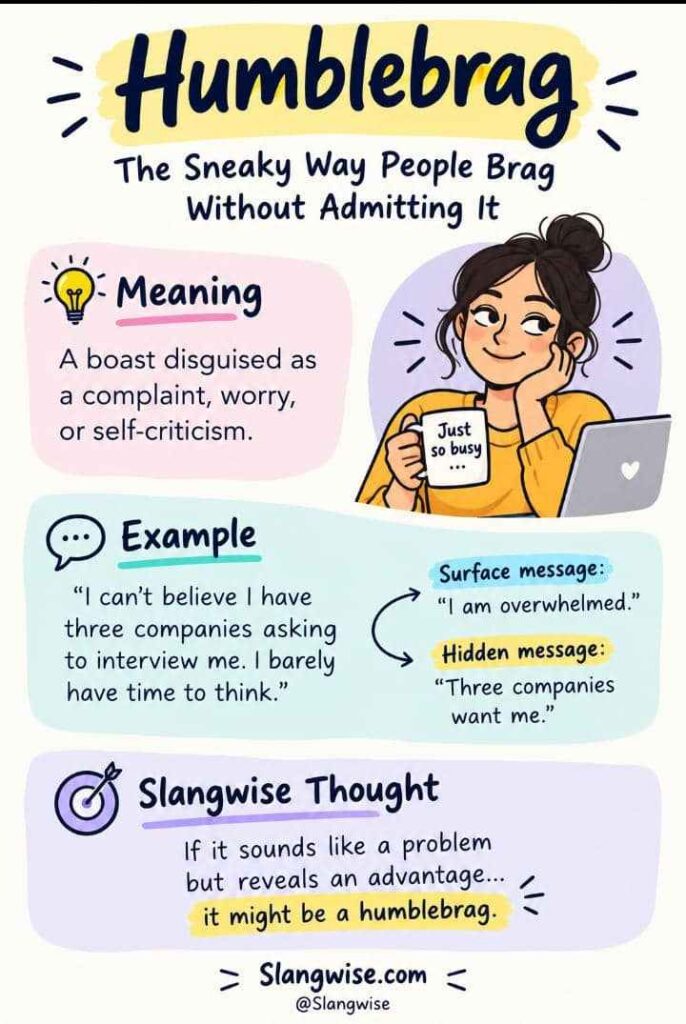
A humblebrag is a boast disguised as humility, a complaint, a worry, or self criticism.
Slang.net, a slang focused site, describes humblebrag as a modest sounding statement made to attract positive attention.
For example:
“I cannot believe I have three companies asking to interview me. I barely have time to think.”
Surface message: “I am overwhelmed.”
Hidden message: “Three companies want me.”
That hidden message is the humblebrag.
Where Did Humblebrag Come From?
The word humblebrag is strongly associated with comedian and writer Harris Wittels, who popularized it through the @Humblebrag Twitter account in 2010. He collected examples of people sounding modest or annoyed while quietly highlighting something impressive.
We want to share good news.
We also do not want to look like we are showing off.
So we soften the achievement, attach a complaint to it, and hope nobody notices what we are really saying.
READ ALSO: Badawesome Meaning: When Something Is So Bad It’s… Awesome?
Humblebrag Examples You Will Recognize
The easiest way to understand slang is to hear it in normal life.
The School Humblebrag: “I planned to study, but everyone kept asking me to explain the lesson.”
Hidden brag: “People rely on me because I understand it.”
The Work Humblebrag: “My calendar is packed again. I do not know how I ended up on this many important projects.”
Hidden brag: “I am trusted with important work.”
The Social Media Humblebrag: “I posted that video as a joke. Now strangers keep tagging their friends under it.”
Hidden brag: “My content is getting attention.”
The Travel Humblebrag: “I really need a break from airports. I feel like I have spent half the month on a plane.”
Hidden brag: “I have been traveling constantly.”
But context matters. A person can genuinely be tired, stressed, or surprised. The clue is whether the supposed problem conveniently reveals an advantage.
Why Do People Humblebrag?
This is the part I find most interesting.
I do not think every humblebrag comes from someone trying to deceive people. Often, it is awkward self presentation.
Most of us like recognition, but many of us dislike sounding arrogant. So we look for a compromise.
Instead of saying, “I am proud of this achievement,” we say, “I cannot believe this is happening.”
Instead of saying, “My post did well,” we say, “My phone will not stop buzzing.”
Humblebrag vs Genuine Sharing
Not every complaint about something fortunate is a humblebrag.
“I am excited about my new job, but I am nervous because there is so much to learn.”
That sounds genuine.
Compare it with:
“I cannot believe how many companies wanted me. Choosing between all these offers is exhausting.”
The second statement makes the achievement sound like the burden.
My simple test is this: what does the speaker actually want you to notice?
If the main point is a real problem, it may be genuine sharing. If the main point is an impressive fact hidden inside the complaint, you may be looking at a humblebrag.
DISCOVER: 80 Most Popular Gen Alpha Slang Words You’ll Hear In 2026 (updated)
How to Catch a Humblebrag in Yourself
This is where my messy desk caption became useful.
Now I ask myself:
“Would I still say this if nobody knew the impressive part?”
That question works surprisingly well.
Watch for complaints like:
“I am tired because everyone keeps inviting me out.”
“My schedule is crazy because people keep asking for my help.”
Sometimes those are real feelings. Sometimes the complaint is mostly a delivery system for the brag.
How to Share a Win Without Humblebragging
You do not need to hide good news.
In my experience, the cleanest approach is usually the simplest: say what happened and own it.
Instead of:
“I cannot believe anyone actually liked my project.”
Try:
“I am really proud of this project. I worked hard on it, and it is exciting to see people respond.”
You can also add gratitude:
“I am grateful for the opportunity and for everyone who supported me.”
Or genuine vulnerability:
“I am excited about this opportunity, but I am also nervous about what comes next.”
Those versions feel more natural because they do not make the reader decode the achievement.
Humblebragging in Internet Culture
Humblebragging fits internet culture unusually well.
Social platforms give people endless opportunities to share achievements, but they also reward relatability. So success often gets packaged inside humor, fake frustration, or self criticism.
You can spot the pattern in posts about work, school, fitness, content creation, networking, travel, or viral moments.
READ MORE: Crikey Mate Meaning: What This Iconic Aussie Phrase Really Says About You
Have You Ever Humblebragged?
Be honest with me.
Have you ever posted something that sounded like a complaint but was secretly a tiny victory lap?
I have.
My messy desk caption was one example, and I still laugh about it because it was such an ordinary moment. I was not trying to fool anybody. I simply wanted to share what was happening without directly saying, “Look how productive I have been.”
Humblebrag In a Nutshell
- Humblebrag: A boast hidden inside a complaint, worry, joke, or display of fake modesty.
- Why people do it: We often want recognition without sounding arrogant.
- How to spot it: Look for an impressive benefit hiding inside the supposed problem.
- Not every complaint counts: Genuine stress, surprise, or gratitude can sound similar, so context matters.
- A better approach: Share your wins honestly, with gratitude or genuine vulnerability, instead of pretending success is a burden.
Concluding Thought
We want people to notice our progress, but we also want to be liked.
Sometimes those two desires produce a sentence that sounds modest on the surface but quietly says, “Please notice how impressive this is.”
I know that feeling because I have done it myself.
So the next time you catch yourself writing, “Ugh, I cannot believe I have to…” pause for a second.
Ask what you really mean.
Maybe the honest version is simply, “I am proud of this.”
And there is nothing wrong with that.
FAQs
A humblebrag is a boast disguised as a complaint, humble statement, joke, or self criticism.
Backdoor brag is another expression for a statement that looks modest but is really meant to highlight something impressive.
No. People sometimes humblebrag without realizing how their words sound. They may simply be trying to share good news without appearing boastful.
Look at the hidden message. If a complaint mainly reveals an achievement, advantage, opportunity, or desirable experience, it may be a humblebrag.
You can state the achievement directly, add genuine gratitude, or explain your real feelings. Honest wording usually makes the message clearer and more relatable.
Table of Contents