
Keeping up with internet slang can feel like trying to read a conversation that changes its dictionary every few weeks. A word that means one thing on TikTok can mean something completely different in a gaming lobby, group chat, Discord server, or comment section.
That is exactly why a useful slang guide needs to do more than throw 270 random words onto a page. The real skill is understanding how people actually use the words, what tone they carry, where they came from, and when a term has already started becoming outdated.
Table of Contents
Why Internet Slang Matters More Than You Think
Internet slang is much more than a collection of funny words. It is one of the fastest ways online communities create identity, humor, belonging, shorthand, and shared cultural references.
Terms such as rizz, cooked, ate, sus, delulu, NPC, and aura can communicate an entire attitude in one word. The meaning is often carried not only by the dictionary definition but also by the tone behind it.
After years of tracking slang across social media, gaming communities, meme culture, music fandoms, group chats, and online conversations, one pattern becomes impossible to miss: slang does not stay still.
Some expressions disappear almost overnight. Others jump from a niche community into mainstream conversation and remain useful for years. A few even become so established that people eventually forget they were once internet slang.
That is why this list does not treat slang as a simple popularity contest. The aim is to explain the language behind the trend.
What You Will Find in This 270-Word Slang Dictionary
This guide brings together expressions from several parts of internet culture, including:
- Social media slang used on TikTok, Instagram, X, Reddit, and other platforms.
- Gaming slang used in multiplayer games, streaming communities, and esports.
- Gen Z and Gen Alpha expressions that spread through memes and short-form video.
- Texting abbreviations used to make conversations faster.
- Meme phrases and catchphrases that become part of online culture.
- Dating and relationship language commonly seen in online conversations.
- Creator and influencer terminology used to describe online behavior and content.
- Older internet slang that still appears regularly despite changing trends.
The result is not simply a vocabulary list. It is a snapshot of how online language works in 2026.
Key Takeaways
- Internet slang changes rapidly because online communities constantly create, remix, shorten, and repurpose language.
- This guide contains 270 popular internet slang words, abbreviations, expressions, and catchphrases.
- Every entry includes a plain-English meaning and a natural example to make the expression easier to understand.
- Context matters because many slang terms can have several meanings depending on the platform or community.
- The newest additions reflect the changing Gen Z and Gen Alpha vocabulary appearing across internet culture in 2025 and 2026.
Take our slang quiz before you read — find out which internet slang terms you already know and discover how much of today’s online vocabulary you can decode.
Results
Nice work!
You passed the Easy Level and your slang game is looking solid.
You unlocked the special bonus Slangwise ebook.
Ready to level up? Proceed to the Hard Level and prove you are a true slang master.
Good try! Slang evolves fast, so missing a few is totally normal.
You still unlocked the special bonus Slangwise ebook for participating.
Want to challenge yourself? You can still try again and see how far you can go.


#1. Calling someone an NPC online usually means:
#2. If a post gets RATIOED on Twitter/X, it means:
#3. NO CAP in Gen Z Slang means:
#4. YEET! is commonly used to:
#5. To STAN someone is to:
#6. When someone says BASED, they usually mean:
#7. What does RIZZ mean?
#8. RATIO + REPLY as a reaction usually indicates:
#9. PERIODT is used to:
#10. If a meme is SENDING ME, it means the meme is:
#11. If someone says I’M DEAD, they mean:
#12. According to Gen Zs, If a song SLAPS, that means the song is:
#13. What does SUS usually mean in Slang?
#14. SIMP refers to someone who:
#15. CHEUGY refers to something that is:
#16. If someone says a snack is BUSSIN, they mean it is:
#17. GOAT stands for:
#18. What’s the meaning of TEA in internet slang?
#19. LOWKEY in internet slang means:
#20. If someone says they’re going to GHOST you, it means they will:
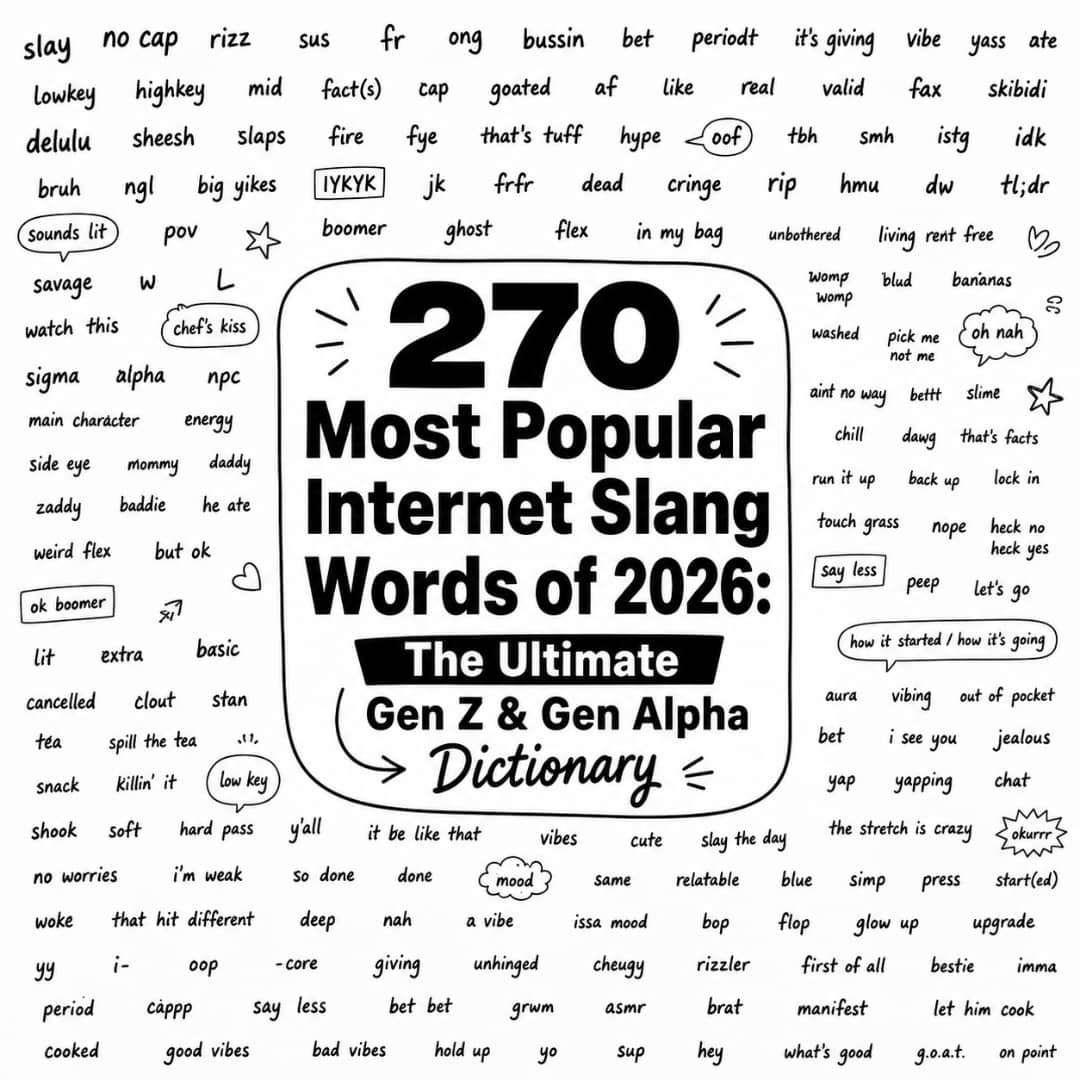
270 Most Popular Internet Slang Words and Their Meanings
1. Ate
Ate means someone did something extremely well. It can describe an outfit, performance, presentation, joke, comeback, edit, or almost any impressive moment. Example: You really ate with that presentation.
2. Ate and left no crumbs
This is an intensified version of ate. It means someone performed so well that there was supposedly nothing left to criticize. Example: She answered every question and left no crumbs.
3. AF
AF means “as fuck” and works as an intensifier meaning extremely or very. It is casual and profane, so it is better suited to informal conversations. Example: That game was difficult AF.
4. AFK
AFK means “away from keyboard.” It originated in online gaming and is now common in chats when someone temporarily steps away. Example: BRB, I’ll be AFK for five minutes.
5. AI generated
AI generated describes content created partly or entirely with artificial intelligence, such as images, text, voices, or videos. Online, it is often used when people notice an artificial-looking detail. Example: That image looks AI generated.
6. Algorithm
Algorithm refers to the systems platforms use to determine what content appears in a user’s feed or recommendations. Example: The algorithm finally picked up my video.
7. Alt
Alt is short for alternative and often describes an alternative style, identity, aesthetic, or online subculture. Example: Her new profile has a very alt aesthetic.
8. Alt account
An alt account is a secondary social media account used for a different audience, purpose, or style of posting. Example: I posted the meme on my alt account.
9. AMA
AMA means “ask me anything.” It is used when someone invites other people to ask questions, particularly during social media posts or community discussions. Example: I just finished the project. AMA.
10. ASAP
ASAP means “as soon as possible.” It signals urgency without necessarily specifying an exact deadline. Example: Please send the updated version ASAP.
11. Astronaut vibe
Astronaut vibe playfully describes someone who seems spaced out, distracted, dreamy, or disconnected from what is happening. Example: He has astronaut vibe today; he hasn’t noticed anything.
12. BAE
BAE is a term of affection commonly interpreted as referring to a romantic partner or someone especially important. Example: I’m meeting my BAE after work.
13. Bae goals
Bae goals describes a couple or relationship that people admire or consider desirable. Example: Their anniversary photos are giving serious bae goals.
14. Based
Based is usually praise for someone who confidently expresses an opinion or acts according to their principles without worrying about approval. Example: She said exactly what she believed. Based.
15. Bag secured
Bag secured means achieving a valuable opportunity, success, payment, deal, or other desirable outcome. Example: He landed the contract. Bag secured.
16. Beige flag
A beige flag is a harmless but slightly unusual trait that makes someone pause and say, “That’s interesting.” It sits between a green flag and a red flag. Example: Her beige flag is that she organizes her snacks by color.
17. Bet
Bet means okay, agreed, or understood. It is commonly used as a quick confirmation. Example: Meet at seven? Bet.
18. Big yikes
Big yikes intensifies yikes and signals strong embarrassment, discomfort, shock, or disapproval. Example: That public argument was a big yikes.
19. Boomer
Boomer originally refers to a member of the Baby Boomer generation but is also used online to describe someone perceived as technologically outdated or out of touch. Example: He called every social app “the internet” — total boomer moment.
20. Boomer energy
Boomer energy describes behavior that feels old-fashioned, technologically confused, or disconnected from current internet culture. Example: Printing a screenshot instead of sending it is boomer energy.
21. Bop
A bop is a catchy or enjoyable song that is easy to listen to repeatedly. Example: This track is such a bop.
22. Bot
Bot literally describes automated software, but online it can also describe someone who behaves predictably or mechanically. Example: He keeps repeating the same line like a bot.
23. Bread
Bread is slang for money or income. It is part of a long tradition of food-related slang for money. Example: That side hustle is bringing in extra bread.
24. Bread up
Bread up means having plenty of money or becoming financially comfortable. Example: After the new contract, he’s really bread up.
READ ALSO: 50 Hidden Emoji Slang Terms That Are Changing How We Talk
25. Breadcrumbing
Breadcrumbing describes giving someone occasional attention or communication to keep them interested without offering genuine commitment or consistent effort. Example: Random “hey” messages every three weeks are classic breadcrumbing.
26. BRB
BRB means “be right back.” It is one of the classic texting abbreviations and remains useful for quick conversations. Example: Getting some water, BRB.
27. Brokie energy
Brokie energy is a joking expression describing overly cheap or financially limited behavior. It is normally humorous rather than a literal financial description. Example: Splitting one small fries between five people is brokie energy.
28. Buff
In gaming, a buff is an improvement to a character, weapon, ability, or mechanic. Outside gaming, it can simply mean a boost or upgrade. Example: The developers finally gave that character a major buff.
29. Bussin
Bussin usually describes food that tastes exceptionally good and can sometimes be extended to something highly enjoyable. Example: This jollof rice is bussin.
30. Camp
Camp describes something deliberately exaggerated, theatrical, dramatic, or excessively stylish in a way that can be entertaining. Example: The whole performance was wonderfully camp.
31. Cancel
To cancel someone means to withdraw public support because of behavior considered unacceptable or offensive. Example: People threatened to cancel the creator after the controversial post.
32. Cancel culture
Cancel culture refers to collective online criticism and withdrawal of support toward people, brands, or organizations accused of problematic behavior. Example: The controversy sparked a major cancel-culture debate.
33. Cap
Cap means a lie, exaggeration, or dishonest statement. No cap means the speaker is being completely serious or truthful. Example: That story is cap.
34. Caught in 4K
Caught in 4K means being exposed with strong or undeniable evidence, usually screenshots, photographs, or video. Example: He denied saying it, but the screenshot caught him in 4K.
35. Certified cook
A certified cook is someone who consistently produces impressive results, especially clever jokes, arguments, edits, performances, or creative work. Example: That comeback was a certified cook moment.
36. Chaotic good
Chaotic good describes someone who does helpful or positive things through unconventional, unpredictable, or humorous methods. Example: She secretly fixed everyone’s presentations. Chaotic good.
37. Cheugy
Cheugy describes something considered dated, overly trendy, or associated with an older internet aesthetic. The word is often used playfully rather than as a serious insult. Example: That old “Live Laugh Love” wall art is being called cheugy again.
38. Clout
Clout means online influence, popularity, attention, or social status. Example: Some creators join trends mainly for clout.
39. Clap back
To clap back means responding to criticism with a sharp, confident, or witty reply. Example: She clapped back with one sentence and ended the argument.
40. Cope
Cope describes an explanation, excuse, or attitude used to deal with disappointment. Online, saying “cope” often suggests that someone is trying to rationalize a loss. Example: Saying the referee caused everything is pure cope.
41. Copium
Copium is a humorous metaphor for unrealistic optimism or denial after disappointment. Example: He’s still convinced his team will win the tournament. That’s copium.
42. Cold
Cold can praise something impressive, stylish, fearless, or emotionally intense. Meaning depends strongly on context. Example: That final move was cold.
43. Cooked
Cooked usually means someone or something is in serious trouble, exhausted, defeated, or beyond easy recovery. Example: We forgot the deadline. We’re cooked.
44. Corecore
Corecore refers to a style of internet video or edit that combines emotional, philosophical, ironic, or unrelated clips to create a particular mood. Example: That edit is pure corecore.
45. Cuffing season
Cuffing season describes the colder part of the year when people jokingly become more interested in relationships and companionship. Example: Everyone starts talking about relationships when cuffing season arrives.
46. Crying screaming throwing up
Crying screaming throwing up is an exaggerated online reaction to something extremely shocking, funny, exciting, embarrassing, or emotionally overwhelming. Example: That plot twist had everyone crying screaming throwing up.
47. Dank
Dank became strongly associated with internet memes and usually describes something especially clever, absurd, humorous, or deeply rooted in meme culture. Example: That is one seriously dank meme.
48. Dead
Online, dead can mean something is extremely funny. It is short for the idea of being “dead” from laughter. Example: That comment has me dead.
49. Deadass
Deadass means seriously, genuinely, or without joking. Example: Deadass, that was the best performance all night.
50. Debuff
A debuff is a negative effect that reduces performance or abilities, especially in games. It can also be used metaphorically online for anything that makes a person or situation worse. Example: That update gave the character a huge debuff.
51. Delulu champ
Delulu champ humorously describes someone who confidently embraces unrealistic expectations or fantasies. Example: He thinks one like means they’re getting married. Delulu champ.
52. Dox
Dox means publicly exposing someone’s private identifying information without permission. It is a serious form of online privacy abuse, not simply ordinary gossip. Example: Posting someone’s private address is an attempt to dox them.
53. Drag
To drag someone means to criticize, roast, or publicly call out their behavior. Example: The comments dragged the brand for ignoring the problem.
54. Drag me
Drag me invites other people to criticize or roast the speaker, often as a joke. Example: Rate my unpopular opinions. Drag me if you disagree.
55. Drip
Drip describes fashionable clothing, accessories, or an overall stylish appearance. Example: That jacket has serious drip.
56. Dusty
Dusty can describe something outdated, stale, uncool, or no longer impressive. Example: That old slogan feels dusty now.
57. EZ Clap
EZ Clap means an easy win, especially in gaming. It can be sincere, playful, or deliberately boastful. Example: That round was EZ Clap.
58. Engagement farming
Engagement farming means deliberately creating posts designed primarily to generate comments, reactions, shares, or arguments. Example: That obvious rage post looks like engagement farming.
59. Extra
Extra describes behavior that is unusually dramatic, excessive, or elaborate. Example: He brought a full sound system to a tiny picnic. That’s extra.
60. Fanum effect
Fanum effect is a playful expression describing how something associated with a popular creator or meme can spread rapidly through their audience. Example: That phrase exploded after one of his videos — the Fanum effect.
61. Fanum tax
Fanum tax jokingly refers to taking some of another person’s food, especially when sharing a meal with friends. Example: You opened the fries near me. Fanum tax.
62. Fam
Fam means close friend, trusted person, or familiar group. Example: What’s happening tonight, fam?
63. FBF
FBF means “Flashback Friday,” a social media tradition of sharing an older photo, memory, or moment on Friday. Example: FBF to our first school trip.
64. Filter
A filter is a digital effect that changes the appearance, mood, or style of an image or video. Example: Which filter did you use for that picture?
65. Fit check
Fit check means showing an outfit online, usually to receive reactions, compliments, or style feedback. “Fit” is short for outfit. Example: Quick fit check before the event.
66. Flex
To flex means to show off an achievement, possession, skill, appearance, or status. Example: Posting the trophy was a serious flex.
67. Folded
Folded means giving up, losing confidence, or failing to continue under pressure. Example: They looked strong at first, then completely folded.
68. FOMO
FOMO means “fear of missing out.” It describes anxiety or discomfort about being excluded from an event, trend, opportunity, or social experience. Example: I went mostly because of FOMO.
69. Frag
In shooter games, a frag is the elimination of an opposing player. It can also refer to the act of securing that elimination. Example: Nice frag!
70. FWB
FWB means “friends with benefits,” referring to a friendship involving romantic or physical intimacy without a traditional committed relationship. Example: The term appeared in their conversation about an undefined relationship.
71. FWIW
FWIW means “for what it’s worth.” It introduces an opinion or piece of information, usually in a relatively low-pressure way. Example: FWIW, the first version was better.
72. Gatekeep gaslight girlboss
Gatekeep gaslight girlboss is an ironic phrase used to parody online empowerment language and influencer culture. It is usually deliberately exaggerated. Example: That entire post was peak gatekeep gaslight girlboss.
73. Gatekeeping
Gatekeeping means controlling access to information, hobbies, communities, trends, or knowledge while discouraging newcomers. Example: Stop gatekeeping the music recommendations.
74. Gaslight
Gaslighting refers to manipulating someone into questioning their own memory, perception, or understanding of events. Online, the term is often used loosely, so it is important not to confuse ordinary disagreement with genuine manipulation. Example: Constantly denying something that happened and making the other person doubt their memory can be gaslighting.
75. Get good
Get good is a sarcastic gaming phrase telling someone to improve their skills instead of complaining about difficulty. Example: You lost again? Get good.
76. GG
GG means “good game.” Gamers commonly use it at the end of a match as a sign of sportsmanship, although it can also be sarcastic. Example: GG everyone. That was close.
77. Gassed up
Gassed up means heavily praised, hyped, or encouraged, sometimes so much that the person becomes overconfident. Example: The comments gassed him up after one viral clip.
78. Glizzy
Glizzy commonly means a hot dog in internet meme culture. In some contexts it has other meanings, so context matters. Example: We’re grilling glizzies this weekend.
79. Glow up
A glow up describes a positive transformation in confidence, style, skills, lifestyle, or overall presentation. It does not have to refer only to physical appearance. Example: His confidence really had a glow up this year.
80. GOAT
GOAT stands for “greatest of all time.” It is used to praise someone considered exceptionally successful or talented. Example: That player is the GOAT of the sport.
81. GN
GN means “good night.” It is a simple texting abbreviation used when ending a conversation before sleep. Example: GN, talk tomorrow.
82. Green flag
A green flag is a positive sign suggesting that a person, relationship, decision, or situation is healthy or promising. Example: Respecting boundaries is a major green flag.
83. Grief
Grief is not originally internet slang, but it frequently appears in online conversations, especially around loss, remembrance, and emotional support. Example: She wrote openly about grief after losing a loved one.
84. Grind
Grind means sustained effort toward a goal, especially in work, study, business, fitness, or gaming. Example: Back to the grind tomorrow morning.
85. Griefer
A griefer is a player who deliberately disrupts other players’ enjoyment of an online game. Example: The griefer kept interfering with every match.
86. Hard launch
A hard launch means publicly and clearly announcing something, often a relationship, project, product, or major life change. Example: They went from subtle hints to a full hard launch.
87. Hard life era
Hard life era humorously describes a period when everything seems unusually difficult or exhausting. Example: This exam week has me in my hard life era.
88. Hard pass
Hard pass means a firm no or complete refusal. Example: Another three-hour meeting? Hard pass.
89. Heat
Heat describes something especially impressive, exciting, talented, or high quality. It is common in music, sports, fashion, and gaming conversations. Example: This album is heat.
90. Heavy on that
Heavy on that means strongly emphasizing or fully embracing a particular idea, mood, aesthetic, or opinion. Example: Heavy on that vintage energy.
91. Highkey
Highkey emphasizes openness or obviousness. It is almost the opposite of lowkey. Example: I highkey want to see that movie.
92. Himbo
Himbo is a playful term for a man portrayed as attractive, kind-hearted, and somewhat naive or unintelligent. Example: The character is a lovable himbo.
93. Hypebeast
Hypebeast describes someone strongly focused on fashionable, highly hyped, or limited-edition products and brands. Example: His collection makes him look like a full-time hypebeast.
94. I can’t even
I can’t even expresses being overwhelmed, surprised, amused, frustrated, or unable to find the right words. Example: I can’t even after that plot twist.
95. IDC
IDC means “I don’t care.” It can sound neutral, dismissive, or blunt depending on context. Example: IDC what time we leave.
96. IDK
IDK means “I don’t know.” It is one of the most common abbreviations in casual digital conversations. Example: IDK, check the group chat.
97. IG
IG commonly means Instagram, although it can also mean “I guess” in some conversations. Example: I saw the announcement on IG.
98. IKR
IKR means “I know, right?” It shows strong agreement with something another person has said. Example: That ending was wild. IKR?
99. ILY
ILY means “I love you.” It can appear between romantic partners, family members, or close friends depending on context. Example: Thanks for helping today. ILY.
100. ILYSM
ILYSM means “I love you so much.” It is a stronger affectionate version of ILY. Example: You were there when I needed you. ILYSM.
101. IMO
IMO means “in my opinion.” It introduces a personal view rather than an absolute claim. Example: IMO, the second season is better.
102. In your bag
In your bag means performing extremely well, often while focused, confident, and in control. Example: She’s in her bag with that new project.
103. Influencer
An influencer is a creator who has enough online reach or credibility to influence opinions, trends, purchases, or conversations. Example: The influencer partnered with the brand for the campaign.
104. Insta worthy
Insta worthy describes something visually appealing enough to inspire an Instagram post or story. Example: That sunset is completely Insta worthy.
105. IRL
IRL means “in real life.” It distinguishes offline experiences from online interactions. Example: We finally met IRL after months of chatting.
106. It’s giving
It’s giving describes the impression, mood, aesthetic, or energy something communicates. Example: That outfit is giving old-school movie star.
107. IYKYK
IYKYK means “if you know, you know.” It signals an inside joke, niche reference, or experience understood mainly by a particular group. Example: That restaurant’s midnight menu is different. IYKYK.
108. Karen
Karen is an internet label for a person perceived as entitled, demanding, or unnecessarily confrontational, particularly in public situations. It can be insulting, so context matters. Example: The comments called the customer’s behavior “Karen behavior.”
109. KD ratio
KD ratio means kill-to-death ratio, a gaming statistic comparing eliminations with deaths. Example: His KD ratio improved after a month of practice.
110. Keyboard warrior
A keyboard warrior is someone who behaves aggressively or confidently online, especially in arguments, while possibly behaving very differently offline. Example: The replies were full of keyboard warriors.
111. Lewk
Lewk is a stylized spelling of “look” and usually refers to a particularly striking or memorable fashion presentation. Example: She arrived with a dramatic lewk.
112. Level up
Level up means making meaningful progress, improvement, or advancement. The phrase comes naturally from gaming language but is widely used outside games. Example: That certification helped her level up professionally.
113. Lit
Lit traditionally describes something exciting, lively, or excellent. Although its peak popularity has passed in some communities, it remains recognizable online. Example: The concert was lit.
114. Litty
Litty is an intensified playful form of lit, describing something especially energetic or fun. Example: The whole festival was litty.
115. LMK
LMK means “let me know.” It is useful when asking someone to provide information or confirmation later. Example: LMK when you arrive.
116. Loop me in
Loop me in means include me in the conversation, plan, email thread, or relevant information. Example: Loop me in when the meeting time is confirmed.
117. L
L means loss or failure and is commonly used online to describe a disappointing outcome. Example: Missing the deadline was an L.
118. Lowkey
Lowkey can mean secretly, somewhat, subtly, or without making a big deal about something. Example: I’m lowkey excited about the trip.
119. Loud wrong
Loud wrong describes someone being confidently incorrect and making the mistake very publicly. Example: He argued for ten minutes before checking the facts. Loud wrong.
120. Lurker
A lurker follows an online community without actively commenting, posting, or interacting. Example: I’ve been a lurker in that forum for months.
121. Main
Main usually refers to someone’s primary social media account, gaming account, or online identity. Example: I’ll post it on my main later.
122. Main character
Main character describes someone behaving as though they are the protagonist of their own story, often with confidence or theatrical energy. Example: Walking into the room with headphones on was peak main-character energy.
123. Mid
Mid means mediocre, average, or disappointing, especially when something was heavily hyped beforehand. Example: The movie wasn’t terrible, but it was mid.
124. Midcore
Midcore can describe a moderate or middle-ground aesthetic or level of commitment between mainstream and deeply niche culture. Example: Her music taste feels very midcore.
125. Meta
Meta can mean self-referential or, in gaming, the currently dominant strategy, character, weapon, or play style. Example: That character is part of the current meta.
126. Mood
Mood expresses strong identification with a feeling, situation, image, or attitude. Example: A sleepy dog on Monday morning? Mood.
127. Moodboard
A moodboard is a collection of images, colors, textures, words, or references used to communicate a particular creative direction. Example: The designer made a moodboard before starting the project.
128. Mood swing
Mood swing describes a noticeable change in emotional state. The term is not specifically internet slang, but it frequently appears in casual digital conversations. Example: That plot twist caused an instant mood swing.
129. Motion
Motion can refer to momentum, progress, opportunities, or active movement toward a goal. Example: Things are finally gaining motion around the project.
130. Moots
Moots is short for mutuals, referring to people who follow one another on social media. Example: My moots always find the funniest posts.
131. Nan
Nan can appear as a playful shorthand meaning nothing or none in some online communities, although it is less universal than many other terms on this list. Example: Nan happening today.
132. NB
NB can mean “nota bene,” meaning pay particular attention to this note. Depending on the conversation, it can also have other meanings. Example: NB: the deadline has changed.
133. No cap
No cap means no lie, no exaggeration, or genuinely. It emphasizes that the speaker believes what they are saying is true. Example: No cap, that was the best meal I’ve had all year.
134. No motion
No motion means there is little or no progress happening. Example: The project has no motion because everyone is waiting for approval.
135. No thoughts head empty
No thoughts, head empty is a humorous expression describing a state of mental quietness, distraction, relaxation, or exhaustion. Example: After finishing the exam: no thoughts, head empty.
136. Noob
Noob describes a newcomer or inexperienced participant, particularly in gaming. It can be playful or insulting depending on tone. Example: Give him a chance; he’s still a noob.
137. NPC
NPC stands for “non-player character.” Online, it describes someone perceived as predictable, scripted, repetitive, or lacking individuality. Example: He keeps repeating the exact same line like an NPC.
138. NPC energy
NPC energy describes behavior that seems robotic, repetitive, scripted, or unusually predictable. Example: That response had serious NPC energy.
139. NSFW
NSFW means “not safe for work.” It warns that content may be inappropriate for professional, school, or public settings. Example: There is an NSFW warning before the link.
140. Oof
Oof is an exclamation used to express sympathy, disappointment, awkwardness, or mild shock. Example: You missed the bus? Oof.
141. OP
OP can mean “overpowered” in gaming or “original poster” on forums and social platforms. Context determines the meaning. Example: That weapon is OP this season.
142. OOTD
OOTD means “outfit of the day.” It is commonly used with posts showing what someone is wearing. Example: Posting today’s OOTD before heading out.
143. Over it
Over it means tired of, frustrated with, or no longer interested in something. Example: After three hours of arguing, I’m over it.
144. Parasocial relationship
A parasocial relationship is a one-sided relationship in which an audience member develops a strong sense of familiarity or connection with a public figure who does not know them personally. Example: Fans can develop parasocial relationships with creators they watch every day.
145. Periodt
Periodt emphasizes that a statement is final, confident, or not open for further debate. Example: That’s the answer, periodt.
146. PFP
PFP means “profile picture.” It is the image representing a person or account on a social platform. Example: I changed my PFP yesterday.
147. Pick me
Pick me describes someone perceived as deliberately seeking approval or attention by presenting themselves as different or superior to others. Example: The comments accused the post of having pick-me energy.
148. Pinned
Pinned means keeping a post, comment, message, or piece of information at the top of a profile or conversation so it remains easy to find. Example: The event details are pinned.
149. Pog
Pog is an enthusiastic reaction associated with gaming and streaming culture, especially for an impressive or surprising moment. Example: That clutch play was pog!
150. Pookie
Pookie is a playful affectionate nickname used for someone a person feels close to, including friends, partners, or pets. Example: What’s up, pookie?
151. Plug
Plug can mean someone who provides access to a sought-after product, service, opportunity, or connection. Its meaning varies heavily by context. Example: She knows a plug for vintage sneakers.
152. Pull up
Pull up usually means arrive, show up, or come over. Depending on tone, it can also sound challenging. Example: Pull up to the event at seven.
153. QRT
QRT means quote repost or quote retweet, where someone shares a post while adding their own commentary. Example: QRT this thread if you want to add your perspective.
154. Rage edit
A rage edit is a short video edit centered around anger, frustration, conflict, or an exaggerated emotional reaction. Example: Someone made a dramatic rage edit from the clip.
155. Real one
A real one is someone considered loyal, genuine, dependable, or authentic. Example: You stayed when everyone else left. You’re a real one.
156. Receipts
Receipts means evidence supporting a claim, particularly screenshots, messages, photographs, recordings, or links. Example: She brought the receipts to prove the timeline.
157. Red flag
A red flag is a warning sign suggesting potentially problematic behavior or a risky situation. Example: Repeatedly ignoring clear boundaries is a red flag.
158. Reels
Reels are short-form vertical videos, particularly associated with Instagram and commonly used for entertainment, education, trends, and discovery. Example: That Reel reached thousands of viewers.
159. Rent free
Rent free means something continues occupying your thoughts without your permission. Example: That chorus has been living rent free in my head all day.
160. Rizz
Rizz means charm or charisma, especially the ability to attract someone’s interest. Example: He has serious rizz when he talks to people.
161. Rizzler
A rizzler is someone perceived as having unusually strong rizz or charm. The term is often playful and meme-heavy. Example: Everyone calls him the rizzler because he’s incredibly confident.
162. RT
RT means retweet, historically used on Twitter/X to reshare another person’s post. Example: RT the announcement so more people can see it.
163. Say less
Say less means “I understand” or “you don’t need to explain any further.” It often signals immediate agreement. Example: Free food at six? Say less.
164. Savage
Savage describes a remarkably blunt, ruthless, fearless, or clever response or action. Example: That comeback was savage.
165. Scrolling injury
Scrolling injury is a humorous expression for feeling physically tired or mentally exhausted after spending too much time scrolling. Example: Three hours of scrolling and now my thumb needs a vacation.
166. Sheesh
Sheesh expresses surprise, admiration, disbelief, or excitement. Example: Sheesh, that was an impressive finish.
167. Shadowban
Shadowban is a popular term for suspected reduction in a user’s content visibility without an obvious notification. Because platform recommendation systems are complex, claims of shadowbanning are often difficult to verify. Example: Her reach dropped sharply and she suspects a shadowban.
168. Ship
To ship two people means to support or imagine them as a romantic pairing, often involving fictional characters or public figures. Example: The fandom ships those two characters.
169. Shitpost
A shitpost is deliberately absurd, chaotic, low-effort, or nonsensical content created primarily for humor or reaction. Example: That entire thread was a deliberate shitpost.
170. Shook
Shook means extremely surprised, shocked, or emotionally affected. Example: I was completely shook by the announcement.
171. Silent rizz
Silent rizz describes perceived charm or attraction achieved through presence, confidence, expression, or body language without much talking. Example: He barely said anything but somehow had silent rizz.
172. Sim
Sim is short for simulation and is common in gaming contexts such as driving or flight simulation. It can also appear in other contexts where a situation is treated as a simulation. Example: That racing sim has incredible physics.
173. Simp
Simp describes someone perceived as giving excessive attention, admiration, or effort to another person, often in the hope of receiving affection or approval. Example: His friends jokingly called him a simp because he kept praising the creator.
174. Situationship
A situationship is a relationship-like connection without clearly defined commitment or labels. Example: They’ve been talking for months but still call it a situationship.
175. Situationship energy
Situationship energy describes behavior that feels romantic or close but remains unclear, inconsistent, or undefined. Example: Daily messages with no actual plans are giving situationship energy.
176. Skibidi face
Skibidi face refers humorously to exaggerated facial expressions associated with chaotic meme culture surrounding “Skibidi Toilet” and related videos. Example: He made a ridiculous skibidi face for the meme.
177. Slaps
Slaps means something is extremely enjoyable or impressive, most commonly a song, beat, food item, or piece of content. Example: This new track slaps.
178. Slay
Slay means performing exceptionally well, looking excellent, or succeeding impressively. Example: You slayed that presentation.
179. Slay era
Slay era describes a period when someone feels especially confident, productive, successful, or expressive. Example: She’s clearly in her slay era.
180. Slide into DMs
Slide into DMs means sending someone a private message, often unexpectedly or because of social or romantic interest. Example: He slid into the creator’s DMs to ask about the project.
181. Slumped
Slumped describes feeling discouraged, exhausted, disappointed, or lacking energy. Example: After the result, the whole team looked slumped.
182. Snack
Snack is an informal compliment describing someone as attractive or appealing. It can be playful, so the appropriateness depends on the audience and context. Example: That actor was called a snack in the comments.
183. Snap
Snap can refer to a photo or short video sent through Snapchat. In general conversation, it can also refer to suddenly reacting or responding. Example: Send me a snap from the concert.
184. Sneaky link
A sneaky link is a person someone meets privately or secretly, usually involving romantic interest or an intentionally discreet connection. Example: The phrase appeared in the comments as a joke about a secret meetup.
185. Snitch edits
Snitch edits are edited clips or posts intended to expose someone’s comments, messages, or behavior in a public online dispute. Example: The creator responded to the controversy with a snitch edit.
186. Soft launch
A soft launch means hinting at something without making a complete public announcement. It is often used for relationships, projects, products, or life changes. Example: She soft launched the new project with one mysterious photo.
187. Soft life
Soft life describes a lifestyle centered around comfort, lower stress, personal boundaries, rest, and intentionally choosing a calmer pace. Example: She’s embracing the soft life and protecting her free time.
188. Soft vibes
Soft vibes describes a gentle, calm, cozy, peaceful, or comforting atmosphere. Example: This playlist gives soft vibes.
189. Spawn
In gaming, spawn means appear or reappear in a particular location. It is especially common when discussing players, enemies, items, and other game elements. Example: The boss will spawn again in ten minutes.
190. Spin back
Spin back can mean return to an earlier point, replay something, revisit a topic, or go back to a previous place. Example: Spin back to the beginning; I missed the first part.
191. Stan
To stan someone means to be an extremely devoted fan. The word has become a general term for intense fandom. Example: She stans that artist and never misses a release.
192. Stan culture
Stan culture refers to highly engaged online fan communities that support, defend, promote, and discuss artists or creators. Example: Stan culture can dramatically influence online music trends.
193. Streaks
Streaks describe consecutive days of interaction on platforms that track daily communication, especially Snapchat. Example: Our streak is over 100 days now.
194. Subtweet
A subtweet is an indirect post criticizing or referencing someone without explicitly naming them. Example: That subtweet was obviously about the argument yesterday.
195. Sus
Sus is short for suspicious or suspect. It became especially famous through gaming and meme culture. Example: That explanation sounds sus.
196. Suss
Suss means investigate, work out, or figure something out. Example: I’ll suss out what happened and let you know.
197. Six Seven (6-7)
6-7 became a viral meme phrase and chant used in intentionally silly or context-free ways. Its appeal is largely the shared joke rather than a fixed dictionary definition. Example: The whole comment section was spamming 6-7.
198. Tea
Tea means gossip, inside information, or interesting details about a situation. Example: Okay, spill the tea.
199. TFW
TFW means “that feeling when.” It is often used to introduce a highly relatable situation or meme. Example: TFW you realize the deadline is tomorrow.
200. TFTI
TFTI means “thanks for the invite.” It can be genuine, but it is frequently sarcastic when someone was excluded from an event or conversation. Example: TFTI — I saw all the photos.
201. Thirst trap
A thirst trap is a social media post deliberately designed to attract attention, compliments, or flirtatious reactions. Example: The comments accused the post of being a thirst trap.
202. Thirsty
Thirsty describes someone who appears overly eager for attention, validation, or romantic interest. Example: Posting five comments in a row looked a little thirsty.
203. Tilted
Tilted means emotionally frustrated or thrown off, particularly in gaming after mistakes or losses. Example: He got tilted after losing the final round.
204. TL
TL usually means timeline, referring to the stream of posts someone sees on a social platform. Example: My TL is completely filled with that meme today.
205. TLDR
TLDR means “too long; didn’t read.” It can introduce a short summary of a long piece of content. Example: TLDR: the deadline moved to Friday.
206. Throw hands
Throw hands means confront or fight someone. Online it is often used jokingly or hyperbolically during playful arguments. Example: They were joking about throwing hands over the last slice of pizza.
207. TMI
TMI means “too much information.” It is used when someone overshares details that the listener did not need. Example: Okay, that’s TMI.
208. TBT
TBT means “Throwback Thursday,” a tag historically used for nostalgic photos, stories, or memories. Example: TBT to our first road trip.
209. Touch grass
Touch grass is a playful way of telling someone they are spending too much time online and should step away from the internet for a while. Example: You’ve been arguing about this for three hours. Touch grass.
210. Troll
A troll is someone who deliberately provokes people online to generate reactions, arguments, amusement, or attention. Example: Ignore the troll; they only want a reaction.
211. Type beat
A type beat is an instrumental track labeled as resembling the style, sound, or mood associated with a particular artist or genre. Example: The producer uploaded a new type beat inspired by modern hip-hop.
See also: 65 Most Popular TikTok Slang Terms of 2025 and Their Meanings.
212. TYT
TYT means “take your time.” It reassures someone that there is no immediate pressure to finish or respond. Example: TYT, I’ll wait for the final version.
213. Ult
Ult is short for ultimate ability, especially in gaming. Example: Save your ult for the boss fight.
214. Unbothered
Unbothered describes someone who appears calm and unaffected by criticism, drama, pressure, or online negativity. Example: Everyone was arguing and she stayed completely unbothered.
215. Vibe check
A vibe check is an informal assessment of someone’s mood, behavior, personality, or the atmosphere of a situation. Example: Quick vibe check: are we still meeting tonight?
216. Vibing
Vibing means enjoying an atmosphere, activity, song, conversation, or moment without stress. Example: We’re just vibing and listening to music.
217. Viral
Viral describes content that spreads rapidly and receives unusually high attention, views, shares, or discussion. Example: The clip went viral overnight.
218. Viral loop
A viral loop occurs when people who discover content share it with others, who then discover and share it again, creating a repeating cycle of distribution. Example: The challenge created a powerful viral loop.
219. Voice reveal
A voice reveal happens when a creator who previously hid or altered their voice finally shares their real voice with followers. Example: The streamer teased a voice reveal for months.
220. W
W means win. It is one of the simplest forms of internet praise for a successful or positive outcome. Example: You got the promotion? Huge W.
221. Wavy
Wavy describes something cool, stylish, smooth, or aesthetically impressive. Example: That playlist is wavy.
222. Woke
Woke originally referred to social awareness, particularly awareness of racial and social injustice. Online today it can be used sincerely, neutrally, or sarcastically depending heavily on the speaker and context. Example: The campaign used “woke” as part of its social commentary.
223. Wild take
Wild take describes an unexpected, controversial, or surprising opinion. Example: Wild take, but the sequel is better than the original.
224. Wildin
Wildin means behaving wildly, chaotically, or unusually energetic. Example: The group was wildin in the comments last night.
225. Whip
Whip is slang for a car. Example: I’ll pull up in my whip at eight.
226. WYA
WYA means “where you at?” and is used to ask someone’s current location or status. Example: WYA? We’re already here.
227. Yass
Yass is an emphatic, stylized form of “yes,” often communicating excitement or strong approval. Example: Yass! That was exactly what we needed.
228. Yeet
Yeet can be an exclamation of excitement or describe throwing something forcefully. Example: He yelled “yeet” and threw the ball.
229. Yikes
Yikes expresses embarrassment, discomfort, awkwardness, or concern. Example: That was an awkward presentation. Yikes.
230. Zero crumbs
Zero crumbs is an intensified way of saying someone “left no crumbs,” meaning they performed exceptionally well. Example: She answered every question — zero crumbs.
231. Zaddy
Zaddy is a playful term for a confident, stylish older man who is admired for his presence and charisma. It is suggestive in some contexts, so it is not appropriate for every audience. Example: The internet jokingly called the actor a zaddy after the interview.
232. Zoomies
Zoomies means a sudden burst of energetic movement, often used for pets and sometimes for people behaving playfully. Example: The puppy got the zoomies after dinner.
233. Zooted
Zooted is informal slang associated with being heavily intoxicated or under the influence. Because the term can refer to substance use, context matters. Example: The word appeared in the meme as a description of someone behaving extremely out of it.
234. Ratio
To ratio someone means getting more engagement on a reply than the original post, often signaling that the audience prefers the response or disagrees with the original. Example: That reply completely ratioed the original post.
235. Finna
Finna means intending or being about to do something. It comes from an established African American English form related to “fixing to.” Example: I’m finna head home.
236. Benching
Benching describes keeping someone interested while not fully committing to a relationship, often by maintaining occasional communication. Example: He keeps checking in without making anything clear, so friends call it benching.
237. Orbiting
Orbiting means continuing to watch someone’s social media activity without directly communicating with them. Example: She still watches every story but never messages — classic orbiting.
238. Snatched
Snatched is a compliment meaning polished, exceptionally well styled, or put together. Example: The entire look was snatched.
239. No chill
No chill describes someone behaving with little restraint, especially when they become overly dramatic, excited, or intense. Example: He saw one comment and immediately wrote a ten-paragraph reply. No chill.
240. FYP
FYP means “For You Page,” especially the personalized recommendation feed associated with TikTok. Example: That video somehow landed on my FYP overnight.
241. Big mad
Big mad means extremely angry or upset. It is often used teasingly. Example: He was big mad after losing the final round.
242. And I oop
And I oop is an expressive reaction to a sudden mistake, surprise, awkward moment, or unexpected revelation. Example: And I oop — I just sent that message to the wrong person.
243. Sksksk
Sksksk is a stylized keyboard expression historically associated with laughter, excitement, awkwardness, or exaggerated online reaction. Example: Sksksk, that comment was hilarious.
244. ICYMI
ICYMI means “in case you missed it.” It commonly appears when resharing an important update, news item, video, or previous post. Example: ICYMI, the event date has changed.
245. TBH
TBH means “to be honest.” It introduces a candid opinion or admission. Example: TBH, the first episode was better.
246. Wig
Wig is an exaggerated reaction meaning something is shocking, impressive, unexpected, or mind-blowing. Example: Wig! That ending changed everything.
247. Rage quit
Rage quit means abruptly leaving a game because of frustration, anger, or defeat. The expression is mostly associated with gaming culture. Example: He rage quit after the connection dropped again.
248. Deepfake
A deepfake is synthetic media created or altered with AI to convincingly imitate a person’s appearance or voice. The term is strongly associated with concerns about misinformation, consent, and privacy. Example: The video was later identified as a deepfake.
249. Squad goals
Squad goals describes a friend group or group moment that looks especially fun, close, successful, or desirable. Example: Their road-trip photos are giving squad goals.
250. Facepalm
Facepalm describes a gesture or reaction expressing embarrassment, disbelief, frustration, or disappointment. It is also commonly represented with the 🤦 emoji. Example: Facepalm — they forgot the meeting again.
20 New Internet Slang Words and Catchphrases for 2026
These next 20 additions help bring the list forward into the current 2026 slang cycle. They include words that have gained significant attention through meme culture, gaming, TikTok, livestreaming, and Gen Z/Gen Alpha conversations. Some are genuine everyday slang, while others are deliberately absurd meme language. That distinction matters because today’s internet does not always create vocabulary to communicate information; sometimes it creates vocabulary simply to create a shared joke.
251. Aura
Aura is modern internet slang for someone’s coolness, confidence, charisma, presence, or general “star power.” Someone with strong aura seems effortlessly impressive, while an awkward moment can be described as losing aura. Example: He walked onto the stage completely calm. That’s aura.
252. Aura points
Aura points are imaginary points people jokingly award or remove based on impressive or embarrassing moments. The idea turns social confidence into a fictional scoring system. Example: Landing that joke perfectly earned at least 1,000 aura points.
253. Aura farming
Aura farming means deliberately doing something in a way designed to make you look cool, confident, mysterious, impressive, or socially powerful. The phrase is closely tied to short-form video and meme culture. Example: That slow walk into the room was definitely aura farming.
254. Brain rot
Brain rot describes the perceived mental effect of consuming excessive amounts of low-value, repetitive, or absurd online content. It can also describe the content itself. Example: After watching meme videos for two hours, my brain rot level is ridiculous.
255. Crash out
Crash out means suddenly losing emotional control, becoming extremely angry or distressed, or reacting dramatically to a frustrating situation. Example: He nearly crashed out when the server went down before the deadline.
256. Lock in
Lock in means becoming intensely focused and serious about achieving a goal. It is especially common in gaming, studying, sports, and productivity culture. Example: The exam is tomorrow. Time to lock in.
257. Unc
Unc is short for uncle and is used online by younger people when referring humorously to someone older, particularly someone perceived as out of touch with current trends. It does not necessarily refer to a literal uncle. Example: Bro still prints memes. Unc is struggling.
258. Yap
Yap means talking at length, especially when someone continues speaking without much pause. Depending on tone, it can be affectionate, teasing, or critical. Example: He started yapping about his favorite game again.
259. Yapper
A yapper is someone who talks a lot, especially someone who can keep a conversation going almost indefinitely. Example: She’s a professional yapper once the topic becomes music.
260. Sigma
Sigma began as shorthand connected to the “sigma male” internet archetype but increasingly appears as an ironic, humorous, or meme-driven expression meaning cool, impressive, independent, or simply absurd depending on context. Example: He called finishing the assignment early a sigma move.
261. Skibidi
Skibidi is one of the clearest examples of modern meme language escaping its original context. It can describe something silly, chaotic, strange, entertaining, or simply function as a deliberately meaningless meme reference. Example: That whole situation was completely skibidi.
262. Standing on business
Standing on business means following through on what you said, defending your position, handling your responsibilities, or refusing to back down from a commitment. Example: She said she would finish the project and did exactly that — standing on business.
263. Let him cook
Let him cook means give someone a chance to continue because they may be doing something impressive. It is also used ironically when someone appears to be heading toward a spectacular mistake. Example: Everyone stop interrupting and let him cook.
264. Clock that
Clock that means notice, recognize, or correctly identify what is really happening. The expression has roots in ballroom culture and later spread widely through internet and social media language. Example: Clock that — the explanation doesn’t match the screenshots.
265. Fan behavior
Fan behavior describes unusually enthusiastic, loyal, defensive, or overly invested support for a person, team, creator, or idea. It can be sincere praise or playful criticism. Example: You’ve defended that team in every comment section. That’s fan behavior.
266. Great Meme Reset
Great Meme Reset refers to a 2026 meme-culture movement advocating a return to older internet meme styles rather than the increasingly absurd “brainrot” trends. It became a humorous way of talking about nostalgia and a perceived reset in online humor. Example: Some users are calling 2026 the Great Meme Reset.
267. Side quest
Side quest comes from gaming, where it refers to an optional task outside the main mission. Online, people use it humorously for unexpected errands, distractions, hobbies, or spontaneous adventures. Example: I left to buy groceries and somehow ended up on a three-hour side quest.
268. Lore
Lore means the backstory or collection of information surrounding a person, fictional world, creator, community, meme, or ongoing online drama. Example: Wait, I need the full lore before this argument makes sense.
269. Low diff
Low diff means “low difficulty” and describes a victory or task that was relatively easy. It is particularly common in gaming and competitive discussions. Example: That match was low diff.
270. Skill issue
Skill issue is a humorous way of blaming someone’s difficulty or failure on their lack of skill rather than the game, situation, or circumstances. Example: You missed three easy shots? Skill issue.
Why Internet Slang Changes So Quickly
There is a reason slang seems to change faster online than it did in previous generations. The internet allows millions of people to participate in the same conversation at almost exactly the same time.
A phrase can begin in a small community, appear in a viral video, get repeated by creators, enter comment sections, become a meme, and eventually appear in everyday conversation. At every stage, the meaning can shift.
Gaming has been particularly influential because gaming communities naturally need fast, efficient language. Terms such as AFK, GG, NPC, buff, debuff, frag, spawn, meta, ult, and rage quit can communicate complicated situations in very few characters.
TikTok and short-form video have accelerated the process even further. A phrase no longer needs to belong to a particular physical neighborhood or subculture before spreading. A sound, joke, phrase, or catchphrase can travel globally within days.
That speed has one major consequence: slang has a shorter shelf life.
A word can be genuinely popular today and already sound outdated six months later. That does not necessarily mean the word was fake. It means the internet moved on.
How to Use Internet Slang Correctly
Understanding a slang word is only half the job. The harder part is understanding when the word actually fits.
Slang carries social information. The same word can sound funny in a group chat, strange in a business email, insulting in a serious conversation, or completely normal inside a gaming community.
Start with context. Ask where the term is being used and what the people around you mean by it.
Next, consider tone. Words like deadass, based, sus, delulu, fan behavior, and unc can be playful among friends but become rude when directed at the wrong person.
Also pay attention to community origin. Many internet expressions have histories in Black American English, queer communities, gaming culture, fandoms, music scenes, or other communities. Knowing that history gives the word more meaning than simply knowing its dictionary definition.
Finally, do not force slang into every sentence. One of the fastest ways to sound unnatural online is to use ten trending words where one normal sentence would work perfectly.
The best use of slang is usually effortless. When it fits the context naturally, it communicates tone quickly. When it is forced, people notice immediately.
Internet Slang Is Not the Same as Internet Abbreviations
These categories overlap, but they are not identical.
Slang includes informal words and expressions such as rizz, cooked, mid, slay, aura, and delulu.
Abbreviations shorten existing phrases. Examples include BRB, IDK, IMO, TBH, ICYMI, LMK, and TLDR.
Meme expressions can be even stranger. Their meaning may come primarily from a video, sound, character, joke, or recurring online format. Skibidi, 6-7, and Great Meme Reset demonstrate how internet communication can create phrases whose cultural meaning matters more than a literal definition.
The Difference Between Gen Z Slang and Gen Alpha Slang
It is tempting to divide internet language neatly into “Gen Z slang” and “Gen Alpha slang,” but real online communication is much messier.
Generations borrow from one another constantly. Gen Alpha may use a phrase created years earlier by Gen Z. Gen Z may revive an older expression. Gaming communities can introduce vocabulary that ignores generation completely.
This is particularly visible with words such as rizz, sigma, skibidi, NPC, brain rot, aura, cooked, lock in, and unc. Their meanings are constantly being remixed.
The more useful distinction is therefore not “Which generation owns this word?” but rather “Which online community is using this word, and what does it mean there?”
Where New Slang Comes From
- Music: Lyrics, artists, fan communities, and music trends can introduce expressions that become everyday language.
- Gaming: Multiplayer communities continually create short terms for game mechanics, strategies, victories, failures, and players.
- TikTok: Viral videos and sounds allow phrases to spread extremely quickly.
- Memes: A joke can turn into a word or phrase used long after people have forgotten the original source.
- Fandoms: Fans often develop their own vocabulary for characters, ships, theories, and community drama.
- Group chats: Small communities constantly create inside jokes that sometimes escape into wider internet culture.
- African American English and other established varieties: Many online expressions have histories that predate the internet and later become popular through digital culture.
Why Context Matters So Much in Slang
One of the biggest mistakes people make with slang is assuming every term has exactly one definition.
OP, for example, can mean “overpowered” in gaming but “original poster” on a discussion platform.
IG can mean Instagram in one conversation and “I guess” in another.
Cooked can describe someone who is in trouble, a player who is exhausted, or a situation that appears hopeless.
Cold may be praise for something impressive or a criticism of something emotionally harsh.
This is why experienced slang readers do not decode words individually. They read the whole sentence, platform, community, and tone.
Common Mistakes People Make With Internet Slang
The first mistake is using a word simply because it is popular. Popularity does not guarantee that it fits your sentence.
The second mistake is ignoring whether a term is already outdated. Internet slang has a lifecycle. Some terms move from fresh to mainstream, then from mainstream to overused, and eventually become ironic.
The third mistake is assuming every slang term is universally understood. Regional internet culture matters. A word common in one country or online community may be unfamiliar somewhere else.
The fourth mistake is forgetting the cultural history of slang. Some terms have roots in communities that existed long before social media popularized them. Giving proper credit and understanding the origin helps prevent careless misuse.
The final mistake is treating slang as a permanent language category. It is not. Slang is one of the most flexible parts of language precisely because it changes.
How to Stay Updated With New Internet Slang
There is no single official dictionary that can perfectly track internet slang because online language develops across thousands of communities simultaneously.
The most reliable approach is to pay attention to repeated usage rather than one viral post. When a term appears consistently across conversations, creators, comments, gaming communities, and memes, it becomes easier to understand its actual function.
It also helps to compare multiple explanations. Some online slang dictionaries repeat definitions without considering context, regional usage, or cultural origin. Experienced slang research requires looking beyond the first definition that appears in a search result.
That is particularly important in 2026 because internet language is increasingly shaped by rapid meme cycles. A term can be everywhere for a month and disappear from casual conversation almost immediately afterward.
Should Adults and Brands Use Internet Slang?
Yes, but authenticity matters more than trendiness.
A brand that naturally uses one appropriate slang expression can sound conversational and culturally aware. A brand that forces ten trending words into a caption can sound like it is trying desperately to imitate a younger audience.
The same principle applies to adults. Understanding slang is valuable even when there is no reason to use every term personally.
In many cases, simply understanding what someone means is more useful than trying to reproduce the vocabulary.
Conclusion
Internet slang moves quickly because internet culture moves quickly. New words emerge, old words are reinterpreted, memes become vocabulary, and vocabulary becomes memes.
That constant movement is what makes online language fascinating.
A term such as rizz can move from niche internet culture into mainstream conversation. A word such as cooked can acquire an entirely new meaning. A phrase like standing on business can travel from established cultural language into modern social media vocabulary. Meanwhile, expressions such as skibidi, 6-7, and brain rot show how meme culture can create language that deliberately resists traditional definitions.
The important lesson is that slang should never be treated as a frozen dictionary.
Its meaning depends on people. It depends on communities. It depends on timing. It depends on tone.
That is why understanding internet slang requires more than memorizing definitions. The real skill is recognizing the cultural situation around the word.
Whether the conversation involves Gen Z, Gen Alpha, gaming communities, TikTok creators, meme accounts, fandoms, or everyday group chats, this 270-word guide gives you a much stronger starting point for decoding the language.
Some of these terms will remain popular. Others will become outdated. New ones will appear almost certainly before this year is over.
That is the nature of internet slang.
The internet never stops talking, so the slang never stops evolving.
FAQs About Internet Slang
Internet slang can change extremely quickly. Some terms remain popular for years, while others become popular for only a few weeks or months before being replaced by newer expressions.
Internet slang helps you understand conversations, jokes, memes, social media posts, gaming communities, and cultural references without having to decode every unfamiliar phrase.
Pay attention to repeated usage across social media, gaming communities, memes, creator content, and online discussions. Context is usually more useful than memorizing an isolated dictionary definition.
Adults can use slang naturally in appropriate casual settings, but forcing trendy language can sound unnatural. Understanding a term is often more important than using it.
Yes. Terms such as OP, IG, cooked, cold, and plug can have different meanings depending on the platform, community, or sentence.
Online communities use slang to communicate quickly, create humor, show group identity, express emotion, and signal familiarity with particular cultural trends.
New slang can come from music, gaming, TikTok, memes, fandoms, group chats, established dialects, creators, and real-world cultural events.
No. Abbreviations such as BRB, IDK, IMO, and TBH are one part of online language, while slang also includes full words, phrases, catchphrases, and meme expressions.
No. Some terms spread globally, while others are strongly associated with particular countries, platforms, communities, or age groups.
Yes. Internet slang has a short lifecycle in many cases. A term can move from popular to mainstream, then become overused, ironic, or outdated.
Slang is informal language used in conversation, while a meme is usually a humorous cultural format, image, phrase, sound, or idea. The two often overlap and influence each other.
Aura means a person’s perceived coolness, confidence, charisma, presence, or social appeal. Online users may jokingly describe someone as gaining or losing aura points.
Crash out means suddenly becoming extremely angry, distressed, or emotionally overwhelmed. It can also have older non-slang meanings, so context matters.
Lock in means becoming highly focused and serious about achieving a goal, especially in studying, gaming, sports, or work.
Unc is short for uncle and is commonly used humorously to describe someone older or perceived as out of touch with current trends.
Reference Sources
- EF GO Blog — 10 English slang terms you need to know
- 120+ Teen Slang Terms: 2025 Guide For Parents — Axis.org
About the Author
Agboola John is the founder of Slangwise.com, a slang-focused website dedicated to decoding internet language, Gen Z expressions, Gen Alpha vocabulary, texting abbreviations, viral phrases, and online culture. Through years of observing how slang changes across social platforms, gaming communities, memes, and everyday digital conversations, he focuses on explaining not only what slang means but also how and when people actually use it.
Slangwise aims to make fast-moving internet language easier to understand without stripping away the cultural context that gives those words their meaning.