
Gaming slang has leaped from niche chat rooms into the mainstream lexicon. Each term carries its own punch, delivering quick, stinging blows in text-based skirmishes.
Mastery of these expressions not only conveys superiority but also cements a player’s reputation as someone who “gets it.”
Drawing on insights from the IGN Gaming Slang Guide and the Polygon Glossary of Gaming Terms, this article explores the 15 most savage slangs dominating online arguments today.
In the Article:
- Core Comebacks: Unlock the power of today’s fiercest gaming phrases that turn the tide in any heated exchange.
- Origins & Evolution: Trace each term from its humble beginnings to its current status as a verbal grenadier.
- Strategic Deployment: Learn when and how to deploy each phrase for maximum psychological impact.
- Cultural Impact: Understand how these slangs shape community norms, rivalries, and the very fabric of online debate.
Slangwise Thought: “When words hit harder than bullets, every keystroke becomes a kill shot.”
Table of Contents
15 Most Savage Gaming Terms
1. Git Gud
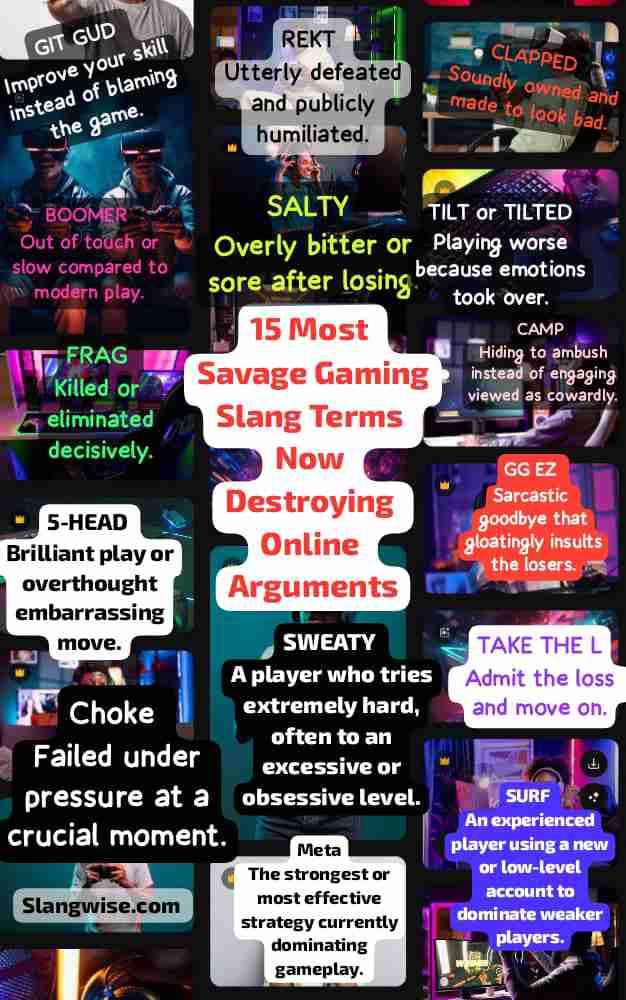
This phrase is a crisp, unsparing prompt to stop complaining and actually get better.
It started in Dark Souls circles as tough love and now works as a conversation closer, because it turns focus from excuses to skill.
When used well it can jolt someone into self reflection. When used carelessly it reads as smug and unhelpful.
In short: Improve your skill instead of blaming the game.
Example: “If you keep missing headshots, git gud.”
2. Rekt
Short for wrecked, rekt is the shorthand for total defeat, the kind that leaves no argument left standing.
Rekt conveys not only loss but humiliation, and is favored because it is fast and final.
People drop it to puncture an opponent’s pride after a clear beatdown.
In short: Utterly defeated and publicly humiliated.
Example: “Dude got rekt in that 1v1.”
3. Clapped
Clapped means being soundly beaten or exposed, often with an extra layer of ridicule. It migrated from UK slang and now signals that someone was not only defeated but embarrassed.
Using clapped lets the speaker seem current and sharp.
In short: Soundly owned and made to look bad.
Example: “Their squad got clapped in the qualifiers.”
4. EZ Kudos or ez clap
A mocking thank you for an easy win, ez clap packages arrogance and dismissiveness into two words.
It implies the opponent contributed nothing of value, which is why it quickly escalates tempers.
It works as a flex when you want to rub salt in the wound.
In short: That win was effortless, you added no challenge.
Example: “No sweat, ez clap.”
Ready to level up your vocab? Dive into the full list of the 50 most popular gaming slangs and unlock the phrases every real gamer is using right now. Click to dominate.
5. Salty
Calling someone salty frames them as bitter or sore after a loss. It undercuts complaints by turning them into an emotional reaction rather than valid criticism.
It is useful when you want to dismiss anger without getting into technical debate.
In short: Overly bitter or sore after losing.
Example: “Stop being so salty about the lag.”
6. Tilt or Tilted
Tilt describes the state of playing worse because emotions took over.
The term comes from pinball and now acts as a diagnosis: you are playing poorly because you let frustration control you.
Spotting tilt can defuse blame and help refocus teammates.
In short: Playing worse because emotions took over.
Example: “You are tilted, take a breath and reset.”
READ ALSO: POG is yet another interesting gaming slang. What does pog mean? You might be surprised.
7. Boomer
Used to call someone out as out of touch or stuck in old ways, boomer trades on the cultural shorthand for generational cluelessness.
In matches it is shorthand for outdated tactics or slow reactions, and it usually shifts the fight from skill to attitude.
In short: Out of touch or slow compared to modern play.
Example: “Stop pinging like a boomer.”
8. OP, Overpowered
OP labels a weapon or strategy as unfairly strong. It shifts blame from player to design, accusing the other side of exploiting something broken.
In debates about balance, calling something OP is the first move toward a community-wide gripe.
In short: Too strong or unfairly powerful.
Example: “That new champ is OP, nerf please.”
9. Frag
Frag still carries the punch of literal elimination. In shooters it means a kill, in trash talk it reads like a taunt describing how easily you took someone out.
Frag is vivid, action oriented, and never polite.
In short: Killed or eliminated decisively.
Example: “I fragged you twice while you camped.”
Think you know what “noob” really means? Click here to uncover the truth behind the term; and why every Roblox player should read this. Don’t stay clueless.
10. Camp
To camp is to hide and ambush instead of engaging. Calling someone a camper questions their courage and creativity.
In many communities camping is seen as cheap play, so labeling it highlights poor sportsmanship.
In short: Hiding to ambush instead of engaging, seen as cowardly.
Example: “Stop camping the spawn and play the objective.”
11. GG EZ
A faux sportsmanlike farewell that actually humiliates, GG EZ mixes politeness with contempt.
It signals dominance while pretending to be gracious, and it reliably provokes because it adds insult to injury.
In short: Sarcastic goodbye that gloatingly insults the losers.
Example: “Thanks for free elo, gg ez.”
12. Noob or n00b
Noob reduces someone to their skill level or experience and is one of gaming’s oldest insults.
It is blunt and dismissive, used to shut down criticism by painting the critic as unskilled.
Because it is so old, it can feel like lazy trash talk unless paired with specifics.
In short: Inexperienced or unskilled player.
Example: “Quit complaining, you play like a noob.”
13. 5-Head
5-head is a cheeky way to praise clever play or mock excessive overthinking. It rose as a playful take on intelligence, and its tone depends on context.
Used positively it highlights genius, used negatively it calls someone out for trying too hard.
In short: Either a brilliant play or embarrassingly overthought move.
Example: “Nice 5-head steal on the objective.”
14. Choke
Choke describes failing when it matters most, like missing a clutch opportunity. It implies that pressure, not skill, caused the failure.
Calling a play a choke is savage because it attacks composure and credibility at the worst possible moment.
In short: Failed under pressure at a crucial moment.
Example: “You had the ace and choked the final shot.”
15. Take the L
Take the L means accept the loss and move on. It is both a surrender and a taunt because telling someone to take the L forces them to own defeat.
The phrase is compact, final, and frequently used to close an argument with a shove.
In short: Admit the loss and move on.
Example: “You keep whining, just take the L.”
When to Use These Slang Phrase
Savage slang becomes most effective when timed correctly. Use “git gud” only after confirming genuine complain: otherwise it rings hollow.
Use “gg ez” post-victory to seal dominance, but beware of community norms that may penalize excessive trash talk.
In team settings, watch out for “salty” or “tilt” charges: call them sparingly to avoid causing real friction.
Cultural Ripples of Savage Slang
These slangs don’t just sting in-game; they spill into social media, forums, and live streams.
Content creators adopt them in video titles and thumbnails to signal edgy content, while brands occasionally harness them for viral marketing.
The very ubiquity of terms like “rekt” and “ez clap” underscores how gaming language shapes broader internet culture; driving memes, merch, and even mainstream headlines.
Conclusion
Mastering these 15 savage gaming slangs grants players more than mere vocabulary: it arms them with strategic tools for online dominance.
From the cutting sarcasm of ez variants to the psychological diagnosis in tilt, each phrase represents a calculated move in the ongoing war of words.
Use them wisely, respect community etiquette, and never underestimate the power of a perfectly timed verbal frag.