
Every now and then, a word shows up online so often that it starts to feel impossible to ignore. Shook is one of those words.
You might see it in a comment under a viral video, in a group chat after a wild announcement, or in a meme reacting to a huge plot twist. And even though the word sounds simple, it carries a very specific vibe.
In slang, shook does not mean physically shaken. It means deeply surprised, stunned, shocked, or emotionally thrown off.
Sometimes it is used for fear, sometimes for admiration, and sometimes for that exact moment when your brain needs a second to process what just happened.
In this post, we are breaking down what shook means, where it came from, how people use it now, what it can mean in different situations, and how you can use it naturally without sounding forced.
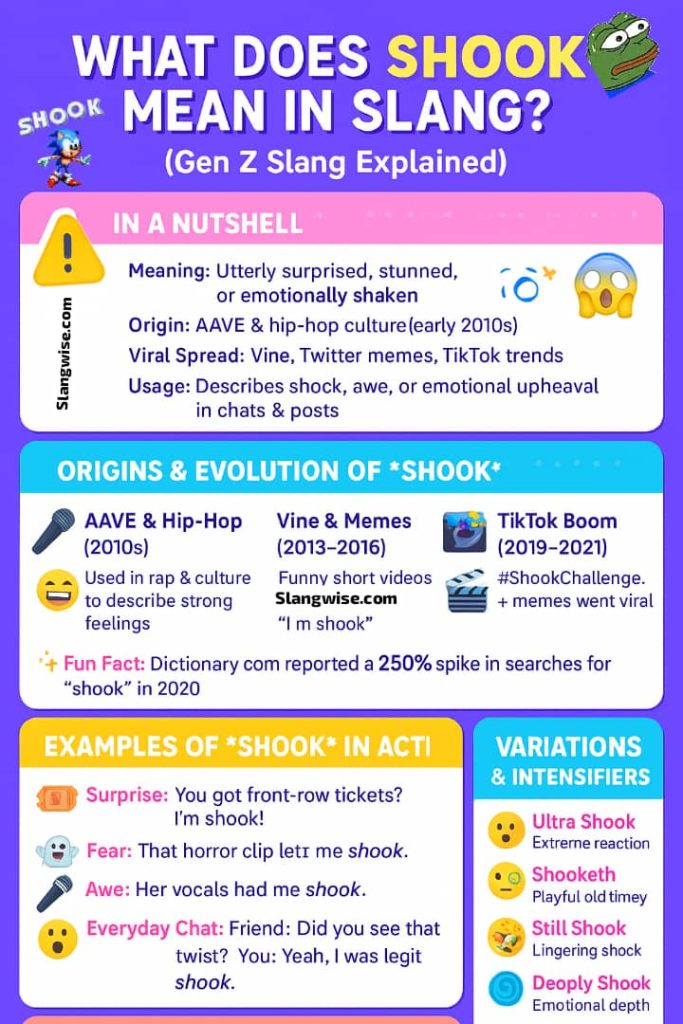
Table of Contents
Shook meaning in a Nutshell
- Shook means strongly surprised or emotionally stunned. It is a casual slang word used for big reactions.
- It can show surprise, fear, awe, or disbelief. The feeling depends on the moment.
- The word became popular online. Social media helped push it into everyday speech.
- It is informal slang. It works best in chats, captions, comments, and casual conversation.
- It has a few related forms. People may say shook, shook up, shooketh, or still shook.
Slangwise Tip: Use shook when the reaction is really big. If the moment is only mildly surprising, a simpler word like surprised may fit better.
Read Also: 7 most Controversial Slang Words in Sports Right Now and why leagues want them banned.
What Does Shook Really Mean in Slang?
When someone says they are shook, they mean something hit them hard emotionally. That reaction could come from a shocking update, a scary scene, a wild twist, or even something so impressive that it leaves them speechless for a moment.
Think of it as the kind of reaction that makes you pause and say, “Wait, what just happened?” That is the energy behind shook.
- Surprise: “You got the last seat? I am shook.”
- Fear or tension: “That ending was so creepy, I am still shook.”
- Awe or admiration: “Her performance left me shook.”
- Disbelief: “They really announced that today? I am shook.”
It is close to shocked, but not exactly the same. Shocked feels more formal and direct. Shook feels more emotional, more casual, and a little more internet native.
Where Did Shook Come From?
The exact path of slang is not always neat, because words move through communities, music, jokes, and social media at the same time. Still, shook is widely tied to AAVE and hip hop speech patterns, where it was used to describe being emotionally affected or thrown off by something.
From there, the word spread online. Once internet users picked it up, it became a fast reaction word for tweets, memes, reaction videos, comment sections, and captions. It fit perfectly into digital culture because it is short, expressive, and easy to understand.
What made shook especially popular is that it works instantly. You do not need a long explanation. One word can carry a whole reaction, and that is exactly the kind of shortcut people love online.
How People Use Shook Today
Today, shook is usually used in informal writing and speech. You will hear it in group chats, see it in comment sections, and spot it in posts where someone is reacting to something dramatic, funny, scary, or unbelievable.
1. In text messages
Friend: “You actually met your favorite artist?”
You: “Yes, and I am still shook.”
2. In social media captions
“I was not ready for that plot twist. Absolutely shook.”
“This outfit? Shook. No further questions.”
3. In comments and replies
“The way this turned out has me shook.”
“I was not expecting that at all, we are all shook.”
4. In spoken conversation
You: “Did you hear what happened in the finale?”
Friend: “Yes, I was completely shook.”
READ ALSO: What Does Cheugy Mean? (Millennial vs. Gen Z Slang Explained)
Other Meanings and Related Forms
Shook is mostly used as slang now, but it can still connect to the normal verb shake. That means if you see someone say I shook the bottle, that is just the regular past tense, not slang.
As slang, though, shook has a few popular variations and related expressions:
- Shook up: This can mean emotionally disturbed, unsettled, or badly affected.
- Still shook: Used when the reaction has not worn off yet.
- Shooketh: A playful, extra dramatic version used online for humor.
- Deeply shook: A stronger version that shows a bigger reaction.
- Ultra shook: A dramatic way to show extreme surprise.
These forms are all casual, and some are more playful than serious. Shooketh, for example, is often used for fun exaggeration, not everyday conversation.
When Should You Use It?
Use shook when you want to sound natural in a casual setting and the reaction is strong enough to deserve it. It works best when you are responding to something that feels big, unexpected, or hard to believe.
For example, it fits well when someone:
- gets surprising news
- sees a shocking video
- watches a crazy finale
- hears about a huge win or loss
- reacts to something impressive or unbelievable
It does not fit as well in formal writing, work emails, academic essays, or professional reports. In those places, a clearer word like surprised, stunned, or shocked is usually better.
Why Shook Became So Popular Online
One reason shook spread so fast is that it feels very visual. Even before someone explains what happened, the word itself already suggests a strong emotional reaction. That is why it works so well with reaction faces, memes, and captions.
It also fits internet language because it is short, expressive, and flexible. Online users love words that can carry a lot of feeling without taking up too much space. Shook does exactly that.
Slangwise Thought: In my view, shook is one of those internet words that lasted because it is useful, not just trendy. It says a lot with very little, and that is always a winning formula in online slang.
Quick tip: You can pair shook with emojis like 😱, 😳, or 😵💫 when you want to make the reaction even more obvious in a chat or caption.
Examples of Shook in Real Life
- “I was shook when I saw the price.”
- “That performance had everyone shook.”
- “The ending left me shook for hours.”
- “I am shook by how well that worked out.”
- “She walked in and the whole room was shook.”
Notice how the word keeps the sentence feeling energetic and dramatic. That is a big part of its charm.
LEARN MORE: Still shook by how much slang changes? Do not stop here, check out my full guide: 200 Most Popular Internet Slang Terms of 2026 and keep building your slang vocabulary. 🚀📱
Final Thought
Shook is one of those slang words that perfectly captures a big emotional reaction in just one small package. It can show surprise, fear, awe, or total disbelief, and that flexibility is part of why people still use it so much.
From its roots in everyday speech and music culture to its place in memes, captions, and viral comments, shook has earned its spot as a go to reaction word. So the next time something catches you off guard, you already know the word to reach for.
Just say it plainly: I am shook.
Frequently Asked Questions
No. It can mean surprise, fear, disbelief, awe, or being emotionally thrown off by something.
No. It is casual slang, so it works best in texts, posts, captions, and everyday conversation.
Shocked is the more standard word. Shook sounds more informal, more emotional, and more common in online slang.
Shooketh is a playful, dramatic version of shook. People often use it for humor or exaggeration online.
Usually no. It is better for casual settings, while professional writing is usually clearer with words like surprised or stunned.