
Some words do not just describe love, they carry a whole emotional atmosphere.
That is exactly why certain millennial love terms still work even now. They are playful, a little nostalgic, sometimes a little cheesy, and somehow still very sincere when used with the right person at the right moment.
They remind people of text messages, early social media captions, song lyrics, group chat jokes, and that specific era when romance online started feeling more casual, more expressive, and a lot more fun.
These phrases endure because they do more than label a relationship. They signal warmth. They suggest familiarity. They carry memory. And in a world where love can sometimes feel over edited or over explained, that kind of language still feels refreshing.
So let us look at 9 distinctly millennial slang terms for love that still hit different, meaning they still carry genuine warmth, nostalgia, or emotional weight years later.
In a Nutshell
At a glance:
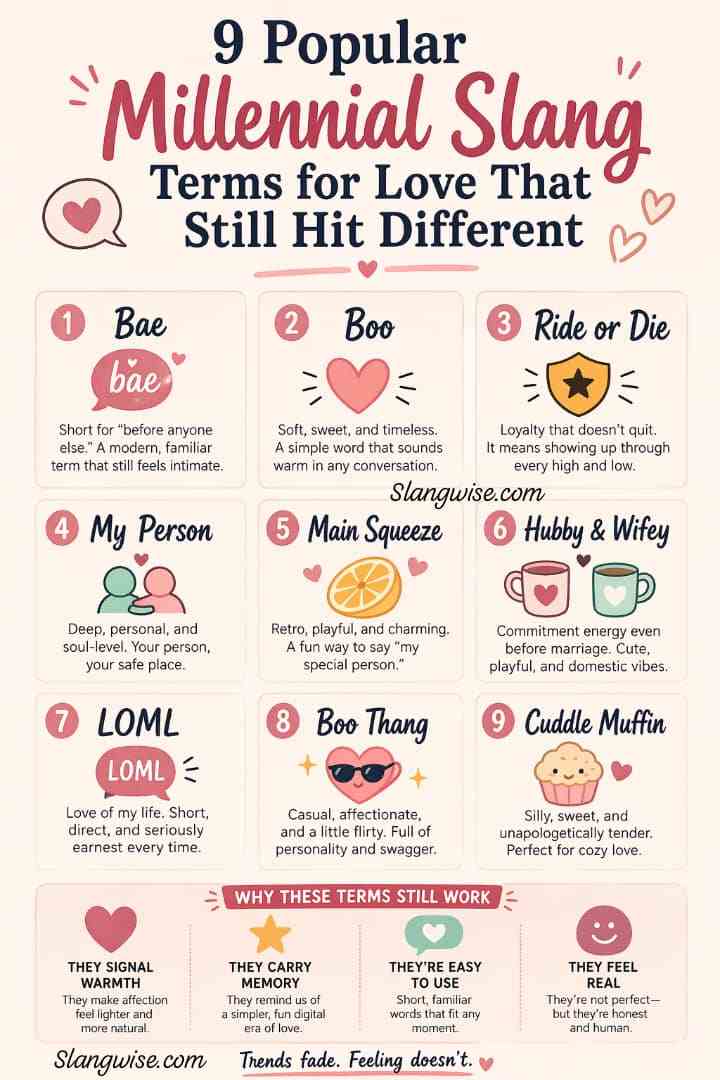
- Bae still feels intimate when used sincerely.
- Boo is soft, playful, and timeless.
- Ride or die means loyalty that does not quit.
- My person feels soul deep and deeply personal.
- Main squeeze has retro charm that still lands.
- Hubby and wifey signal commitment even before marriage.
- LOML feels especially earnest because it is so direct.
- Boo thang is casual, affectionate, and a little flirty.
- Cuddle muffin is silly, sweet, and oddly unforgettable.
Why These Love Terms Still Work
Millennials came of age in a very specific language moment. Texting was becoming normal. Social media was making public affection more visible. Nicknames started moving from private conversations into bios, captions, tweets, and status updates.
As far as I am concerned, that shift is a big part of why these expressions lasted. They were personal enough to feel real, but flexible enough to survive the internet.
The best millennial love slang usually has three things going for it: It sounds warm. It is easy to understand. It does not try too hard to be perfect.
That last part matters. A phrase like bae or boo does not need a long explanation to feel affectionate. It just works. And even the more playful ones, like cuddle muffin, still communicate something sincere underneath the joke.
1. Bae
Few millennial terms became as famous as bae.
Originally popularized as shorthand for “before anyone else,” bae became a go to term of endearment for a romantic partner, or at least someone treated like one. It got overused, memed, mocked, and lovingly recycled all at once. But when somebody says it with genuine affection, it still lands.
Example:
- “I am picking up dinner for bae.”
- “That gift was so thoughtful, total bae behavior.”
- “Happy birthday to my bae, the one who always remembers the little things.”
What makes bae endure is that it sits right between cute and casual. It is short enough for a text, soft enough for a caption, and familiar enough that almost everyone recognizes it immediately. Even now, it still gives off a specific kind of intimacy.
If you use it sincerely, it feels personal. If you use it playfully, it feels current. That is a pretty strong combination for any slang term.
2. Boo
Boo is one of those words that never really leaves.
It has a long history, but millennials gave it a fresh modern life as a sweet, affectionate nickname for a romantic partner. Compared with some other terms, boo feels softer and more relaxed. It is the kind of word that sounds natural in a text message, a voice note, or a quiet little compliment in conversation.
Example:
- “My boo is picking me up after work.”
- “We are just a couple of boos trying to survive the week.”
- “That is my boo, and I adore them.”
What makes boo hit different is how effortlessly it can sound both playful and sincere. It is not trying to be fancy. It is not trying to be dramatic. It just feels warm. That simplicity is part of the charm.
And honestly, some nicknames age well because they are not tied to a trend so much as a feeling. Boo is one of those.
BOOKMARK: 15 Popular Millennial Slangs for Money That Still Pop Up Everywhere
3. Ride or Die
Now we are moving from cute to deeply loyal.
Ride or die is not just about romance. It is about loyalty, trust, and the sense that somebody is with you through good times and messy times alike. It can absolutely describe a romantic partner, but it can also describe a best friend, a chosen family member, or anyone who shows up consistently.
Example:
- “That is my ride or die, always has been.”
- “You need a ride or die, not just a good time.”
- “They stayed through everything, real ride or die energy.”
This phrase hits different because it carries weight. It is not just about affection. It is about commitment that has been tested. It feels bigger than a nickname and deeper than a casual compliment.
That is why people still use it. It gives language to a kind of love that is proven, not just professed.
4. My Person
This one has a soft place in a lot of hearts.
My person became widely associated with Grey’s Anatomy, but it spread far beyond the show because it describes something many people instantly understand. It is not just “my partner” or “my best friend.” It is the person who feels like home, comfort, and belonging all at once.
Example:
- “That is my person, no question.”
- “I knew from day one that she was my person.”
- “You do not just love your person, you trust them with the quiet parts too.”
What makes my person hit different is that it is not limited to romance. It can describe a deep friendship, a soulmate style bond, or a relationship that blends love and safety in a very human way.
It feels emotionally grounded. It feels less like a performance and more like recognition. That is why people still reach for it when they want to say something meaningful without sounding overly formal.
70 Most Popular Millennial Slang Words and What They Really Mean (From Adulting to YOLO)
5. Main Squeeze
Main squeeze has a retro flavor that millennials seem to enjoy a lot.
The phrase feels charming in a slightly old fashioned way, but not so old fashioned that it feels stiff. It is affectionate, playful, and just a little bit cheeky. It says, “This is my special person,” without sounding overly intense.
Example:
- “I am taking my main squeeze to dinner tonight.”
- “That is my main squeeze, and I am very proud of them.”
- “Found my main squeeze, and the rest is history.”
The appeal of main squeeze is partly in the sound of it. It is easy to say, fun to say, and memorable. It has a kind of cozy confidence to it. It does not scream for attention. It just smiles and stays in the conversation.
If a phrase could wear a vintage jacket and still look good on Instagram, this would be it.
6. Hubby and Wifey
These two terms have had a long run because they communicate something people enjoy saying out loud: this person feels like permanent partnership energy.
Hubby and wifey are often used before marriage, which is part of what makes them feel playful and emotionally loaded at the same time. They can suggest long term commitment, domestic comfort, shared routines, and a sense of claiming each other with affection.
Example:
- “My hubby is cooking tonight.”
- “She is my wifey, whether the papers say it or not.”
- “We are in full hubby and wifey mode.”
What makes these terms still work is that they are not trying to be subtle. They openly signal closeness. They also carry a little domestic fantasy, which many people find sweet rather than cheesy.
Used sincerely, they can feel very warm. Used jokingly, they can feel like a fun relationship inside joke. Either way, they still make hearts flutter for the right audience.
READ ALSO: Millennial vs Gen Z Slang in 2026: Why One Sounds Nostalgic and the Other Sounds Wildly New
7. LOML
LOML stands for love of my life, and somehow the abbreviation often feels even more earnest than writing the full phrase.
That might seem strange at first, but it makes sense. Acronyms can create a kind of emotional shorthand that feels intimate and efficient, especially in texts, captions, or posts where people want to say a lot with just a little.
Example:
- “Happy anniversary to the LOML.”
- “You are my LOML, end of story.”
- “Found the LOML and I am never pretending otherwise.”
What makes LOML hit different is its directness. There is no wiggle room. No ambiguity. It says exactly what it means. And because the phrase is so loaded with feeling, the short form can almost make it feel more intense, not less.
It is the kind of term people use when they are not being casual at all. They are making a statement.
8. Boo Thang
Boo thang is where affection meets swagger.
This phrase feels more playful and a little more street than some of the others. It has a relaxed, familiar energy that makes it sound both affectionate and slightly flirty. When a millennial says it, you usually know the relationship is real enough to joke about, but still private enough to feel claimed.
Example:
- “I am going out with my boo thang tonight.”
- “That is my boo thang, do not act surprised.”
- “He might be acting casual, but he is definitely boo thang material.”
The reason this phrase still hits is that it has personality. It is not polished in a corporate, generic way. It has rhythm. It has flavor. It sounds like somebody who knows exactly what they mean and wants to say it with style.
There is also something fun about the slight informality. It keeps the affection from feeling too stiff.
9. Cuddle Muffin
This one is a little silly, and that is exactly why it still works.
Cuddle muffin is a warm, goofy, unmistakably affectionate nickname. It is the kind of phrase that can make people laugh and melt at the same time. It is not cool in the sleek, minimalist sense. It is lovable in the very specific way millennials embraced when they were not afraid of a little sweetness.
Example:
- “Good morning to my cuddle muffin.”
- “You cannot tell me that is not cuddle muffin behavior.”
- “My cuddle muffin is staying in tonight with snacks and a blanket.”
What makes cuddle muffin hit different is that it is unapologetically tender. It does not pretend to be cool. It just is cute. And sometimes cute is exactly the point.
A phrase like this works best when the relationship has enough comfort and playfulness for both people to laugh with it rather than at it. That is the sweet spot.
FIND OUT: Millennial Pause Meaning: Why That Tiny Video Delay Became a Viral Nostalgia Trend
Why Millennials Keep These Terms Alive
There is a reason these words have not disappeared.
Millennial slang for love tends to balance sincerity and irony in a way that feels very culturally specific. Millennials often grew up in the middle of a big shift between private romance and public digital expression. That meant their love language had to work in real life and online, in texts and captions, in jokes and serious moments.
These terms survived because they do at least one of two things very well: They make affection feel lighter. They make affection feel deeper.
That is a powerful combination.
A phrase like boo softens the moment. A phrase like ride or die deepens it. A phrase like my person turns love into belonging. A phrase like LOML compresses a huge feeling into four characters and still manages to feel sincere.
In my view, that is why these expressions still hit different. They are not perfect, but they are emotionally useful.
How to Use These Terms Today
The best way to use millennial love slang in the present day is to let it sound natural, not forced.
Use bae when you want a modern, familiar term that still feels sweet. Use boo when you want something softer and more timeless. Use ride or die when you want to emphasize loyalty, not just romance. Use my person when the bond feels deeper than a label. Use main squeeze when you want retro charm with affection. Use hubby or wifey when the vibe is long term and playful. Use LOML when you want the feeling to come through instantly. Use boo thang when you want casual affection with a little attitude. Use cuddle muffin when the mood is goofy, tender, and unserious in the best way.
The key is matching the word to the relationship and the tone. That is what keeps these terms from feeling corny. When they are used honestly, they can still feel very alive.
READ ALSO: Millennial Slang vs Gen Alpha Slang in 2026: 45 Words That Show How Internet Language Changed
Tiny Conversation Starters You Can Steal
If you are trying to use these words without sounding awkward, here are a few easy styles you can borrow.
- “I swear, my person just gets me.”
- “That is my boo, and I am not explaining further.”
- “Please, this is giving full ride or die energy.”
- “You are acting very main squeeze right now.”
- “Happy birthday to the LOML, always.”
- “My hubby has been winning at life lately.”
- “That is my cuddle muffin, do not speak on them.”
Simple. Warm. Clear. No extra effort needed.
Conclusion
Millennial slang for love still hits different because it captures something real. These phrases are cute without being empty, nostalgic without being stuck in the past, and affectionate without needing to sound overly polished.
Whether it is bae, boo, ride or die, my person, main squeeze, hubby, wifey, LOML, boo thang, or cuddle muffin, each one carries a slightly different flavor of love. Some are playful. Some are deeply loyal. Some are soft and private. Some are downright goofy. But they all point to the same thing, that feeling of being seen, chosen, and emotionally held in a way that words can still manage to capture.
And honestly, that is probably why they last. Trends fade. Feeling does not.
Frequently Asked Questions
Bae is an affectionate term for a romantic partner or someone very special. It is often explained as short for “before anyone else.”
Yes. Boo is still used as a soft, affectionate nickname for a romantic partner or close loved one.
It means someone is deeply loyal and supportive through good times and bad. It can describe a partner or a close friend.
My person usually suggests a deeper emotional bond, often combining friendship, trust, and love. Bae is more of a direct affectionate nickname.
Not if the relationship fits the tone. It is playful and sweet, so it works best when both people enjoy a goofy, affectionate style.
Table of Contents