
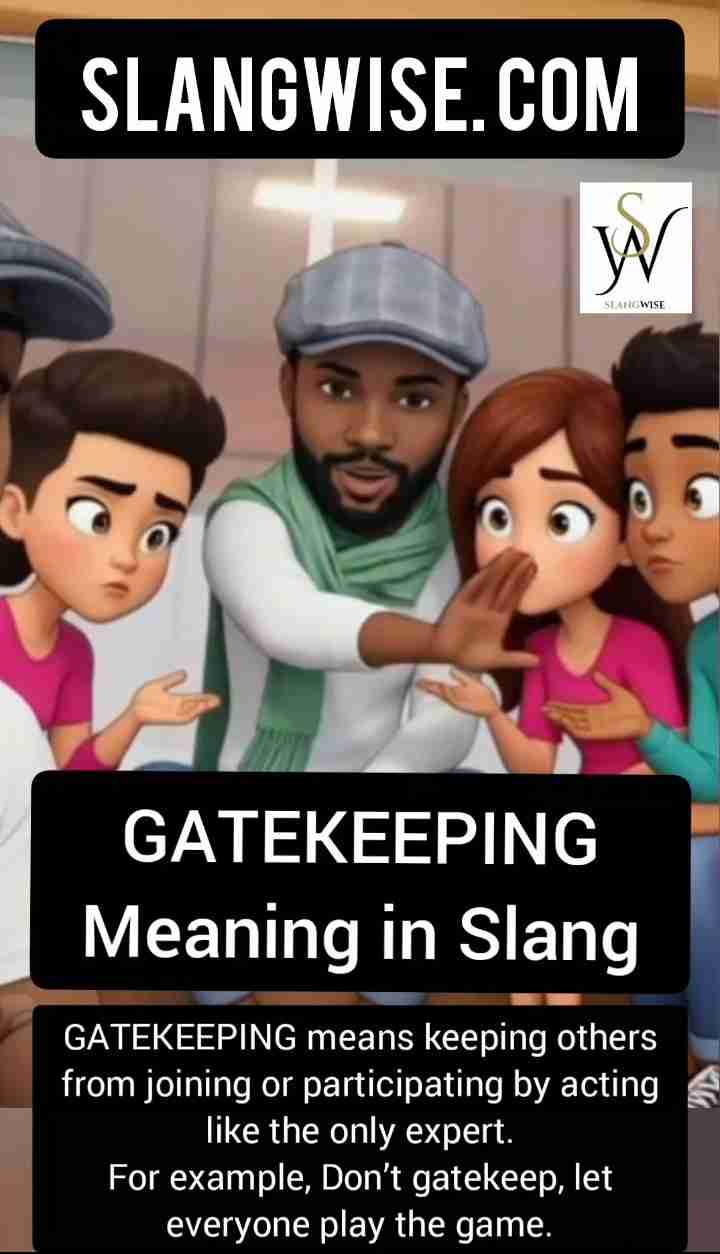
Some words sound simple until you notice how often people use them to call out a whole attitude. Gatekeeping is one of those words.
In simple terms, gatekeeping means trying to control who gets access to something. That something could be information, a community, an opportunity, a hobby, a trend, or even a certain kind of taste. In slang, it usually has a negative vibe because it suggests someone is acting like they get to decide who belongs and who does not.
Online, people use it when someone refuses to share helpful information, acts like only a select few are allowed to enjoy something, or decides who counts as a “real” fan, “real” expert, or “real” member of a group. That is why the word shows up so often in fandoms, fashion spaces, gaming, and social media arguments.
So today, let us break it down properly. What does gatekeeping mean in slang? Why do people use it so much online? And how do you tell the difference between gatekeeping and simple privacy?
Table of Contents
In a Nutshell
- Gatekeeping means controlling who gets access to something.
- In slang, it usually has a negative meaning because it can feel exclusive or unfair.
- People use it when someone acts like only certain people belong in a space.
- It can show up in fandoms, fashion, gaming, and online communities.
What Gatekeeping Really Means
The clearest way to understand gatekeeping is this: one person tries to control access to something that others want. Dictionaries describe it as restricting access to information, knowledge, resources, power, or opportunities. In slang, that same idea becomes more social and emotional. It can mean, “Why are you acting like only you deserve this?” or “Why are you making this harder for everyone else?”
In my view, the slang version feels stronger because it is not just about control. It is also about attitude. A person might gatekeep by being smug, secretive, dismissive, or overly protective of something they think makes them special. That is why the word often sounds like criticism, even when the behavior looks small on the surface.
READ ALSO: Drag Me Explained: The Sassy Slang Phrase Everyone Uses Without Realizing What It Really Means
How People Use Gatekeeping Online
On social media, gatekeeping often shows up when people refuse to share where they bought something, how they learned a skill, or what tool they used to get a result. Sometimes it is harmless and playful, like keeping a favorite product secret so it does not sell out. Other times it is more annoying, especially when the person is pretending to protect a community while really just trying to feel superior.
You also see gatekeeping in fandoms. For example, someone may insist that a new fan is not “real” enough because they joined late, do not know enough trivia, or like one popular song instead of the deep cuts. That kind of behavior is exactly what people mean when they say someone is gatekeeping a hobby, a culture, or an identity.
Fashion is another place where the word pops up constantly. Some style spaces become so focused on taste and insider knowledge that people start acting like there is a hidden membership rule. That is one reason the term gets used so much in conversations about trends, aesthetics, and online communities.
A Few Simple Examples
Here are some easy examples of gatekeeping in slang.
Someone says, “You are not a real fan unless you have followed this artist since day one.” That is gatekeeping because they are setting a private rule for who belongs.
Someone refuses to tell people where they got a skincare product because they want to keep it “exclusive.” That can also be gatekeeping, especially if the real goal is to keep others out or keep the item feeling elite.
Someone tells beginners they do not belong in a hobby because they are not skilled enough yet. That is gatekeeping too, because they are using knowledge or experience as a barrier instead of helping people learn.
Someone acts like only a certain type of person can enjoy a song, a show, or a style. That is probably the clearest slang use of all, because it turns taste into a test.
If you like tracking how internet language shifts across different trends, you may also like 68 Most Popular TikTok Slang Words of 2026.
Why People Gatekeep
People gatekeep for different reasons, and not all of them are obvious. Some do it to feel important. Some do it because they are afraid that if too many people join in, the thing they love will lose its special feeling. Some do it because they want power in a group, and controlling access gives them that power.
There is also a cultural side to it. In some online spaces, people treat gatekeeping as a way to protect taste, identity, or exclusivity. That is why the term can describe both a problem and, in certain contexts, a deliberate strategy. The meaning depends a lot on intent.
That is why the word can sound judgmental in one conversation and almost trendy in another. The difference usually comes down to whether someone is simply keeping something private or actively blocking other people from joining in.
Gatekeeping Versus Privacy
This is where people often get confused. Not sharing something is not always gatekeeping. Privacy is simply choosing not to disclose personal or useful information. Gatekeeping is more about controlling access in a way that affects other people, especially when it creates a barrier or a sense of exclusion.
That difference matters. A person can keep a private detail private without being gatekeeping. But if they are actively making others feel unworthy, unwelcome, or excluded from something that is meant to be shared, the word fits much better.
READ MORE: Debuff Meaning in Slang: Why Gamers Use It, What It Really Means, and How to Use It Naturally
How to Respond When Someone Is Gatekeeping
The smartest response is usually calm confidence. You do not need to prove yourself to someone who is inventing rules on the spot. Sometimes the best move is to ignore the attitude, learn from someone more generous, and keep moving. A gatekeeper often wants a reaction, so not feeding the performance can take the fun out of it.
If the situation matters, a simple question can work: “Why does that have to be limited to a certain group?” or “What makes that person less qualified?” That kind of question exposes the gatekeeping without turning the moment into a big argument. It shifts the spotlight from status to logic.
The Bigger Takeaway
Gatekeeping in slang is really about exclusion. Sometimes it is subtle, like withholding useful information. Sometimes it is loud, like telling people they do not belong. And sometimes it is wrapped in style, fandom, or insider culture, which makes it look cooler than it really is. But once you spot the pattern, the meaning is pretty easy to recognize.
The best way to remember it is this: if someone is acting like they control who gets to join, know, enjoy, or qualify for something, they are probably gatekeeping. That is the slang meaning in plain English, and it is one of those words people use when they want to call out unnecessary exclusivity.
Gatekeeping may sound like a small internet word, but it points to a bigger issue we all understand pretty quickly, who gets included, who gets ignored, and who gets to decide.
SEE ALSO: Engagement Farming Explained: The Sneaky Social Media Trick That Makes Posts Blow Up
Frequently Asked Questions
Gatekeeping means trying to control who gets access to something, or acting like only certain people are allowed in.
Usually, yes. In slang, it often has a negative meaning because it can feel unfair, exclusive, or judgmental.
Privacy is choosing not to share personal information. Gatekeeping is actively controlling access or making others feel excluded.
People often use it in fandoms, fashion spaces, gaming, and online communities where belonging and taste matter a lot.