
Cuffing Season vs Cuffing Lite Meaning in Slang
The moment the temperature drops, the dating mood starts to shift. People text a little differently, plans get a little cozier, and the idea of having someone to talk to through the colder months suddenly feels a lot more appealing. That seasonal change is exactly what people mean when they talk about cuffing season.
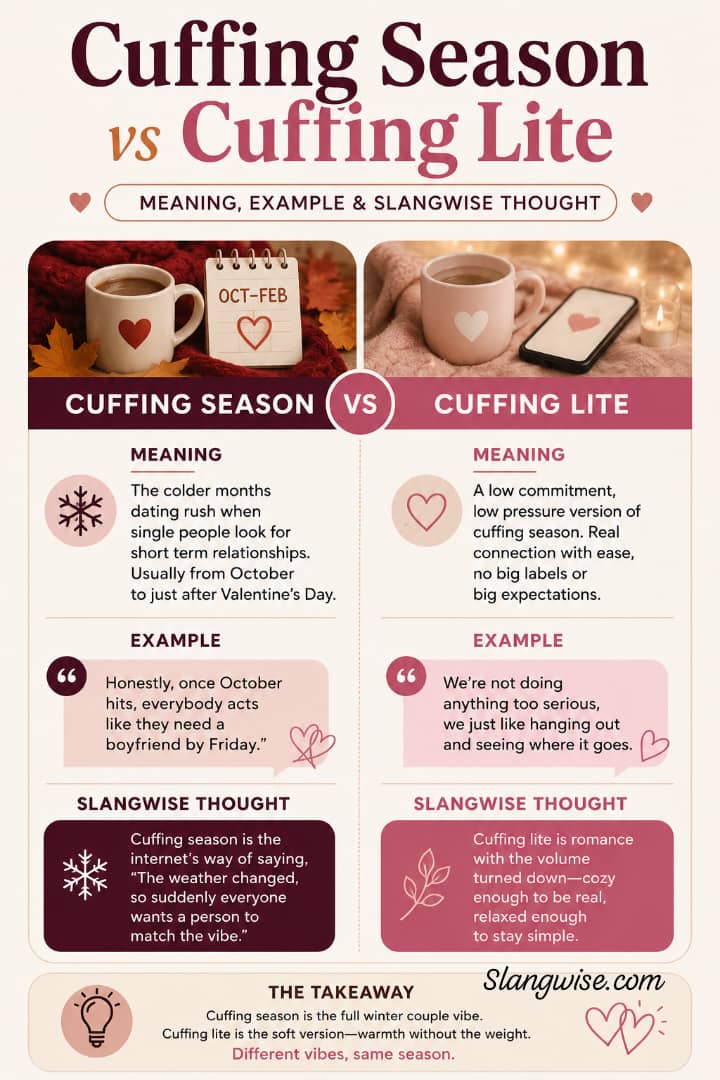
Cuffing season is the slang term for the time when single people start looking for short term partnerships during the colder months, usually from October through just after Valentine’s Day.
The word cuffing links back to the idea of being tied down or connected to someone, with roots in African American English and hip hop usage.
Cuffing lite is the softer, looser version of that same dating mood. In the sources I checked, it shows up more as an informal online phrase than a fixed dictionary entry, so in this post I am using it to mean a lower commitment, lower pressure version of cuffing season.
Think of it as dating with warmth, but without the full weight of big labels, big promises, or big expectations.
In a Nutshell
- Cuffing season is the colder months dating rush, when single people start looking for short term relationships.
- It usually shows up in fall and winter, and many descriptions place it from about October to just after Valentine’s Day.
- Cuffing lite is a gentler, less serious version of that idea, where the connection is real but the pressure is low.
- The biggest difference is intent: cuffing season often leans toward exclusivity, while cuffing lite leans toward ease, flexibility, and less emotional intensity.
READ ALSO: Double Tap Romance Meaning in Slang: The Tiny Instagram Habit That Can Feel Weirdly Personal
What Cuffing Season Really Means
Cuffing season is one of those slang phrases that makes immediate sense once you hear it in context. It refers to the stretch of the year when people start wanting a partner more than usual, especially when the weather gets cold and staying in begins to sound better than going out.
Merriam Webster describes it as the period when single people begin looking for short term partnerships to get through the colder months, and Dictionary.com similarly ties it to fall and winter, including the run from Thanksgiving to Valentine’s Day.
The nice thing about the phrase is that it is vivid without being complicated. The cuff part suggests being linked, tied, or locked in with someone, which is why the slang can feel a little playful and a little dramatic at the same time.
The term appeared in college newspapers in 2011 and later spread through hip hop and social media, which helped it move from niche slang into everyday conversation.
From my view, that is what makes cuffing season so relatable. It is not only about romance. It is also about comfort, company, and the very human urge to have someone beside you when the days get shorter and the mood gets quieter.
That is why the term sticks, even for people who are not necessarily trying to build a forever relationship.
Slangwise Thought
Cuffing season is basically the internet’s way of saying, “The weather changed, so suddenly everyone wants a person to match the vibe.” It sounds funny, but it captures a real seasonal shift in dating behavior.
What Cuffing Lite Really Means
Now let us talk about the newer, softer cousin of the phrase.
In this post, cuffing lite means a low commitment relationship season. It is not the full “we are locking this down for winter” energy of cuffing season. It is more like, “We are enjoying each other, we are spending time together, and we are not turning this into a whole life plan.”
It is a relationship mode with fewer labels, fewer expectations, and a lot more breathing room.
That is why cuffing lite feels different from classic cuffing season. Cuffing season tends to suggest a stronger push toward exclusivity, even if the relationship is still temporary. Cuffing lite, on the other hand, sounds like the version where people still want warmth, attention, and a little romance, but they also want space to keep things easy.
The phrase is not yet as standardized as cuffing season in the sources I found, which is why I treat it as emerging slang rather than a fully fixed dictionary term.
You could almost think of cuffing lite as the “no pressure” edition. Somebody might still want a favorite person for the season, but without the heavy relationship script.
That can mean casual dates, soft consistency, and a shared understanding that things are pleasant, but not necessarily permanent. That interpretation comes from how the phrase is being used informally online, not from a formal dictionary entry.
READ MORE: Big Anima Energy Meaning: The Niche Slang That Turns Softness Into Power
Slangwise Thought
Cuffing lite feels like the person who wants a relationship that is cozy enough to be real, but relaxed enough to stay simple. It is romance with the volume turned down.
Cuffing Season vs Cuffing Lite
The easiest way to separate the two is to look at the energy.
Cuffing season usually says, “I want somebody.” It is seasonal, emotional, and often a little more serious than casual dating. It can be driven by cold weather, holiday plans, and the desire not to spend the season alone.
Cuffing lite says, “I want company, but I also want ease.” It is the lower stakes version where people may like each other a lot, but they are not trying to force a big relationship timeline. In that sense, cuffing lite is less about locking in and more about flowing along.
That difference matters because not everyone wants the same kind of closeness. Some people want the full seasonal couple experience. Others want warmth without weight.
Neither one is automatically better, but they are definitely not the same thing. The key is knowing which lane you are in before somebody starts expecting a deeper commitment than the other person intended.
Why These Slang Terms Hit So Hard
Part of the reason cuffing season stays popular is that it describes a pattern many people recognize instantly. When the weather changes, routines change. People stay in more. Holidays bring family questions. Social energy drops a little. In that environment, wanting a partner can feel practical as much as romantic.
Cuffing lite connects for a similar reason. Not everyone wants a dramatic relationship arc. Some people want connection without pressure, affection without a full commitment story, and consistency without intensity.
That makes the phrase feel modern, especially in a dating culture where people often want clarity, but not always a traditional label.
In my opinion, both terms work because they give language to something very ordinary: people adjust their dating habits to match their season of life.
Sometimes that season is cold weather. Sometimes it is emotional bandwidth. Sometimes it is just a desire for comfort. Slang is at its best when it names a feeling everyone had, but nobody had phrased well yet.
SEE ALSO: 40 Most Popular Internet Catchphrases of 2026 (Updated)
Examples in Everyday Talk
Here is how cuffing season might sound in a real conversation:
“Honestly, once October hits, everybody acts like they need a boyfriend by Friday.”
That is cuffing season energy. It is the joke, the rush, and the sudden urge to pair up for winter.
Now here is cuffing lite:
“We are not doing anything too serious, we just like hanging out and seeing where it goes.”
That feels like cuffing lite. There is attention and connection, but the relationship is deliberately light.
Another way to think about it is this: cuffing season is often about choosing a person for the season, while cuffing lite is about choosing a vibe for the season. One leans more committed. The other leans more casual.
How to Tell Which One You Are In
This part is simple. Ask yourself what the relationship is actually trying to be.
If the connection feels exclusive, cozy, and future focused for the colder months, that is much closer to cuffing season. If the connection feels sweet, easy, and intentionally low pressure, that is much closer to cuffing lite.
The most useful question is not “What is this called?” The better question is “What did we both agree this is?” That is where a lot of confusion gets avoided. A cute slang term is fun, but clear expectations are even better.
DISCOVER: 68 Most Popular TikTok Slang Words of 2026 – Quick Meaning and Examples
Slangwise Thought
Cuffing season and cuffing lite are two sides of the same dating mood. One is the full winter couple fantasy. The other is the soft version, where people still want connection but refuse to overcomplicate it. Both are valid, as long as everybody understands the assignment.
The Real Takeaway
What makes these phrases so useful is that they are more than just trend words. They are shorthand for how people behave when the season changes and relationships start feeling a little more important, or a little more optional, depending on the person.
Cuffing season gives us the classic version of seasonal romance. Cuffing lite gives us the modern remix.
So whether you are someone who loves the idea of being paired up when it gets cold, or someone who prefers a light connection with no pressure attached, both slang terms help describe what is happening. And honestly, that is what makes slang fun. It does not just define words. It defines moods.
Conclusion
Cuffing season is the familiar colder months dating trend where people start looking for short term romantic partnerships, often for warmth, comfort, and company.
Cuffing lite is the lighter version, a low commitment relationship season that keeps the connection sweet without making it heavy. One is more exclusive. The other is more relaxed. Both reflect the same basic truth: people date differently when the weather, the calendar, and their emotional needs change.
READ ALSO: 72 Most Popular Gen Z Slang Words of 2026 – Rizz, Delulu, Skibidi etc., And What They Secretly Mean Online
Frequently Asked Questions
It is the period, usually in fall and winter, when single people start looking for short term partnerships or committed romantic connections to get through the colder months.
Many descriptions place it around October, and it often lasts until just after Valentine’s Day. Some sources describe it more broadly across fall and winter.
In this post, cuffing lite means a lower commitment version of cuffing season, where the relationship is casual, easy, and low pressure. It is an emerging informal phrase rather than a standard dictionary entry in the sources I checked.
Not exactly. Cuffing season usually implies a seasonal push toward pairing up, while a situationship is more about unclear boundaries and commitment.
Table of Contents