
Picture this. Someone sends a message in the group chat that sounds way too intense for the moment, and then another person replies, “I am about to crash out.” Now everybody pauses. Are they tired? Annoyed? Overwhelmed? Being dramatic for effect? That is exactly why this phrase gets people talking.
Crash out is one of those catchphrases that sounds simple at first, but the meaning shifts depending on the situation. Sometimes it sounds funny. Sometimes it sounds tense. Sometimes it sounds like a person has reached their limit and is no longer interested in being calm.
That flexibility is a big reason the phrase keeps showing up online and in everyday conversation. Merriam Webster’s slang entry defines it as becoming suddenly, uncontrollably angry or distressed, while Cambridge still lists older standard English uses such as falling asleep quickly or losing in a competition.
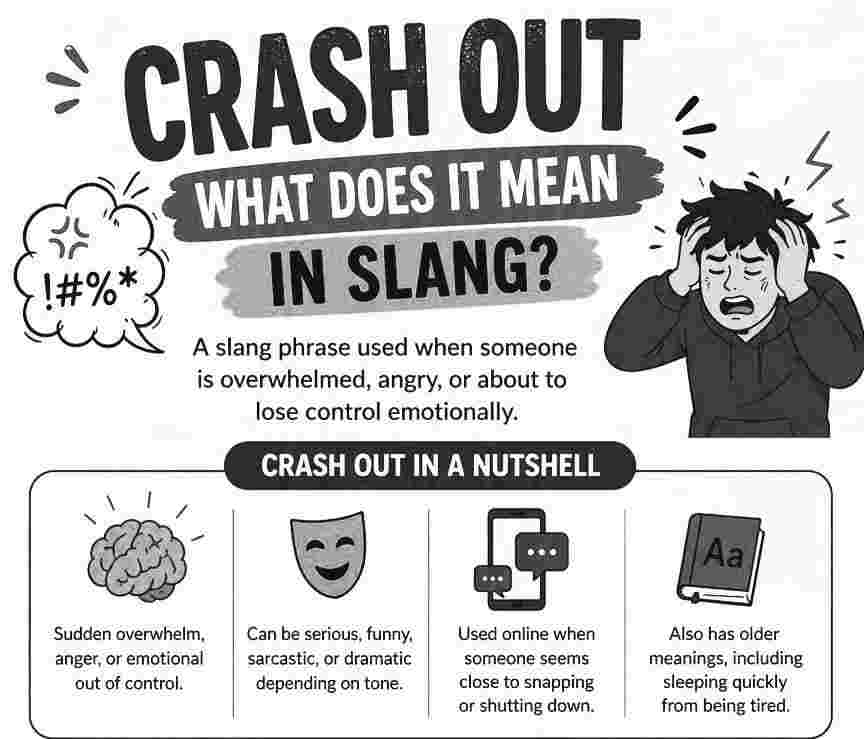
Crash out In a Nutshell
- In slang, it usually means someone is becoming suddenly overwhelmed, angry, or emotionally out of control.
- It can sound serious, funny, sarcastic, or dramatic, depending on the tone.
- Online, people use it when someone seems close to snapping, stressing out, or emotionally shutting down.
- The phrase also has older non slang meanings, including sleeping quickly because you are tired.
What Does Crash Out Mean in Slang?
In slang, crash out usually means to hit a sudden emotional limit. It is the kind of phrase people use when someone is so frustrated, stressed, or overwhelmed that they are about to react in a big way. Merriam Webster defines the slang sense as becoming suddenly, uncontrollably angry or distressed.
Think of it like this: the person is not just annoyed. They are not simply having a bad mood. They are at the point where their emotions are spilling over. That might look like yelling, venting, shutting down, or doing something impulsive.
Recent explainers describe it as a way to talk about sudden emotional overload or a breakdown in self control.
Examples:
- “I am trying not to crash out over this assignment.”
- “He crashed out when he saw the message.”
- “She said one more thing and I almost crashed out.”
That is the heart of the phrase. It is about a person reaching the edge of what they can handle.
DISCOVER: Pop Off Meaning: Why This Slang Sounds Like Praise, Drama, and Confidence at the Same Time
Slangwise Thought
One thing that makes crash out so useful is that it sounds casual, even when it is describing something serious. People like slang that helps them name a feeling quickly, especially when normal words feel too soft or too formal.
That is part of why the phrase keeps spreading through social media, where people often want language that sounds immediate and real.
Where Did Crash Out Come From?
The phrase did not appear out of nowhere. It has older roots, and sources note that the current slang sense gained wider attention much more recently.
Merriam Webster says the slang use has earlier evidence, and that some online sources credit a 2017 NBA YoungBoy lyric with helping popularize it. Other recent coverage says the phrase has become especially common in Gen Z and social media spaces, especially on TikTok.
That part matters because slang often spreads when a phrase feels like it perfectly captures a mood people already recognize. In this case, crash out gives people a quick way to describe emotional overload without using a long explanation.
Why People Use Crash Out So Much Online
Social media loves phrases that are dramatic, flexible, and easy to reuse. Crash out checks all three boxes.
It can describe a tiny moment of frustration, like when someone is annoyed by a bad text, or it can describe a bigger emotional reaction. That range is part of why the phrase travels so well online. Recent articles describe it as shorthand for outbursts, emotional strain, burnout, or sudden loss of composure.
People also use it because it sounds relatable. A sentence like “I am about to crash out” feels more vivid than saying “I am very stressed right now.” It is shorter, punchier, and a little more expressive, which is exactly the kind of language that tends to stick in comments, captions, and DMs.
READ MORE: Admin Night Meaning: Why Everyone Is Suddenly Talking About This Quiet Productivity Trend
Different Ways People Use Crash Out
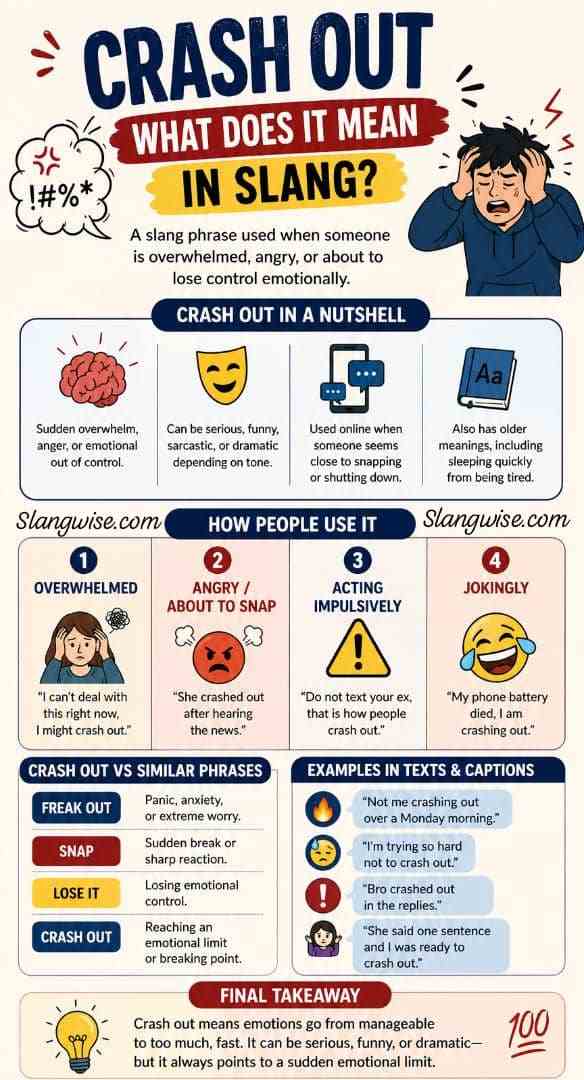
1. When someone is overwhelmed
This is probably the most common slang use. The phrase suggests a person has taken in too much and is close to an emotional tipping point.
Examples:
- “After that call, I was ready to crash out.”
- “He has been under so much pressure, he is about to crash out.”
- “I cannot deal with this right now, I might crash out.”
2. When someone is angry or about to snap
Sometimes crash out means a sudden burst of anger or frustration. Merriam Webster’s slang entry specifically includes anger and distress in the definition, and recent coverage repeatedly links the phrase to emotional outbursts.
Examples:
- “She crashed out after hearing the news.”
- “Why is he crashing out over one small mistake?”
- “They really crashed out in the comments.”
3. When someone is acting impulsively
The phrase can also point to a person making a sudden emotional move without thinking it through. Some recent explainers describe crashing out as a kind of emotional shutdown or dysregulated reaction that can lead to poor decisions.
Examples:
- “Do not text your ex, that is how people crash out.”
- “He crashed out and quit the whole plan.”
- “She was so frustrated she almost crashed out and walked away.”
4. When people use it jokingly
Online, the phrase is often used in a playful way. Someone might say they are “crashing out” because of a small annoyance, even if they are not truly in crisis. That casual use is part of what made it so popular in internet language.
Examples:
- “My phone battery died, I am crashing out.”
- “The Wi Fi lag made me crash out.”
- “I failed one question and now I am crashing out.”
That kind of exaggerated humor is a big part of how slang works online.
DISCOVER: 25 Slang Words Brands Use Wrongly (And Why It’s Hurting Their Image)
Crash Out in Text Messages and Captions
In texts, captions, and replies, crash out usually comes across as a reaction to stress or emotional overload. The phrase is effective because it sounds natural in casual speech and it works well in short, fast messages.
You might see it like this:
- “Not me crashing out over a Monday morning.”
- “I am trying so hard not to crash out.”
- “Bro crashed out in the replies.”
- “She said one sentence and I was ready to crash out.”
The phrase fits especially well in situations where somebody wants to exaggerate their feelings for humor. But when the mood is more serious, it can still sound very real. That double use is part of why it keeps spreading.
Crash Out vs Similar Slang Phrases
People often compare crash out with phrases like freak out, snap, or lose it.
- Freak out usually means to become very anxious, panicked, or upset.
- Snap often means a sudden emotional break or sharp reaction.
- Lose it can mean losing control emotionally.
Crash out is close to all of them, but it often feels more tied to emotional overload, burnout, or a sudden breaking point. It is not just a reaction. It is the moment when somebody feels like they have reached their limit.
Common Mistakes People Make With Crash Out
One common mistake is assuming crash out only means sleep. That older meaning still exists in standard English, and Cambridge lists “to go to sleep very quickly because you are very tired” as a current dictionary definition.
Another mistake is using the phrase without paying attention to tone. In one context, it can sound like a joke. In another, it can sound like a real emotional issue. If the conversation feels tense, then the phrase likely carries more weight.
A third mistake is treating it like a random synonym for everything. It works best when there is a clear sense of overload, frustration, or emotional pressure.
DISCOVER: The Ultimate List of 250 Most Popular Internet Slang Words of 2026
Real Examples That Make the Meaning Clear
Here are a few simple examples that show how naturally the phrase can be used:
- “I stayed up too late and now I am crashing out.”
- “She crashed out when the plan changed at the last minute.”
- “Do not push him, he is already close to crashing out.”
- “Everybody in the group chat was crashing out over the same drama.”
- “I am not trying to crash out today, so let me breathe first.”
Notice how each sentence points to a different kind of emotional pressure. That is exactly what gives the phrase its power.
When to Use It and When to Skip It
Crash out works best in casual conversation, group chats, captions, comments, and online posts where people already understand slang. It is a good fit when the tone is relaxed, expressive, or a little dramatic.
It is not the best choice for formal writing, school work, or professional messages. In those settings, a clearer phrase like “I am overwhelmed,” “I am frustrated,” or “I need a break” will usually work better.
In everyday speech, though, the phrase is easy to use once you get the mood behind it.
Final Takeaway
So, what does crash out mean in slang?
Most of the time, it means a person is reaching a sudden emotional limit, feeling overwhelmed, or reacting in a strong and uncontrolled way.
The phrase can sound serious, funny, or dramatic, depending on the context. It also has older non slang meanings, which is why some people still associate it with sleep or other standard uses.
The simplest way to remember it is this: crash out is what people say when emotions go from manageable to too much, fast.
READ ALSO: Christianese Explained: 100 Popular Christian Slang Terms That Reveal Church Culture
Frequently Asked Questions
In slang, crash out usually means to become suddenly overwhelmed, angry, distressed, or emotionally out of control.
They are similar, but crash out often feels more tied to emotional overload or hitting a breaking point, while freak out can mean panic, shock, or strong anxiety.
Yes, in standard English it can mean to go to sleep very quickly because you are tired. That is an older dictionary meaning, separate from the slang use.
Yes. A natural example is, “I am trying not to crash out over this situation.”
Table of Contents