
IDK means “I don’t know.” It is one of the most recognizable abbreviations in texting, social media, DMs, group chats, gaming conversations, and everyday internet communication.
But the definition is only part of the story. Depending on context, IDK can sound neutral, hesitant, playful, or even dismissive. Capitalization, punctuation, emojis, and the surrounding conversation all help determine the tone.
IDK Meaning in Slang: 5 Things to Know
- IDK means “I don’t know.” It is mainly used in informal digital communication.
- It can express uncertainty, hesitation, humor, or disinterest.
- “idk” often feels casual, while “IDK.” can sound more abrupt.
- IDK is not automatically rude; context determines the tone.
- It works best in casual communication, not formal writing.
What Does IDK Mean in Texting?
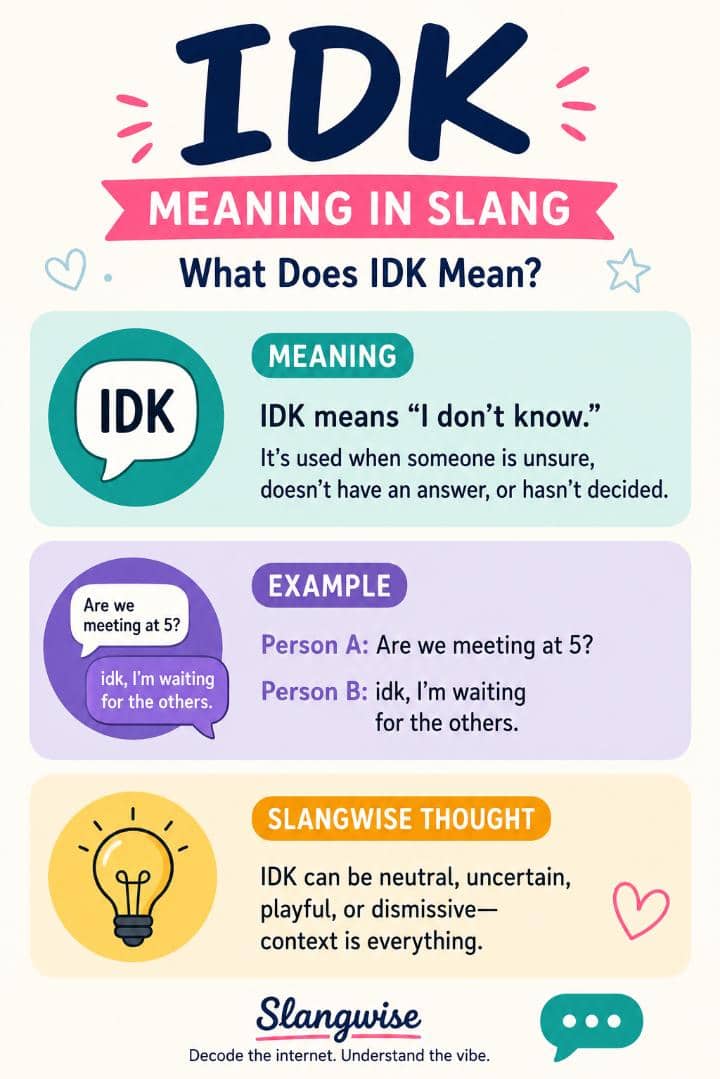
In texting, IDK stands for “I don’t know.” People use it when they do not have an answer, are unsure, have not decided, or simply want to reply quickly.
Example: “What time does the movie start?” — “IDK, let me check.”
Here, IDK is completely literal. But it can also introduce an opinion:
Example: “idk, the new update seems better to me.”
The speaker clearly has an opinion. IDK simply makes it sound less absolute. That is an important part of understanding internet slang: the dictionary meaning and conversational function are not always identical.
READ ALOS: GRWM Meaning in Slang: What It Really Means and Why Everyone Is Saying It
What Does IDK Stand For?
IDK stands for “I don’t know.” The letters come from the initial letters of the phrase:
- I = I
- D = Don’t
- K = Know
Its popularity grew with texting, instant messaging, forums, and other forms of fast digital communication.
How People Actually Use IDK
1. Genuine Lack of Knowledge
Example: “Did Jay submit the assignment?” — “IDK, I haven’t checked.”
The sender simply does not know.
2. Uncertainty
Example: “Are you coming tomorrow?” — “idk, depends on when we finish.”
Here, IDK is close to “I’m not sure.”
3. Softening an Opinion
Example: “IDK, that trailer actually looks pretty good.”
The person has an opinion but presents it casually rather than forcefully.
4. Playful Ignorance
Example: “Who finished the last piece of cake?” — “IDK 👀.”
The sender may be joking rather than genuinely confused.
5. Avoiding a Conversation
Example: “Why did you leave the group chat?” — “IDK.”
A one-word response can feel closed-off, especially compared with “IDK, I just needed some space.”
Of the 18 most efficient slangs ever created, IDK is the second on the list. Check out number one and the rest.
Where Did IDK Come From?
The phrase “I don’t know” is much older than the internet. What is modern is shortening it to IDK.
As SMS texting, instant messaging, forums, and online chat became popular, abbreviations such as IDK, LOL, BRB, and IMO helped people communicate faster. IDK eventually became a familiar part of informal digital language.
IDK, idk, Idk, or IDK. — Does Formatting Matter?
- “idk” — usually casual and conversational.
- “IDK” — neutral in many situations but sometimes more emphatic.
- “Idk…” — may suggest hesitation or uncertainty.
- “IDK.” — can feel firm or abrupt.
- “idk 😭” — can sound humorous, overwhelmed, or dramatic.
- “idk lol” — usually makes the reply feel lighter.
These are patterns, not strict rules. Context still matters most.
Is IDK Rude?
IDK is not inherently rude. Compare:
- “idk, let me find out.” — helpful and cooperative.
- “IDK.” — potentially abrupt if someone expected an explanation.
Even the second example is not automatically rude. The sender could simply be busy or genuinely unable to answer.
IDK vs. Similar Slang Expressions
- IDK vs. “I’m not sure”: Both express uncertainty, but “I’m not sure” sounds more polished.
- IDK vs. “No idea”: Both can mean a lack of information.
- IDK vs. “Maybe”: IDK means the person does not know; maybe suggests a possibility.
- IDK vs. IDC: IDK means “I don’t know,” while IDC means “I don’t care.”
- IDK vs. “I don’t think so”: IDK expresses uncertainty; “I don’t think so” gives a negative opinion or prediction.
When Should You Use IDK?
IDK fits naturally in texts, group chats, social media comments, DMs, gaming chats, and other casual conversations.
For professional emails, academic work, applications, or business documents, phrases such as “I’m not sure,” “I don’t have that information,” or “I’ll confirm and get back to you” are usually clearer.
That does not make IDK “bad English.” It simply belongs to informal language.
DISCOVER: 250 Most Popular Internet Abbreviations of 2026 Explained for Easy Texting
How to Respond When Someone Says IDK
- Genuine uncertainty: “No worries. Can you check and let me know?”
- Undecided: “That’s fine. Want to decide later?”
- Joking: “That ‘IDK’ looks suspicious 😂.”
- Abrupt: “No problem, just wanted to check.”
Real-Life IDK Examples
- Planning: “Are we meeting at 5?” — “idk, I’m waiting for the others.”
- Entertainment: “Is that movie worth watching?” — “IDK, the reviews are mixed.”
- Group chat: “Who changed the group name?” — “IDK 😭.”
- Social media: “Do people still use that app?” — “idk, I keep seeing it on my feed.”
- Playful: “Who took my snacks?” — “IDK 👀.”
Slangwise Tip: Read the Whole Conversation
When decoding IDK, do not focus only on the three letters. Look at the message before it, the message after it, and the relationship between the speakers.
“idk, let me check” and “IDK.” have the same basic meaning, but they can create very different impressions.
Conclusion: What Does IDK Really Mean?
IDK means “I don’t know,” but in real conversations it can express uncertainty, soften an opinion, signal hesitation, create a joke, or make a response feel distant.
When you see IDK in a text, TikTok comment, DM, or group chat, check the context before judging the tone. In casual communication, IDK remains one of the quickest ways to say “I don’t know.”
FAQs About IDK Meaning in Slang
IDK means “I don’t know.” It is an informal abbreviation widely used in casual digital communication.
It usually means “I don’t know,” but the tone can range from uncertain to playful depending on context.
Not by itself. A short “IDK.” may feel abrupt, but the surrounding conversation determines whether it is actually dismissive.
IDK means “I don’t know,” while IDC means “I don’t care.” They communicate completely different ideas.
It is usually better to use a complete phrase such as “I’m not sure” or “I’ll confirm and get back to you” in professional communication.
About the Author
Agboola John, founder of Slangwise, is a slang enthusiast, decoder, and graphics designer focused on explaining the fast-changing language of the internet. His work breaks down slang, acronyms, abbreviations, and online expressions into clear meanings that make digital conversations easier to understand.
Table of Contents