
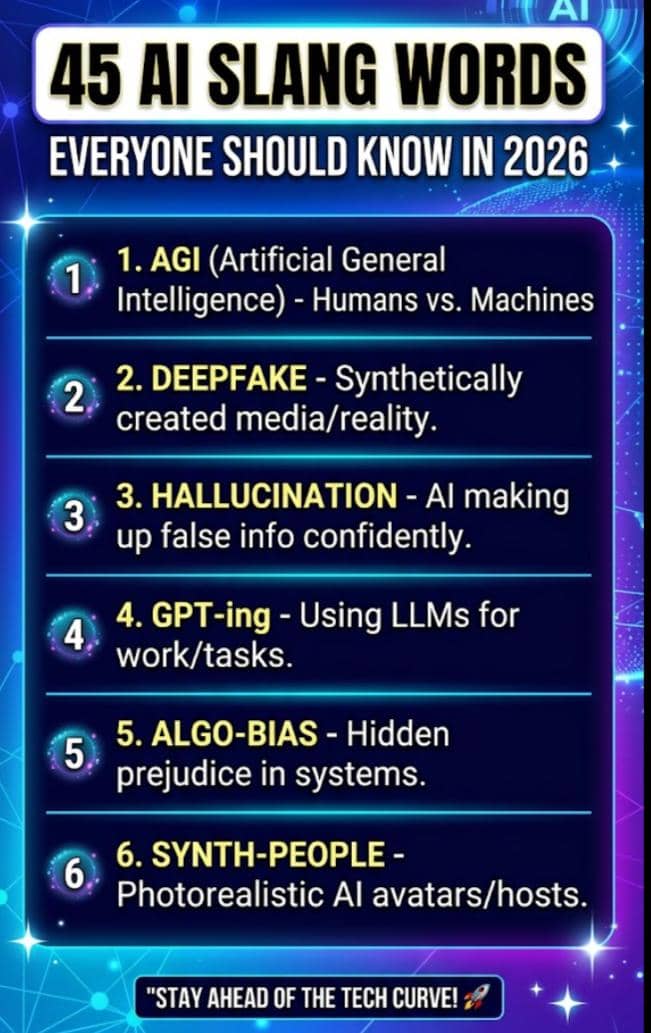
If you spend even a little time on TikTok, X, YouTube, product demos, coding forums, or AI news, you have probably noticed something funny: the language around AI changes almost as fast as the tools themselves.
One week people are talking about prompts and tokens, the next week it is agentic AI, MCP, or vibe coding. That is why this guide exists. It is your friendly A to Z map through the AI words people keep saying like everyone should already know them.
Generative AI is now a major category of AI that creates text, images, video, audio, or code, and modern systems often depend on concepts like context windows, tools, embeddings, and evaluation workflows to work well.
The goal here is not to make AI sound more intimidating. It is the opposite. Once you understand the language, the whole space gets easier to follow.
You will be able to tell the difference between a model, a prompt, a tool, a vector database, and the newest buzzwords that are showing up in builder conversations everywhere. And yes, I have kept the list in alphabetical order so you can scan it fast whenever a term pops up and makes you pause for a second.
1. AGI
AGI stands for artificial general intelligence. In plain English, it means a theorized kind of AI that could match or exceed human ability across a wide range of tasks instead of being good at only one narrow job.
People talk about AGI a lot, but it is still a future idea, not something everyday users should assume is already here.
2. AI
AI is the umbrella term for systems that can sense, reason, act, adapt, or make decisions in ways that feel intelligent. In practice, people use “AI” to describe everything from simple machine learning models to giant generative systems.
That is why the word gets thrown around so casually: it covers a lot of ground.
3. AI Agent
An AI agent is a system that can take actions toward a goal, not just generate a reply. It can use tools, call functions, search for information, or complete multi-step tasks with less hand-holding than a normal chatbot. In other words, it is not just answering you; it is trying to do something for you.
4. AI Slop
AI slop is a newer slang term for low-quality, mass-produced content made with AI. The phrase is usually used critically, especially when people feel the internet is getting flooded with shallow, repetitive, or junky material that looks polished at first glance but has very little real value.
5. Agent
In AI, an agent is software that does more than chat. It can decide what step to take next, choose tools, and push toward a goal over multiple turns. If a model is the “brain,” an agent is the brain plus the hands. That is why agents are a big deal in modern AI products.
6. Agentic AI
Agentic AI describes AI that behaves with more independence, like an agent that can pursue outcomes with limited human involvement.
The word is used a lot in 2025 and 2026 because products are moving from simple Q and A into systems that can plan, act, and keep going. That shift is why “agentic” has become one of the hottest AI words around.
7. Alignment
Alignment is the idea of making AI behave in ways that match human goals, instructions, and safety expectations.
Developers work on alignment so models are more helpful, less misleading, and less likely to do something weird when given ambiguous instructions. In real life, it is one of the biggest challenges in AI development.
8. Benchmark
A benchmark is a standard test used to compare how well models perform. Think of it like an exam paper for AI. Benchmarks matter because they help teams see whether a model is better, worse, faster, or more accurate on specific tasks instead of relying on vibes alone.
9. Chain-of-Thought
Chain-of-Thought, often shortened to CoT, is a prompting technique that encourages a model to work through intermediate steps before giving the final answer.
It is often used for harder reasoning tasks because step-by-step thinking can improve performance on complex problems. This is one of those AI terms that sounds nerdy but is actually very useful to know.
10. Context Engineering
Context engineering is the craft of shaping the information, instructions, memory, and tools around a model so it can do a better job. Instead of just writing one clever prompt, you design the whole environment the model sees.
That includes relevant files, retrieved data, and the right amount of context to keep the answer grounded.
11. Context Window
The context window is the amount of text, measured in tokens, that a model can process at one time. A bigger context window means the model can handle longer prompts, bigger conversations, or more background material without losing track as quickly.
This term matters a lot when people compare models or wonder why one model “forgets” less than another.
12. Embedding
An embedding is a numerical representation of meaning. Instead of storing a word or a sentence as plain text, the system turns it into a vector that captures semantic relationships. That is why embeddings are so useful for search, recommendations, and retrieval systems. They help AI find “similar meaning,” not just matching keywords.
13. Evals
Evals, short for evaluations, are tests you run to see whether a model output meets your expectations. They are especially important when you are changing prompts, upgrading models, or building production systems that need consistent behavior.
In a fast-moving AI world, evals are the difference between “it looks good” and “we actually measured it.”
14. Few-Shot
Few-shot means you give the model a few examples in the prompt before asking it to solve the new task. Those examples act like training wheels. They help the model understand format, tone, or pattern without needing a full fine-tune. If zero-shot is “figure it out,” few-shot is “here are a few hints first.”
15. Fine-Tuning
Fine-tuning is the process of adapting a base model to do a specific task better by training it on additional data. It is useful when you want more specialized behavior, more consistent formatting, or a stronger fit for a particular domain. Think of it as customizing a general-purpose model into a more focused one.
16. Foundation Model
A foundation model is a large model trained on broad data that can be adapted for many different tasks. It is the base layer behind many modern AI products, especially generative ones. In practice, a foundation model can become a chatbot, code assistant, image tool, or search system depending on how it is used.
17. Function Calling
Function calling, also called tool calling, lets a model ask your app to run a function or access a tool. Instead of guessing, the model can send a structured request and get real data back.
This is one of the biggest reasons AI apps feel more practical now, because they can connect to systems outside the model itself.
18. GenAI
GenAI is short for generative AI. It refers to AI that creates original content such as text, images, video, audio, or software code in response to a prompt.
People use “GenAI” constantly because it is quicker to say than the full phrase, and because the whole field has grown fast enough to need a shorthand.
19. Grounding
Grounding means tying an AI response to trusted external information so the answer is more factual and context-aware. You will often hear this word in connection with retrieval systems, enterprise search, and RAG.
The basic idea is simple: do not let the model freestyle when there is a reliable source it can consult first.
20. Guardrails
Guardrails are the safety and policy controls around an AI system. They can help keep outputs on topic, reduce harmful behavior, and make the model safer to use in real products.
When people say a system needs guardrails, they usually mean it needs boundaries, checks, and better refusal handling.
21. Hallucination
A hallucination happens when an AI produces something that sounds convincing but is wrong, made up, or unsupported. This can happen because models are designed to generate likely output, not magically know the truth. Hallucinations are one of the most important reasons to verify AI answers before trusting them.
22. Inference
Inference is the moment a trained model actually uses what it learned to produce a prediction or answer. Training is the learning phase; inference is the doing phase. So when your AI app responds to a question, that response is the result of inference.
23. Instruction Tuning
Instruction tuning is a training process that teaches a model to respond better to instructions. It helps the model become more useful in chat-like settings, because it learns that user requests should be answered directly, clearly, and in the expected format. In modern AI, this is a big reason models feel more assistant-like.
24. Jailbreak
A jailbreak in AI is an attempt to get a model to ignore its rules or safety behavior. People use the term when someone tries to trick the model into answering what it should not answer or behaving in a way it was not meant to. It is one of the most common safety and security terms in the AI world.
25. LLM
LLM means large language model. It is a model trained on huge amounts of text so it can understand and generate language in a flexible way. LLMs are the backbone of most chatbots, writing tools, and many AI assistants people use today.
26. MCP
MCP stands for Model Context Protocol. It is an open standard that connects AI applications to external systems, tools, and data sources in a standardized way.
MCP became one of the big AI buzzwords because it helps models plug into files, databases, workflows, and other services without every integration being built from scratch.
27. Max Tokens
Max tokens is a setting that limits how long a model’s response can be. It is a practical control for cost, speed, and output length. If you have ever wondered why one model gives you a short reply while another keeps going, token limits are often part of the reason.
28. Multimodal
Multimodal means a model can work with more than one type of input or output, such as text, images, audio, or video. This is why modern models feel much more powerful than old-school text-only systems. Instead of reading only words, they can process several forms of information together.
29. Open Weights
Open weights means a model’s learned parameters are available for others to use, study, or adapt. This does not always mean every part of the model ecosystem is open, but it usually signals more transparency and flexibility than a fully closed model.
People care about open weights because they make experimentation and deployment easier for some teams.
30. Prompt
A prompt is the input or instruction you give to an AI model. It can be a question, a command, a paragraph of context, or even a whole workflow. In AI, the quality of the prompt often changes the quality of the result more than beginners expect.
31. Prompt Engineering
Prompt engineering is the process of writing effective instructions so a model consistently gives the kind of output you want. It is part art, part testing, and part common sense. Good prompt engineering does not just ask for “a better answer”; it gives enough structure for the model to know what “better” means.
32. Prompt Injection
Prompt injection is a security problem where malicious text tries to hijack a model’s instructions. The model may be told to ignore its system rules, reveal hidden data, or act in an unintended way.
This matters especially in AI agents that read web pages, documents, or third-party content that may not be trustworthy.
33. RAG
RAG stands for retrieval-augmented generation. It means the model first retrieves relevant information from an external knowledge source and then uses that information to generate a response.
RAG is popular because it helps reduce hallucinations and makes answers more grounded in current or domain-specific data.
34. Reasoning Tokens
Reasoning tokens are tokens used internally while a model works through a problem. You usually do not see them directly in the same way you see user-facing output, but they matter because they can affect how a model plans, checks, or works through hard tasks. This is one reason some models feel more deliberate than others.
35. RLHF
RLHF stands for reinforcement learning from human feedback. It is a training method that uses human judgments to help align the model toward more useful, safer, and more preferred behavior. RLHF became famous because it helped make chat models feel much more cooperative and assistant-like.
36. SLM
SLM means small language model. It is a language model that is smaller and usually cheaper or faster than a large language model. SLMs are attractive when you need efficiency, local deployment, or a model focused on narrower tasks instead of a giant generalist.
37. Synthetic Data
Synthetic data is data generated by an algorithm or AI rather than directly observed from the real world. It is often used to augment training, improve privacy, or fill gaps where real data is limited. In AI work, synthetic data is especially useful when you want scale without exposing sensitive information.
38. Temperature
Temperature is a generation setting that affects how random or creative a model’s output feels. Lower temperature usually makes the model more predictable, while higher temperature can make it more varied and exploratory.
If a response feels too stiff or too wild, temperature is one of the knobs developers adjust.
39. Token
A token is a chunk of text that the model processes, and it is not always the same as a word. A single word might be one token, or it might be several, depending on how the tokenizer splits it. Tokens matter because they affect context window size, speed, and cost.
40. Tokenizer
A tokenizer is the tool that breaks text into tokens so the model can read and process them. This is the hidden machinery behind many AI text systems.
When people talk about token limits, they are really talking about how much text survives the tokenizer and fits into the model’s context window.
41. Tools
Tools are external capabilities that extend what a model can do, such as web search, file access, function calls, or remote services.
In modern AI apps, tools are what let a model move from language generation into useful action. This is also why tool use has become central to agents and workflow automation.
42. Top-k
Top-k is a sampling method that limits the model to the top k most likely next-token choices. It helps control randomness during generation. Developers use it when they want a model to be less chaotic without making it completely rigid.
43. Top-p
Top-p is another sampling method, sometimes called nucleus sampling. Instead of choosing a fixed number of top options, it keeps the smallest set of likely tokens whose combined probability reaches a chosen threshold.
Like temperature and top-k, it is one of the controls that shape how creative or conservative output feels.
44. Vector Database
A vector database is a database built to store and search embeddings efficiently. Instead of matching exact words only, it looks for meaning-based similarity in high-dimensional vector space. That is why vector databases are so common in RAG systems, semantic search, and AI applications that need memory or retrieval.
45. Zero-Shot
Zero-shot means asking a model to do a task without giving examples first. You just ask directly and see how well it generalizes. It is a very common way to test whether a model understands your request quickly, especially when you are comparing it with few-shot prompting.
Final Thought
AI vocabulary can feel overwhelming at first, but it gets much easier once you break it into pieces. The more of these words you know, the easier it becomes to understand AI news, use AI tools more confidently, and spot when someone is talking real substance versus just tossing around hype words.
FAQ
Start with the basics: AI, GenAI, LLM, prompt, token, context window, hallucination, RAG, and function calling. Those terms show up everywhere and help you understand almost everything else on the list.
AI slop, vibe coding, agentic AI, and AGI are the most slang-like or buzzword-heavy. They are common in online conversations because they are short, memorable, and easy to throw into debates about the future of AI.
Because MCP makes it easier for AI apps to connect to tools and data in a standard way. Instead of every team inventing a custom integration, MCP gives developers a common protocol for building these connections. That makes it a big deal for real-world AI products.
Because it helps models use trusted outside information instead of relying only on what they memorized during training. That usually improves freshness, accuracy, and relevance, especially for business tools or knowledge-heavy use cases.
Probably hallucination. It is the easiest way to remember that AI can sound confident and still be wrong. Once you understand that, you start reading AI output with a healthier level of caution.
Not exactly. Some are true slang, some are technical terms, and some are the kind of fast-moving buzzwords that people use like slang. In AI culture, those categories blur together pretty quickly, which is part of the fun and part of the confusion.
Table of Contents