
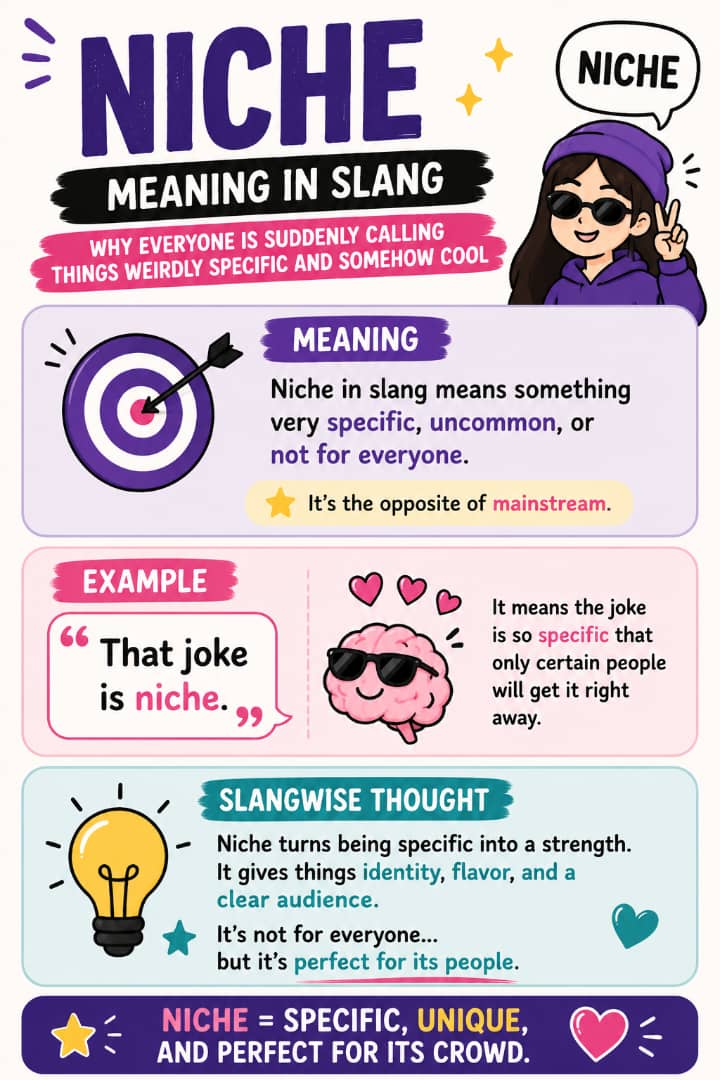
- Niche in slang means something very specific, uncommon, or not for everyone.
- People use it to describe interests, humor, styles, communities, and content that feel targeted to a smaller group.
- Online, niche can sound like a compliment because it makes something feel unique and distinctive.
- It is often the opposite of mainstream, which means widely popular and familiar.
- The word is casual, flexible, and very common in internet conversation, especially when people talk about taste, identity, and small communities.
Niche Meaning in Slang
Have you ever heard someone describe a joke, a hobby, a style, or even a whole personality as niche and wondered whether that was a compliment, a dig, or just internet code for “you had to be there”?
That confusion is very normal.
In slang, niche usually means something specific, unusual, or made for a smaller audience rather than everybody. It can describe a taste, interest, joke, aesthetic, or community that feels a little off the main path.
In simple words, niche means not mainstream, very specific, and often uniquely interesting to a certain type of person.
That is why people use it for things like obscure music tastes, oddly specific humor, tiny fan communities, or content that only a certain group immediately gets. The word can sound neutral, playful, or even complimentary depending on the tone.
So if someone says your taste is niche, they are usually saying it is specific, unusual, or delightfully outside the usual crowd. Sometimes that is meant as praise, sometimes as teasing, and sometimes as both at once.
READ ALSO: 80 Most Popular Gen Alpha Slang Words You’ll Hear In 2026 (updated)
Table of Contents
What Does Niche Mean in Slang?
When people use niche online, they are usually pointing to something that feels very specific or tailored to a particular group. It is the kind of word people use when they want to say, “This is not for everybody, but it is perfect for the people it is for.”
For example, a person might say, “That is such a niche interest.” That means the interest is not broad or universal. It is specialized, a little unusual, and likely understood by a smaller circle.
Another person might say, “That joke is niche.” Here, they usually mean the joke is so specific that only certain people will get it right away. The humor is part of a tiny shared world, not the whole internet.
That is really the heart of the slang meaning. Niche points to something with a narrow but strong appeal. It may not be broadly popular, but it can be deeply loved by the people who understand it.
Slangwise Thought
Niche is interesting because it does not always sound like a normal compliment, but in online culture it often becomes one. Calling something niche can mean it has identity, flavor, and a clear audience. In a world where so much content tries to be for everyone, niche feels more personal and more specific.
That is why the word shows up so much in internet spaces. It helps people label things that are too particular to call mainstream, but too cool or too funny to ignore.
The real magic of niche is that it turns being specific into a strength. Instead of saying something is weird in a bad way, it can suggest that it belongs to its own little world, and that world has fans.
Where Did Niche Come From?
Outside of slang, niche has long been used to mean a special position, a fitting role, or a specialized market. That older meaning helped it slide naturally into internet slang, where people now use it to talk about narrow interests and communities.
Online, the word got a more casual life. Instead of only meaning a market or a role, it became a quick way to describe tastes and content that sit outside the biggest trends. Social media has made that kind of label more useful because niche communities can form very quickly around tiny shared interests.
That is why you will hear people talk about niche humor, niche music, niche aesthetics, niche hobbies, and niche internet references. The word has become a shortcut for “small audience, specific vibe.”
And honestly, that is a very internet thing to do. Take one simple word, stretch its meaning, and suddenly it becomes the perfect label for a whole mood.
How People Use Niche
People use niche in a few common ways, and each one still circles back to the same idea. It describes something specific, specialized, or appealing to a smaller crowd.
1. In hobbies and interests
“That is a niche hobby.”
This means the hobby is not super common, and only certain people are likely to be into it.
2. In humor
“That joke is niche.”
This means the joke is very specific and probably only makes sense to people who share the same reference or taste.
3. In style or aesthetics
“Her style is niche.”
This usually means the style is unusual, distinctive, or clearly not trying to fit the crowd.
4. In communities
“That is a niche community.”
This means the group is small, specialized, and built around a very specific shared interest.
So when you hear the word in conversation, it is usually doing one of two things. It is either describing something small and specific, or it is quietly saying that something belongs to a very particular type of person.
That is why the word feels so natural in online conversation. It is flexible enough to describe taste, culture, humor, and identity without needing a long explanation.
Niche vs Mainstream
This is where the meaning gets even clearer.
Mainstream usually means widely known, widely liked, or broadly accepted. Niche usually means narrow, specific, and more limited in audience.
Compare these:
“That song is mainstream.”
It is popular and familiar to a large audience.
“That song is niche.”
It appeals to a smaller, more specific group of listeners.
That does not mean niche is worse. In fact, a lot of people prefer niche things because they feel more personal, more original, and less generic. Social platforms have also made niche content easier to find and share, which helps small interests grow into recognizable communities.
So if something is niche, it is not automatically tiny or unimportant. It just has a more specific audience than the big mainstream stuff everyone already knows.
READ ALSO: Why Gen Z Loves Describing Everything as a Vibe
Examples of Niche in Conversation
Here are some natural ways the word might show up:
“My music taste is niche.”
Meaning: my taste is specific and probably not for everyone.
“That is such a niche reference.”
Meaning: only a small group will understand it immediately.
“He has niche humor.”
Meaning: his jokes are very specific and probably appeal to a certain crowd.
“That style is niche, but I love it.”
Meaning: the style is unusual or specialized, but that is part of the appeal.
“This is a niche community.”
Meaning: the group is small and centered on a very specific interest.
Once you see it in context, the word becomes easy to understand. It is basically a flexible label for specificity, uniqueness, and smaller audience energy.
When to Use Niche
Use niche when you want to describe something that feels very specific, less common, or tailored to a smaller group. It works well in casual conversation, online comments, and content that talks about trends, taste, or identity.
It is especially good when you want to sound conversational but still precise. Instead of saying something is simply “different,” niche tells people that the difference is part of the appeal.
That makes the word useful for talking about humor, fandoms, fashion, and little online worlds where the audience is not huge, but the connection is strong.
It also works nicely when you want to give a light compliment without sounding overly formal. Saying something is niche can feel cool, self aware, and a little clever.
When Not to Use Niche
Do not use niche when you need complete clarity in formal writing unless you are sure the audience understands the slang sense. In business or academic settings, the older standard meaning may be safer.
Also, be careful with tone. Depending on how it is said, niche can sound flattering, neutral, or slightly dismissive. The same word can praise uniqueness or imply that something is too obscure for most people.
If you need a plain version, just say:
“That is very specific.”
or
“That appeals to a smaller audience.”
READ MORE: 41 Meaning in Slang: Why Everyone Keeps Saying a Random Number Like It Means Something
Final Thoughts
Niche is one of those words that feels small at first but carries a lot of social meaning. In slang, it usually points to something specific, uncommon, or built for a particular group rather than everybody.
What makes it so useful is that it can be descriptive and stylish at the same time. It can talk about humor, taste, aesthetics, communities, and even personality without needing a long explanation.
So the next time someone says something is niche, you will know they are not just calling it weird. They are usually saying it has its own little world, its own audience, and its own kind of charm.
FAQs
In slang, niche means something specific, uncommon, or not for everyone. It often describes a hobby, joke, style, or community with a smaller audience.
Usually it can be. It often suggests uniqueness, originality, or a special kind of appeal, though tone can change the meaning.
Mainstream means widely popular and familiar, while niche means more specific, specialized, and appealing to a smaller group.
Yes. People often use niche to describe specific jokes, aesthetics, fashion choices, and internet references that only certain people immediately get.