
- Fambushing is slang for “family ambushing.” It describes a situation where family members unexpectedly show up where another family member is.
- It is strongly linked to location sharing. The trend became popular because apps now let families see each other’s real time locations.
- Most commonly, kids “fambush” parents. Teens often use location tracking to find where their parents are and show up unannounced.
- The tone is usually playful, not serious. It is typically used as a joke about surprise visits, not something harmful or malicious.
- It reflects modern digital family life. The term shows how technology has changed privacy, communication, and family interactions.
What Fambushing Actually Means
If you have seen fambushing floating around online and felt a little confused, you are not alone. It is one of those fresh internet words that sounds funny the second you hear it, even before you fully know what it means.
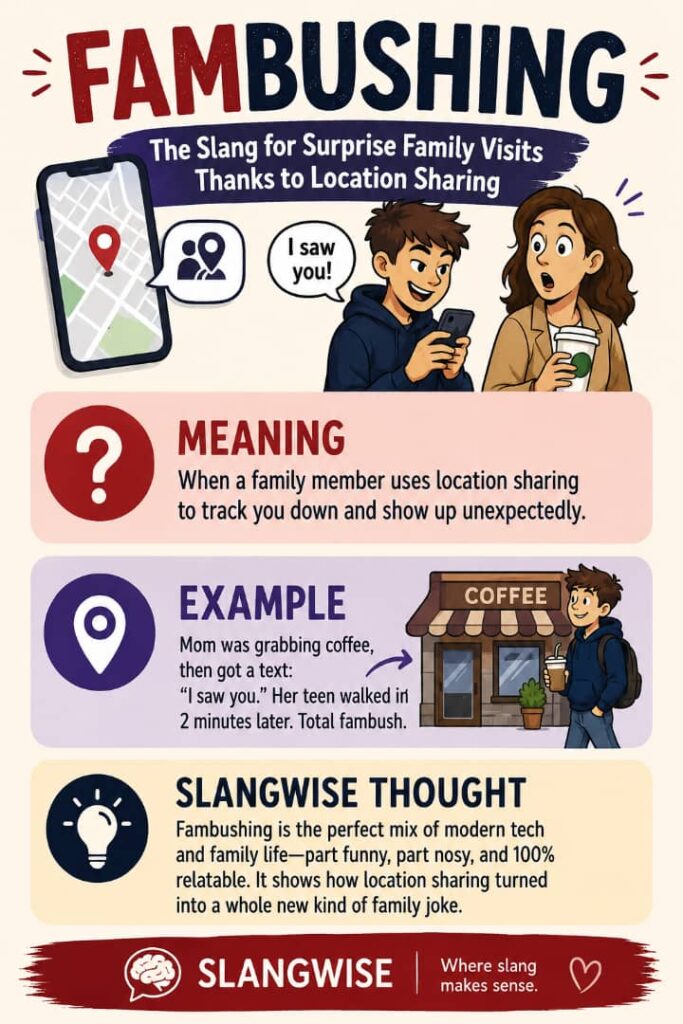
In Gen Alpha slang, fambushing is a playful blend of family and ambushing, and it describes the moment kids use location sharing to track down their parents and show up unexpectedly, often at lunch, errands, or other everyday stops.
The trend has recently been described in parenting coverage and lifestyle writeups as a reverse version of the usual “parent tracking child” setup.
Plainly, fambushing is what happens when a child, usually a teen, checks a parent’s live location and then appears out of nowhere, often to ask for food, a ride, or just to join in on whatever the parent is doing.
Now, picture a mom grabbing Starbucks and suddenly getting a text that says, “I saw you.” Or a dad eating lunch and finding out his kid is already walking into the restaurant. That is the vibe. It is not usually meant in a scary way.
Most of the time, it is framed as a funny, slightly nosy, family centered move that comes from location sharing apps and constant digital connection.
The slang word itself makes sense the moment you break it apart. It is basically family plus ambush, which is why it sounds so instantly memorable. A recent guide to kid culture described it exactly that way, and other articles used the same idea when explaining the trend to parents and general readers.
The name is clever because it captures both the closeness and the surprise. It feels affectionate, but it also has a tiny bit of chaos in it, which is probably why the word spread so fast.
READ ALSO: 40 Most Popular Internet Catchphrases of 2026 (Updated)
Why Fambushing Sounds So Weirdly Perfect
The phrase works because it joins two ideas that internet culture loves. The first is aura, which has long meant the feeling or atmosphere a person seems to give off. The second is farming, a gaming style word for repeatedly doing something to gain points, items, or experience. Put together, aura farming means repeatedly doing cool looking things to build up your social glow.
That gaming connection matters more than people think. In video games and anime, characters often repeat stylish actions, stand in dramatic lighting, or move with unreal confidence.
Online slang borrowed that energy and turned it into a joke, a compliment, and a bit of a roast all at once. That is why the phrase can sound admiring in one moment and teasing in the next.
Where Fambushing Blew Up
Fambushing started getting attention as location sharing became more common in family life. Parents often use apps to keep track of kids for safety, especially when they are driving or spending more time on their own.
But the trend seems to have flipped that old power dynamic. Now many teens are using the same tools to watch their parents instead, and that reversal is what made the slang take off online.
There is also a longer older trail behind the word. An earlier “fambush” definition appeared years ago as a funny label for unexpected family visits, which shows that the basic joke is not brand new, even if the current social media trend is.
Actually, what feels new is the specific location sharing angle and the way Gen Z turned the idea into a recognizable online behavior with its own name. In other words, the slang has old roots, but the current meaning is very much a product of modern app culture.
A big reason it became much more visible is the viral boat dance from Indonesia involving Rayyan Arkan Dikha, an 11 year old boy who performed a calm, stylish dance on the front of a racing boat during the Pacu Jalur festival.
So, that clip spread widely, got remixed online, and turned into a global trend, with celebrities and athletes recreating it too. In other words, the phrase moved from niche internet slang into a full blown cultural moment.
READ ALSO: 9 Sigma Slangs for Quiet Confidence, Lone Energy, and the Walk Away Vibe
Is Fambushing a Compliment or a Roast?
Here is where it gets interesting to me. Fambushing can absolutely be a compliment.
People use it when someone does something that feels effortlessly funny, unexpected, or bold, like showing up at exactly the right moment, pulling off a surprise visit, or appearing out of nowhere with perfect timing.
It can describe the kind of family chaos that makes people laugh right away.
But there is a flip side. If the surprise feels intrusive, overdone, or too frequent, fambushing can sound sarcastic. That is because the phrase lives in the same space as irony. It is often about turning a real family habit into a joke.
The magic is in making it sound harmless and funny, but the moment it feels too invasive, people may stop laughing.
What Fambushing Looks Like in Real Life
Fambushing is not just for teens, parents, or app obsessed families. It can show up in everyday life too. A kid might spot a parent’s location and show up at a coffee shop, a restaurant, or a store without warning.
The action itself may be ordinary, but the fact that it happens through live tracking makes it feel funny and a little dramatic.
That is why the phrase has become so shareable. People enjoy spotting little moments that feel like family ambushes, then attaching the label fambushing to them.
It is almost like the internet is keeping score on surprise, timing, and the weird new ways families stay connected. The joke is that everyone knows the person is not lost. They were found on purpose.
The whole thing feels cinematic in a very modern way. Instead of a random drive by visit, you get a location ping, a quick text, and then somebody appears like they were summoned. That is exactly the kind of everyday chaos internet slang loves to name.
DISCOVER: 35 New Slang Words Taking Over the Internet Right Now (2026 Watchlist)
Why People Are So Obsessed With Fambushing
From Slangwise point of view, fambushing is popular because it fits the way people already behave online. Social media rewards moments that look funny, surprising, and memorable.
At the same time, people love irony, so they also enjoy calling out the performance behind the surprise. Fambushing sits right in that sweet spot between affection and mockery.
It also connects nicely with the internet’s obsession with family visibility. People do not just want to know where someone is anymore. They want a running joke around it. Fambushing is basically the slang version of that whole idea, turning location sharing into a playful family moment.
From my experience, slang like this spreads fast when it feels obvious the second you hear it. The word is easy to picture, easy to repeat, and funny enough to stick. That combination is exactly why it keeps showing up in posts and conversations.
So, What Should You Take From It?
Fambushing is the internet’s way of describing someone who is using location sharing to show up unexpectedly, usually inside a family setting.
It can be playful, nosy, funny, or a little intrusive depending on how it is done. The funniest part is that the phrase itself is almost a joke and a warning at the same time.
So the next time you see someone appearing at a family hangout out of nowhere, ask yourself one question: were they invited, or were they fambushed? Either way, the internet will probably notice. And honestly, that is exactly why the phrase caught on so fast.
READ ALSO: Millennial vs Gen Z Slang in 2026: Why One Sounds Nostalgic and the Other Sounds Wildly New
FAQs About Fambushing
It means a family member unexpectedly shows up where another family member is, often using location tracking to find them.
Not usually. It is mostly used in a funny or lighthearted way, though it can feel intrusive if overdone.
Most often, children or teenagers fambush their parents, but it can go either way in a family.
Yes. It is closely tied to location sharing apps that allow family members to see each other’s whereabouts.
The word comes from combining “family” and “ambushing,” because the visit is unexpected and surprise based.
Table of Contents