
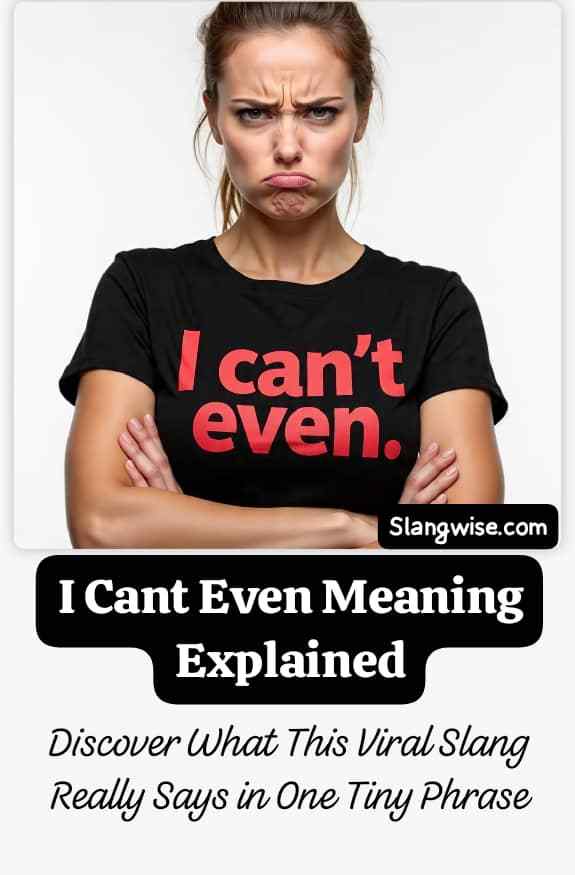
Some slang phrases are short. Some are dramatic. And then there is “I cant even”, a tiny expression that manages to say a whole emotional meltdown in just three words.
Generally, “I cant even” is what people (mostly Gen Zs and Gen Alphas) say when something is so shocking, frustrating, funny, embarrassing, exciting, or overwhelming that they do not know how to finish the thought.
It is often used as an unfinished reaction, which is exactly why it feels so real. Dictionaries and language sources describe it as a reaction to situations that leave someone speechless or unable to fully process what just happened.
Simply, it means something like:
“I do not even have the words for this.”
Or:
“This situation is too much for me right now.”
That is the beauty of it. The phrase sounds incomplete because the feeling behind it is incomplete too. Your brain is overloaded, so the sentence stops right where the emotion peaks.
Table of Contents
In a Nutshell
- “I cant even” is used when a feeling is too strong to finish explaining.
- It can show shock, frustration, excitement, embarrassment, or disbelief.
- The phrase is informal and works best in casual speech, texts, and online posts.
- Its unfinished form is part of the meaning and the humor.
What “I cant even” actually means in slang
“I cant even” is not meant to be taken literally. Nobody is actually claiming they are physically unable to “even” something. That missing ending is the joke, the mood, and the message all at once.
It usually shows one of these emotions:
- Shock
- Frustration
- Overwhelm
- Excitement
- Disbelief
- Amusement
Dictionary.com explains that the phrase can express something that is too amazing, frustrating, surprising, or exciting to handle, while Cambridge describes it as something you say when you are so shocked, angry, happy, disappointed, or overwhelmed that you do not know what to say.
That range is what makes the phrase so useful. It can work in a funny conversation, a dramatic text message, or a reaction to something wildly unexpected.
For example, if a friend sends you a photo of their chaotic outfit and you are trying to be supportive but your brain has left the room, “I cant even” fits perfectly.
If someone tells you a plot twist that is so wild it feels fake, “I cant even” also fits perfectly.
If your favorite snack suddenly gets discontinued, yes, “I cant even” again.
SEE ALSO: Himbo Meaning: Why This “Sweet But Silly” Slang Word Became a Whole Personality
Why the phrase feels so powerful
One thing I have noticed about slang like this is that it works because it sounds human. Real people do not always speak in polished, complete sentences when emotions spike. Sometimes we trail off. Sometimes we stop mid thought. Sometimes we just surrender to the feeling.
“I cant even” captures that exact moment.
It is also versatile. You can use it for positive reactions, negative reactions, or just plain disbelief. Merriam-Webster notes a related expression, “can’t even begin to describe,” as a way to say something is so good it is beyond description.
That lines up with how the phrase is often used online when a situation is too intense or too impressive to summarize neatly.
So even though the phrase looks casual, it carries a lot of emotional weight. It is the linguistic version of putting your hands up and saying, “Nope, I am done trying to explain this.”
How people use “I cant even” in everyday speech
People usually drop the phrase at the end of a sentence, or they use it by itself as a reaction.
Here are a few natural examples:
Shock:
“Wait, they canceled the concert last minute? I cant even.”
Frustration:
“My phone just updated again and moved all my apps. I cant even.”
Excitement:
“He finally replied to the message. I cant even.”
Embarrassment:
“I waved at someone who was not even talking to me. I cant even.”
Humor:
“That dog just stole the entire sandwich while staring at us. I cant even.”
Notice how the phrase works best when the situation already carries a strong feeling. It is not really about giving facts. It is about reacting.
That is also why it shows up so often in texts, comments, and memes. The phrase is quick, expressive, and easy to understand even when the rest of the sentence is missing.
SEE ALSO: I Cant Even Meaning Explained: What This Viral Slang Really Says in One Tiny Phrase
The internet helped make it iconic
Like many modern slang phrases, “I cant even” grew stronger through online culture. Cambridge has noted that similar forms such as “I literally can’t even” became common as an informal way to express extreme emotion in a compressed, punchy style.
The internet loves phrases that are short, dramatic, and easy to remix. “I cant even” checks every box. It is vague enough to be flexible, but specific enough to instantly communicate a mood.
That is probably why it spread so widely. It feels like a reaction anyone can borrow, whether they are reacting to a celebrity scandal, a messy group chat, a surprise gift, or a ridiculous video.
And because the phrase ends abruptly, it leaves room for the reader or listener to fill in the emotional blank. That unfinished feeling is part of the appeal.
Further Examples
“The teacher said the test was tomorrow and I had not even started studying. I cant even.”
This shows panic and shock.
“They brought out my favorite food after I said I was not hungry. I cant even.”
This shows surprise and excitement.
“He sent the most random text at 2 a.m. I cant even.”
This shows disbelief mixed with humor.
“I saw the ending of that show and I cant even.”
This shows strong reaction to a plot twist.
“My little brother painted the dog blue by accident. I cant even.”
This shows a reaction to something absurd.
READ MORE: Heavy On That Meaning Explained: The Slang Phrase That Hits Harder Than It Sounds
When to use it and when not to
“I cant even” works best in informal situations. It sounds natural in casual chat, social posts, and playful conversation. It is not the best choice for serious settings, school writing, or anything that needs clear, formal language.
Use it when you want to sound:
- casual
- expressive
- dramatic in a funny way
- relatable
- lightly overwhelmed
Skip it when you need to sound:
- professional
- calm
- precise
- formal
For example, in a text to a friend, “I cant even” feels perfect. In a job application, not so much.
Similar expressions people use
If you like this phrase, you will probably recognize its cousins too:
“I am speechless”
“I cannot deal”
“I am done”
“No words”
“I am obsessed”
“I am screaming”
These expressions overlap, but “I cant even” has a special kind of internet energy. It is less polished than “I am speechless” and more playful than “I cannot deal.” It sounds like something you say when your reaction is bigger than your ability to explain it.
That is probably the sweet spot.
DISCOVER: 68 Most Popular TikTok Slang Words of 2026 – Quick Meaning and Examples
Slangwise thought
The real power of “I cant even” is not just in what it says, but in what it refuses to finish. It leaves the sentence hanging because the feeling is already doing all the work. That is why it is so easy to understand, so easy to repeat, and so easy to use in everyday life.
In my view, that is what makes a slang phrase stick. It does not just describe an emotion. It performs it.
Quick takeaways
“I cant even” means you are too shocked, overwhelmed, amused, frustrated, or excited to finish your thought. It is informal, expressive, and very common in internet style communication. It usually works best in casual conversation where the goal is not perfect grammar, but strong reaction.
Final thoughts
If you have ever opened a message, seen a post, or heard a story that made your brain pause for a second, then you already understand “I cant even.” It is the phrase people reach for when ordinary language feels too small for the moment.
That is the reason it stays popular. It is simple, emotional, and instantly recognizable. Whether the feeling is funny, stressful, exciting, or just plain absurd, “I cant even” says exactly what a person means without needing a full explanation.
And honestly, that is probably why it keeps showing up everywhere. Some moments do not deserve a full sentence. Some moments deserve a dramatic pause.
I cant even.
DISCOVER: What Does CEO of Mean on TikTok & Instagram in 2026? (The Viral Slang Explained + Examples)
Frequently Asked Questions
It means you are so shocked, overwhelmed, amused, frustrated, or excited that you cannot finish your thought.
No. It is an expressive slang phrase, not a literal statement.
People usually use it in casual speech, texting, comments, memes, and other informal online spaces.
Yes. It can express excitement, frustration, shock, embarrassment, or disbelief depending on the situation.