
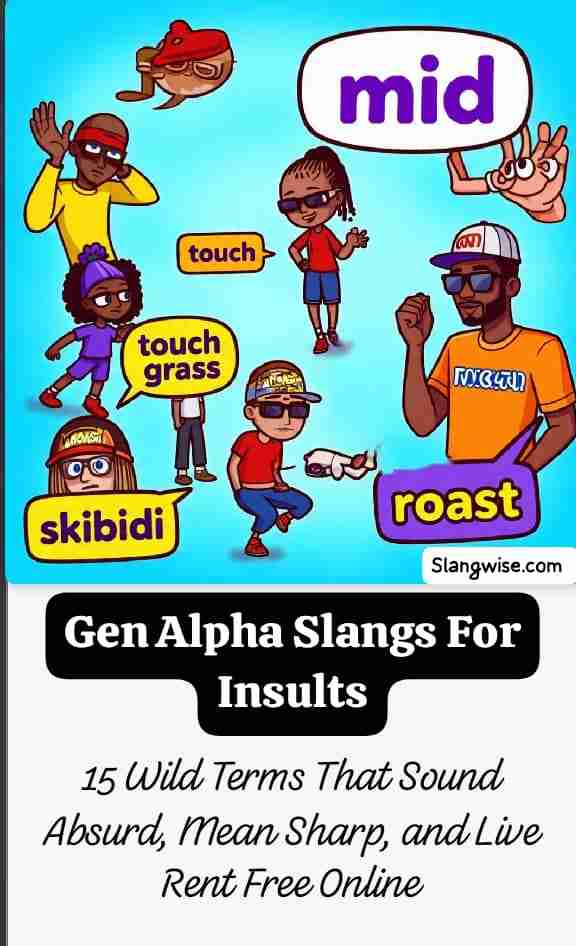
If you have spent even a little time around TikTok comments, school hallway jokes, or the kind of internet posts that feel like they were written at full speed after three hours of sleep, you have probably noticed something interesting.
Gen Alpha slang does not just try to describe something, it tries to roast it, confuse it, and turn it into a meme at the same time. A lot of these newer terms are built for speed, humor, and online identity, which is exactly why they spread so fast across social platforms.
Some of these words are harmlessly silly. Some are just a bit rude. A few are genuinely mean and should be understood more than repeated. That is part of the reality of internet slang right now.
It moves fast, it borrows from memes, it borrows from older slang, and it often changes meaning depending on who is using it and where it shows up.
So let us break down the chaos (Gen Alpha Insult Slang) in a way that is actually easy to follow.
In a Nutshell
- Gen Alpha insult slang is full of meme language, algorithm jokes, and words that sound random until you know the internet context.
- Some terms, like mid, touch grass, skibidi, Ohio, unc, and aura farming, already have fairly stable slang meanings in major references.
- Others, like group 7, city boy, dih, and choppelganger, are more meme driven or still shifting online.
- A few terms on this list are harsh, especially bop and chuzz, so they are best understood as examples of online language, not words to casually throw at people.
Why Gen Alpha Insults Feel So Different
What makes these slang insults stand out is not just the meaning. It is the tone. A lot of them feel like they were designed to sound unserious while still landing a punch. That is why slang words like skibidi, Ohio, and group 7 can work as insults, jokes, reactions, or random callouts depending on the vibe.
Meme culture has turned nonsense into a language of its own, and younger users are often the ones pushing it forward.
Another big part of the appeal is speed. A phrase does not have to be elegant anymore. It just has to be funny enough, weird enough, or savage enough to catch on. That is why slang can go from a tiny inside joke to something millions of people recognize almost overnight.
1. Choppelganger
Choppelganger is a newer insult blend built from chopped and doppelganger. In the way it is used online, it points to someone who looks like a worse, off brand, or degraded version of another person. Community definitions describe it as a grotesque or uglier counterpart to a doppelgänger.
The joke here is not subtle. It is basically saying, “You resemble someone else, but not in a flattering way.” It is one of those words that exists because internet slang loves twisting old vocabulary into something rude and ridiculous. The concept is vivid, even if the word itself is not standard dictionary language yet.
Example: “That haircut turned him into a total choppelganger.”
LEARN MORE: Why Is Everyone Saying Chopped and Choppelganger Right Now? The Meaning Might Surprise You
2. Mid
Mid is one of the most established terms on this list. Major slang references define it as mediocre, disappointing, or unimpressive, especially when something was supposed to be excellent. It became widely popular on TikTok and in everyday online use.
What makes mid so useful is how compact it is. It says, “This is not terrible, but it is nowhere near impressive.” That bluntness is part of its power. It can be applied to food, music, movies, outfits, or even behavior.
Example: “Everyone hyped that song up, but honestly, it is mid.”
3. City Boy
City Boy is one of the more absurd meme callouts floating around online. Know Your Meme traces the phrase to a Gravity Falls clip where Deputy Durland repeatedly yells it at Dipper, framing him as out of place.
On social media, it has become the kind of random insult or reaction phrase that people use when someone is acting awkward, cringe, or simply not fitting the moment.
The funny part is that the phrase does not really have to make literal sense. That is exactly why meme slang works so well. It can be more about energy than definition. In practice, people may use it like a playful callout for someone who looks lost, awkward, or try hard in a situation.
Example: “He showed up to the hiking trip in dress shoes, total City Boy behavior.”
4. Dih
Dih is algospeak, meaning a censored or softened spelling used to dodge moderation systems. Know Your Meme describes it as slang for an explicit male body part, commonly used in memes and online jokes to avoid censorship.
This term is a good example of how internet language bends around platform rules. People are not just inventing slang for fun. They are also trying to outsmart filters, recommendation systems, and content moderation tools. That is part of why algospeak keeps evolving so quickly.
Example: “That comeback was so bad, it sounded like pure dih energy.”
5. Touch Grass
Touch grass is a now familiar internet insult aimed at people who seem chronically online. Merriam Webster defines it as participating in normal real world activities instead of being stuck in online experiences, and it is usually meant as a dig at someone who needs to log off.
This phrase has become so common because it is immediately understandable. You do not need a long explanation to get the message. It basically means, “You need to step away from the screen and reconnect with actual life.” The insult is funny because it is both literal and metaphorical at the same time.
Example: “Please touch grass before you argue with strangers all night.”
6. Aura Farming
Aura farming refers to doing things in a way that makes you look cool, impressive, or stylish, often while seeming effortlessly confident. Merriam Webster and Dictionary.com both describe it as cultivating an image of coolness or social aura, sometimes on purpose and sometimes in a way that is meant to look natural.
As a diss, it works when someone is obviously trying too hard to look smooth, popular, or iconic. The joke is that their effort is showing. Instead of seeming effortlessly cool, they look like they are performing coolness for attention. That is exactly why the phrase took off online.
Example: “He walked into the room wearing sunglasses indoors, full aura farming mode.”
7. Clanker
Clanker is a derogatory term for robots, chatbots, or AI technology. Merriam Webster and Dictionary.com both note that it is used as an insult toward machines, especially in internet conversations reacting to automation and AI.
This one matters because it shows how quickly slang can move from fictional sci fi language into real world meme culture. What started in older pop culture has turned into a modern way of mocking AI systems or robotic behavior. In some spaces, people use it jokingly. In others, it can slide into more serious anti technology hostility.
Example: “That chatbot kept repeating itself like a clanker.”
8. Chopped
Chopped is slang for unattractive or undesirable. Merriam Webster includes it in its Gen Alpha slang coverage with that meaning.
It is a blunt insult, and there is not much softness in it. The phrase tends to be used in the same fast, dismissive online style as other roast words. Because it can be tied to appearance, it is also a good example of why some slang lands as mean rather than just funny.
Example: “That profile pic got called chopped in the comments.”
READ MORE: 17 Dead Slang Words Gen Alpha Keeps Bringing Back and Why They Still Hit
9. Unc
Unc is short for uncle and is often used on the internet to jokingly suggest someone is old, ageing, or acting older than their age. Merriam Webster describes it as a humorous shortening that can imply outdated behavior or old age.
Sometimes unc is playful, sometimes it is a light roast, and sometimes it is a pretty obvious way of saying someone is out of touch. The exact tone depends on context. A friend might say it teasingly, but the same word can feel rude if used to mock someone who is simply older than the speaker.
Example: “Bro showed up in cargo shorts and tried to dance like a teenager. Full unc behavior.”
10. Group 7
Group 7 is a bizarre but very real example of how random internet language becomes meaningful because people decide it is meaningful. Coverage of the trend explains that it came from a TikTok experiment by musician Sophia James, whose seventh video became its own viral identity and turned viewers into supposed members of an elite group.
As an insult or jab, it can imply that someone is not in the cool crowd, not part of the joke, or just generally outside the vibe. The absurdity is part of the sting. It is so random that it becomes memorable, which is often all internet slang needs to succeed.
Example: “You are not even Group 7, sit this one out.”
11. Bop
This is one of the terms on the list that needs the most caution. Merriam Webster notes that in its recent Gen Alpha sense, bop is used as a derogatory term for a girl or woman, often carrying a meaning similar to a sexual insult. It can also mean a good song in older or different contexts, but the insult sense is offensive.
Because of that, it is not a phrase to casually repeat or recycle for laughs. It is useful to know what it means so you can understand references online, but the word can easily become misogynistic and harmful.
Example: In a critical discussion, you might say, “This is the kind of word people use to shame women online,” rather than using the insult directly.
READ ALSO: CEO of Chill Meaning: What This Gen Alpha Slang Really Says About Someone
12. Mog
Mog is a humorous internet slang term meaning to outclass someone, especially in appearance. Merriam Webster explains that it originally had strong ties to comparing men in attractiveness or physical presence, and it can now broadly mean to look or perform far better than someone else.
In roast culture, mog is used when one person appears so much better, cooler, or more impressive that the comparison feels unfair. It can be playful, but it can also feed status anxiety, which is why some commentary around the term points out that it is not always as harmless as it sounds.
Example: “He mogged everybody at the party without even trying.”
13. Skibidi
Skibidi is a nonsense internet term linked to the absurdist YouTube show Skibidi Toilet. Merriam Webster describes it as a gibberish word that spread from the meme and is now used online in a nonsensical or sometimes pejorative way.
This is one of the clearest examples of meme language becoming a full communication style. Sometimes it means bad. Sometimes it means weird. Sometimes it means nothing at all and is just there for comedic chaos. That ambiguity is exactly what makes it so powerful online.
Example: “That hallway drama was pure skibidi energy.”
14. Ohio
Ohio has become internet shorthand for something weird, awkward, cringeworthy, or otherwise undesirable. Merriam Webster defines it that way, and the phrase is strongly tied to meme culture around bizarre or surreal content.
The joke is not really about the state in a literal sense. It is about using the name of a place as a stand in for strange behavior or cursed internet energy. That is why you will see people say things like “That is so Ohio” when something feels deeply off.
Example: “This is the most Ohio video I have seen today.”
READ ALSO: Skibidi Meaning 2026: Viral Gen Alpha Slang Explained with 10 Variants
15. Chuzz
Chuzz is a harsh, offensive term that Merriam Webster lists as meaning ugly people, and other slang references describe it as a derogatory term aimed at women.
This is another one that belongs in the category of “know it so you can recognize it, but do not casually use it.” It is mean, appearance based, and rooted in the kind of internet talk that can quickly become humiliating rather than funny.
Example: In a safety focused explanation, the right move is to say, “This is a hurtful insult people use online,” rather than repeating it as a joke.
The Bigger Pattern Behind These Words
When you zoom out, all 15 terms tell the same bigger story. Gen Alpha slang loves speed, irony, randomness, and performance. It borrows from memes, gaming, social media trends, old school insults, and platform censorship. It also mixes harmless nonsense with words that can sting very hard if used carelessly.
That is why the best way to approach these words is with curiosity and context. Some are just funny internet shorthand. Some are ways of clowning on someone for trying too hard. Some are explicit workarounds for moderation systems. And some are flat out nasty. Learning the difference matters.
How to Read This Slang Without Sounding Lost
If you see one of these terms in a comment thread, the first thing to ask is not “What does it mean in a dictionary?” It is “What is the tone here?” That is usually where the real meaning lives. Internet slang is often less about literal definitions and more about social positioning, jokes, and group identity.
For example, mid is usually a blunt dismissal. touch grass is a call to log off. unc is usually about age or outdated behavior. group 7 is a random joke that became a social badge. aura farming is about trying to look cool. And skibidi can be almost pure nonsense, which is why it keeps showing up in absurd internet jokes.
READ ALSO: 80 Most Popular Gen Alpha Slang Words You’ll Hear In 2026 (updated)
Conclusion
Gen Alpha slang insults are weird, fast, and weirdly effective. That is the point. They are built for a digital world where jokes travel faster than explanations and where a word can become iconic simply because enough people keep repeating it.
From mid and touch grass to aura farming, Ohio, and skibidi, these terms show how online language keeps reinventing itself.
At the same time, not every trendy insult is harmless. Words like bop and chuzz can be openly misogynistic, while dih and clanker show how censorship, technology, and culture all shape what people say online. Understanding the language is useful. Repeating the cruel parts without thinking is not.
So the next time somebody calls a video chopped, says something is mid, yells unc, or accuses a person of aura farming, you will not just hear random internet noise. You will hear the whole strange, funny, chaotic logic of Gen Alpha slang doing what it does best.
Frequently Asked Questions
It means mediocre, average, or disappointing, especially when something was expected to be better.
Yes. It is usually used to tell someone to log off and spend more time in the real world.
It means trying to look cool, impressive, or stylish, often in a way that seems deliberate.
It is mostly a nonsense meme word, though it can sometimes be used in a pejorative way online.
No. They are derogatory and can be misogynistic, so it is better to understand them than to repeat them casually.
Table of Contents