
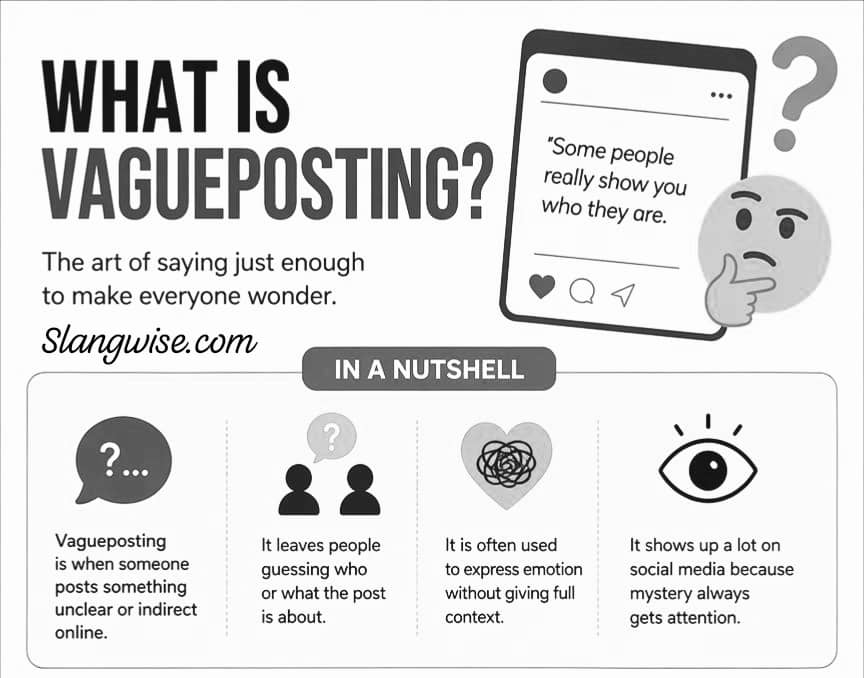
Some posts make you stop scrolling for a second because they feel oddly specific, but also strangely incomplete. A line like, “Some people really show you who they are,” or, “I see everything, I just stay quiet,” can spark instant curiosity.
You know something is being said, but you are not always sure exactly who it is about or what happened behind it. That is where vagueposting comes in.
It is one of those internet habits that feels both familiar and slightly dramatic at the same time. People use it to hint at a feeling, an event, or a reaction without giving the full story.
Sometimes it is harmless. Sometimes it is messy. And sometimes it is just plain entertaining to watch from the outside.
In this post, we are breaking down what vagueposting means, why people do it, how to spot it, and whether it is actually a clever way to express yourself or just another way to stir the pot online.
In a Nutshell
- Vagueposting is when someone posts something unclear or indirect online.
- It leaves people guessing who or what the post is about.
- It is often used to express emotion without giving full context.
- It shows up a lot on social media because mystery always gets attention.
What Does Vagueposting Mean?
Simply, vagueposting means posting something online in an indirect or unclear way.
The word itself is very easy to break down. “Vague” means not fully clear, and “posting” means sharing something online. Put them together, and you get a post that says something, but not enough to fully explain itself.
That is the entire game.
Instead of naming names or explaining the whole situation, a person drops a cryptic line that hints at a feeling, an issue, or a drama without spelling it all out. The result is that everyone who sees it starts filling in the blanks.
Think of it like this. The post is not really a full sentence. It is more like a clue. And because people are naturally curious, they usually want to know more.
READ ALSO: Slayed Without Remorse Meaning in Gen Z Slang: Why This Phrase Feels So Powerful
Slangwise Thought
One thing I have noticed is that vagueposting is rarely just about the post itself. It is about the reaction it creates.
Sometimes people want to be heard without having a full conversation. Other times they want to protect their privacy while still letting their feelings show. And sometimes, let us be honest, they just want attention without saying so directly.
A Quick Note On Vagueposting King
A vagueposting king is someone who always posts mysterious, indirect, or slightly dramatic messages that make everybody ask, “Who is this about?”
If your timeline keeps serving up cryptic captions and emotional one liners with no context at all, you might know exactly the type.
Where Did Vagueposting Come From?
Vagueposting grew out of social media culture, especially on platforms where people often share their thoughts fast and publicly.
It became more visible as people started using sites like Facebook, Twitter, and Instagram to express themselves in short bursts. Instead of writing long explanations, users began posting short emotional statements, subtle complaints, or unclear hints about their day, relationships, or frustrations.
Over time, people noticed the pattern. Some posts seemed intentionally indirect. They were not quite a rant, not quite a confession, and not quite a joke. They were just vague enough to make others ask questions.
That is how the term stuck.
The internet loves labels for behavior that feels familiar, and vagueposting was one of those things everyone recognized once it had a name.
READ ALSO: Girl Math vs Boy Math vs Human Math: Why Everyone Suddenly Thinks Their Spending Makes Sense
Why Do People Vaguepost?
There are a few different reasons, and not all of them are negative.
Some people vaguepost because they want to express how they feel without starting a direct confrontation. They may be upset, disappointed, or frustrated, but they are not ready to say exactly who or what caused it.
Others vaguepost because they want privacy. Not everything has to be spelled out online, and sometimes people prefer to hint at an experience rather than explain it in detail.
Then there are the people who vaguepost because they want attention, curiosity, or a little drama. A mysterious post can pull in comments very quickly, especially if people think it is about them or someone they know.
And sometimes people vaguepost simply because that is the style they have fallen into. It becomes part of how they communicate online.
Be honest, which one sounds the most familiar to you?
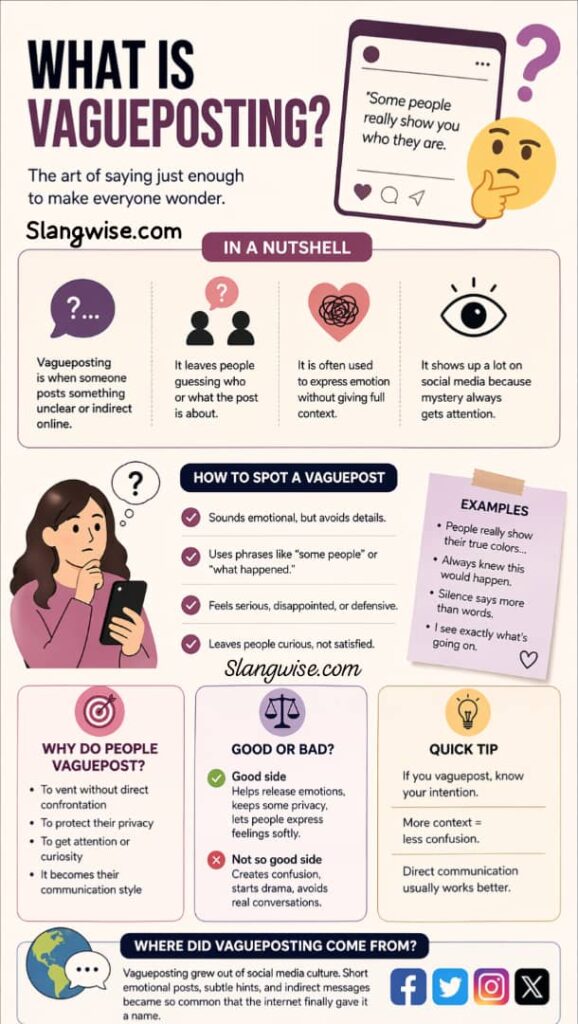
How to Spot a Vaguepost
A vaguepost usually has a few clear signs.
It often sounds emotional, but it avoids details. It may talk about “some people,” “certain situations,” or “what happened” without saying exactly what happened. It may also sound serious, disappointed, or defensive, but still stop short of explaining the full story.
For instance, a post like, “People really show their true colors when they think nobody is watching,” gives you a vibe, but not a full explanation.
Another one might say, “I always knew this would happen.” Again, that feels loaded, but it is also missing the part that would make it fully clear.
That is the nature of vagueposting. It gives just enough information to make people curious, but not enough to satisfy them.
Real Life Examples
Here are a few posts that feel very much like vagueposting:
- Some people only love you when it is convenient.
- Funny how silence says more than words.
- I will never understand fake loyalty.
- Not me realizing everything too late.
- I see exactly what is going on.
Now, none of these are especially long, but they all leave space for interpretation. That space is exactly what makes vagueposting so effective.
It invites people to wonder, guess, and sometimes even overanalyze.
And yes, that can be a little fun from the outside.
DISCOVER: 72 Most Popular Gen Z Slang Words of 2026 – Rizz, Delulu, Skibidi etc., And What They Secretly Mean Online
Is Vagueposting Good or Bad?
The answer is, it depends.
On the good side, vagueposting can be a way to release emotions without feeling exposed. Sometimes people are not ready to talk directly, and a vague post helps them express something in a softer way. It can also give someone a sense of privacy while still letting them speak their mind.
On the not so good side, vagueposting can create confusion. People may assume the post is about them, or they may start gossiping and filling in details that were never actually there. It can also keep problems from being addressed properly if the real issue never gets discussed out loud.
Here is the thing. Vagueposting is not automatically toxic. But it can become frustrating when it turns into a habit of indirect communication instead of honest communication.
So the real question is not just whether vagueposting is bad. It is whether it helps or hurts the situation.
When Vagueposting Makes Sense
There are moments when vagueposting can feel understandable.
If someone wants to vent without naming anyone, that is a personal choice. If they are processing something and are not ready to explain it, a vague post may feel safer than a direct one. And if the post is just a harmless mood statement, it may not be that serious at all.
In other words, not every vague post is a hidden attack.
Sometimes it is just a feeling floating around online.
READ ALSO: NPC Meaning in Gen Z Slang: Why Everyone Suddenly Sounds Like a Video Game Character
When It Backfires
Vagueposting can backfire when people use it to avoid direct communication for too long.
That is when it starts causing more confusion than clarity. Instead of solving anything, the post can create tension, misunderstandings, or unnecessary guessing. People may spend more time decoding the post than actually dealing with the real issue.
It can also make someone seem more dramatic than they intended. Even when the person means well, the cryptic style can easily be read as passive aggressive.
So if vagueposting becomes the main way someone handles problems, it might be worth asking whether a direct conversation would actually work better.
Similar Slang and Online Behaviors
Vagueposting is similar to a few other online habits.
One is subtweeting, which is when someone posts something indirect about another person, often without naming them. That idea is very close to vagueposting, especially on platforms like X.
Another is posting “for attention,” which usually means sharing something in a way that is designed to pull in reactions without giving full context.
You may also see people make soft, indirect comments that are clearly emotional but still avoid specifics. All of these behaviors live in the same world of online hinting, half telling, and leaving people curious.
DISCOVER: Gen Z Attraction Slangs: 25 Slang Words People Use When They Are Into Someone
Why Vagueposting Keeps Trending
Vagueposting keeps showing up because people love mystery.
A clear post is easy to ignore. A vague one makes people stop and think. It creates a little emotional puzzle, and the internet is full of people who enjoy solving puzzles, even when they are not asked to.
It also fits the way people already communicate online. Social media moves fast, and not everyone wants to write out a full explanation. A short indirect post can feel quicker, easier, and sometimes more powerful.
That is why vagueposting does not seem to be disappearing anytime soon.
Practical Tips If You Do It
If you are going to vaguepost, it helps to think about why you are doing it.
If your goal is just to vent, that is one thing. If your goal is to create drama, that is another. And if your goal is to express a feeling without turning everything into a public conversation, that is fair too.
The key is to know your intention.
Also, try to remember that people will interpret vague posts in their own way. The less context you give, the more room there is for misunderstanding. So if you really need to be understood, direct communication usually works better.
Conclusion
Vagueposting is the habit of posting something unclear or indirect online, usually in a way that makes people guess what is really going on.
It can be funny, emotional, annoying, mysterious, or all of the above depending on the situation. Sometimes it helps people express themselves. Sometimes it causes confusion. And sometimes it just keeps the drama moving one cryptic post at a time.
The next time you see a post that feels loaded but vague, you will know exactly what it is.
And maybe, just maybe, you will recognize a vagueposting king when you see one.
SEE ALSO: Popopopopo Meaning: The Strange Sound Everyone Is Typing Online
FAQs
It is posting something indirect or unclear online, usually so people have to guess the meaning.
They are similar. Subtweeting is usually more specific to indirect posts about someone else, while vagueposting is broader.
People vaguepost to vent, protect their privacy, avoid direct confrontation, or get attention.
Not always. It depends on the intention and whether it creates more confusion than communication.
Table of Contents