

Have you ever heard someone say dig it and wondered what on earth they were talking about?
At first glance, it sounds like someone is talking about a shovel, a garden, or maybe some kind of construction work. But in the world of 70s slang, dig it had a much cooler meaning. It was one of those short, stylish phrases that carried attitude, confidence, and a laid back sense of understanding.
During the 1970s, people loved slang that felt relaxed, expressive, and easy to drop into everyday conversation. That was part of what made dig it so popular. It could mean do you understand, do you like it, or are you with me on this, depending on how it was used. That flexibility gave it a smooth, memorable, and very cool vibe.
So let us break it down properly, because this little phrase has more personality than it first appears.
Table of Contents
In a Nutshell
Dig it is a classic slang phrase that can mean:
- Do you understand?
- Do you like it?
- Do you agree with me?
- I really like that
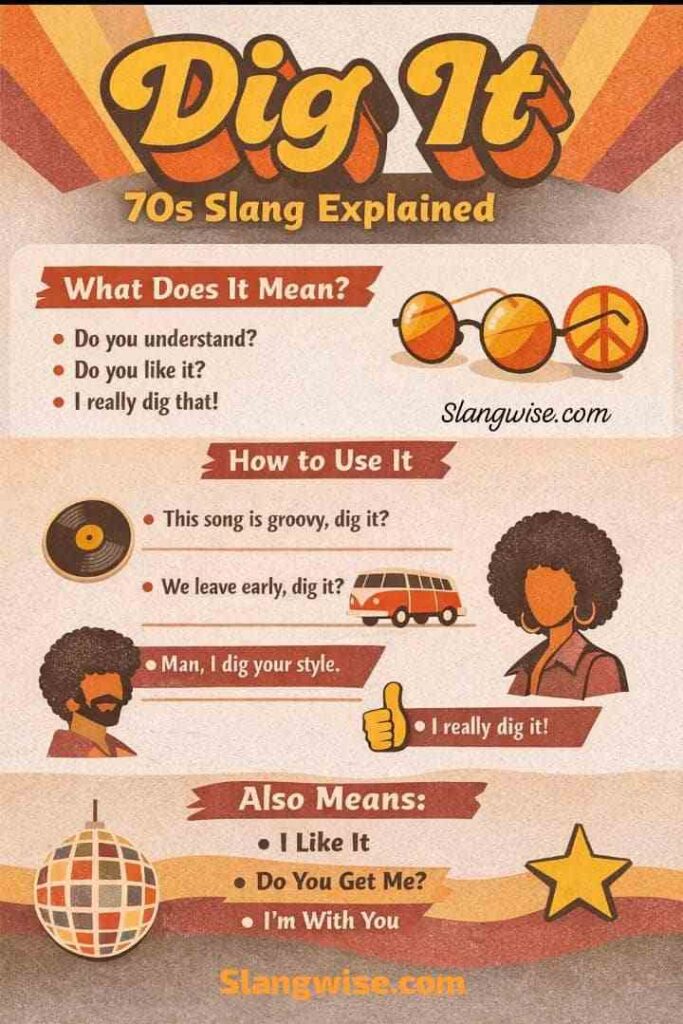
It became especially popular in the 1970s, but the phrase actually has roots that go back even earlier. Today, it still appears in music, pop culture, and retro style conversations.
What Does Dig It Mean?
The phrase dig it is all about understanding or appreciating something.
If someone says, “You dig it?” they are usually asking something like:
- Do you get what I mean?
- Do you like this?
- Are you following me?
- Are you feeling this vibe?
If someone says, “I dig it,” they mean:
- I like it
- I appreciate it
- I am into it
- That works for me
So the meaning changes slightly depending on the situation, but the core idea stays the same. It is a phrase built around approval, awareness, and connection.
READ ALSO: 70 Most Popular Millennial Slang Words and What They Really Mean (From Adulting to YOLO)
Why Was It So Popular in the 70s?
The 1970s were a huge decade for self expression. Music, fashion, movies, and street culture all helped shape the way people spoke. Slang was not just a way to talk. It was also a way to signal identity, style, and belonging.
Dig it fit the mood perfectly because it sounded casual, smooth, cool, and easy to say. It did not try too hard, and that made it feel authentic.
That kind of language matched the era of funk, disco, soul, bell bottoms, and laid back confidence. People wanted phrases that sounded natural and stylish, and dig it delivered exactly that.
In many ways, saying dig it was like saying, “I understand the vibe, and I am comfortable with it.”
How People Used Dig It in Conversation
One of the best things about this phrase is how simple it was to use. It could show up at the end of a sentence, in the middle of a conversation, or as a direct response.
Here are a few easy examples:
1. Asking for understanding
“People have to work together if they want real change, dig it?”
This means: Do you understand what I am saying?
2. Showing approval
“That new record is amazing. I really dig it.”
This means: I really like it.
3. Checking agreement
“We leave early, avoid traffic, and get there on time, dig it?”
This means: Do you agree with this plan?
4. Expressing appreciation
“Man, I dig your style.”
This means: I like your style.
As you can see, it was a versatile phrase. It was short, smooth, and packed with meaning.
Dig It vs Just Dig
To understand dig it, it helps to look at the base slang word dig.
Back then, dig often meant to like, understand, or appreciate something.
So:
- I dig jazz means I like jazz
- Do you dig it? means do you understand it or like it?
- I really dig this place means I really like this place
The word itself had a very positive feel. It suggested that you were not just noticing something, you were actively enjoying it.
That is part of why the phrase lasted so long in pop culture. It did not feel harsh or formal. It felt warm, rhythmic, and open.
DISCOVER: The Ultimate List of 250 Most Popular Internet Slang Words of 2026
Slangwise Thought
Dig it is one of those old school phrases that proves slang does not need to be complicated to be memorable.
What makes it fun is its tone. It sounds cool without sounding forced. It can be playful, sincere, or even a little stylish depending on how it is said. That is probably why it still grabs attention today, even if most people now use modern alternatives like you feel me, I get it, or that makes sense.
From a language perspective, phrases like dig it show how slang often grows from real social scenes before spreading into wider use. Jazz culture, Black American speech, and later youth culture all played a role in shaping this expression.
One thing I have come to realize after looking at phrases like this is that slang rarely stays frozen in time. It changes shape. A phrase might begin as a niche expression, then become mainstream, then sound old fashioned, and finally return as retro style language.
That is exactly what happened with dig it. It moved from cultural speech to everyday slang, and now it mostly survives as a nostalgic phrase that still feels cool when used in the right setting.
In my view, that is the beauty of vintage slang. It carries a little piece of its era, and dig it is a perfect example of how language can keep a whole vibe alive.
Similar Phrases and Modern Alternatives
If you want to translate dig it into modern everyday language, these are some close equivalents:
- Do you get it?
- Do you feel me?
- I like that
- I am into it
- That makes sense
- I am with you
These phrases do the same job in today’s conversation, but they do not have the same retro flavor. That is why dig it still stands out. It has personality.
Can You Still Use Dig It Today?
Absolutely. You can still use it, but the tone matters.
If you are talking with friends, writing something playful, or trying to bring a retro vibe into a conversation, it can work really well.
For example:
- I dig this song.
- You dig it, right?
- That plan? I dig it.
It sounds nostalgic, cool, and slightly old school in a good way.
However, in very formal settings, it may sound dated or casual. So it is best used when the mood is relaxed.
A Quick Look at the Phrase in Pop Culture
Dig it became especially visible because 70s culture loved phrases with rhythm and attitude. You could hear similar wording in music, television, and youth conversations of the time.
That style of speech helped define the decade. People wanted language that sounded alive, expressive, and fun. Dig it was one of those phrases that slipped easily into that energy.
Even now, when someone says it, the phrase instantly feels retro. That is part of its charm.
Why People Still Search for Dig It Meaning
People still look up this phrase because it can be confusing if you are hearing it for the first time. It is short, but it does not mean just one thing.
Someone might hear:
- “I dig that”
- “Dig it?”
- “Man, I really dig this”
and wonder whether it means literally digging, understanding, liking, or something else entirely.
That confusion is what makes the phrase such a fun one to unpack. It is small, but it carries layers.
READ ALSO: The queer slang term once banned that’s exploded in 2026: full meaning, history, and why it’s reclaimed and viral today
Conclusion
Dig it is a classic 70s slang phrase that means understand it, like it, or appreciate it. It reflects the easygoing, expressive style of the decade and still works today when you want to sound relaxed, retro, or simply cool.
So the next time someone says dig it, you will know they are not talking about a shovel. They are talking about vibe, approval, and understanding.
And honestly, that is what makes old slang so fun. It gives language character. It gives conversations personality. And sometimes, it gives us a phrase that is too good to forget.
Frequently Asked Questions
In slang, dig it usually means do you understand, do you like it, or are you with me on this. It depends on the way it is used.
I dig it means I like it, I appreciate it, or I am into it.
It became especially popular in the 1970s, but the phrase existed before then and is still recognized today as retro slang.
In slang, dig it usually means do you understand, do you like it, or are you with me on this. It depends on the way it is used.