

Honestly, the world we live now is the kind where our entire personality is often summed up by how quickly we reply to a text or whether we use “ok” vs. “kk.”
We’ve got acronyms flying around faster than we can keep up with. We know LOL, we’ve mastered BRB, and we’re all trying to figure out if IFT means something sweet or something scary.
But today, I want to talk about a quiet little acronym. A humble one. One that sits in the middle of sentences like a polite cough before someone gives you advice you didn’t necessarily ask for.
I’m talking about FWIW.
If you’ve ever seen “FWIW” pop up in a Slack channel, a Reddit thread, or a text from your slightly too philosophical friend, you might have nodded along pretending to know what it meant. Don’t worry, I’ve been there.
So, grab your coffee (or tea, I don’t judge), and let’s unpack this acronym together. By the end of this, you won’t just know what it means; you’ll know the psychology behind it.
Table of Contents
In a Nutshell
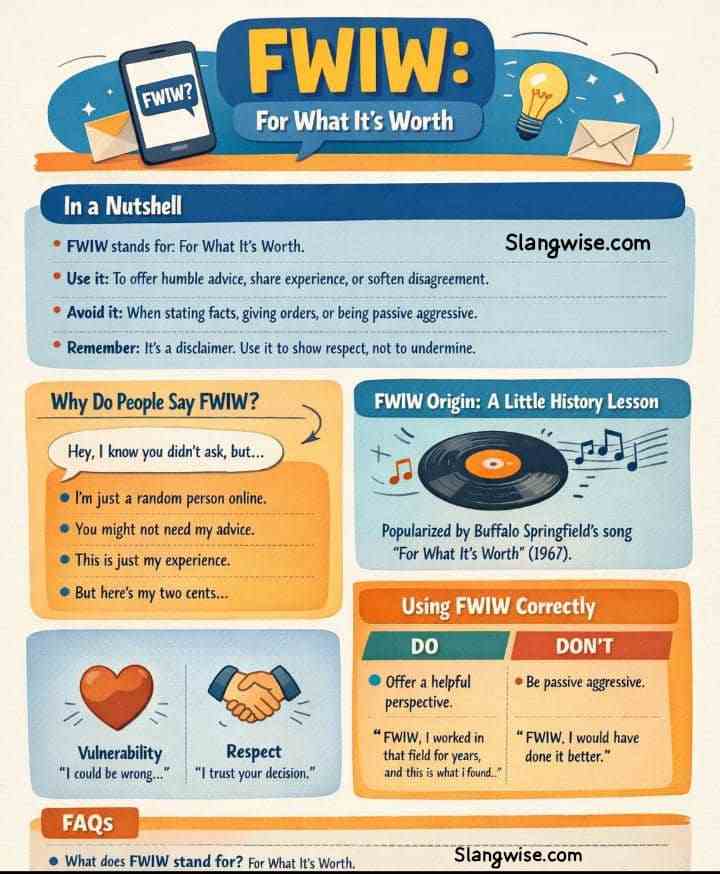
- FWIW stands for: For What It’s Worth.
- Use it: To offer humble advice, share experience, or soften disagreement.
- Avoid it: When stating facts, giving orders, or being passive aggressive.
- Remember: It’s a disclaimer. Use it to show respect, not to undermine.
FWIW MEANING
Let’s start with the basics, because I’m not about to leave you hanging.
FWIW stands for: For What It’s Worth.
Yep. It’s that simple. No hidden secret code. No dark web meaning. Just “For What It’s Worth.”
But here’s the thing: while the translation is easy, the usage is where it gets tricky. If you’ve been using it randomly, you might be accidentally throwing off the vibe of your conversations.
READ ALSO: LOL Meaning in Text: Why This Tiny Acronym Still Shapes Online Chat
Why Do People Say FWIW?
Here is where we get interesting. Raise your hand (virtually, of course) if you’ve ever been about to give someone advice, but you weren’t sure if they actually wanted it?
I see you. Put your hand down now before your coworkers think you’re stretching.
That hesitation? That is the exact energy that “FWIW” was invented to capture.
When someone types “FWIW,” they are essentially putting up a disclaimer. They are saying:
- “Hey, I know I’m just a random person on the internet.”
- “Hey, I know you didn’t specifically ask for my opinion.”
- “Hey, I know my experience might not apply to you.”
- “But… here’s my two cents anyway.”
It’s the humble brag of advice giving. It’s a way to insert your perspective into a conversation without sounding like a know it all.
FWIW ORIGIN: A Little History Lesson
Before the internet, “For what it’s worth” was a phrase used in spoken English and formal letters. It dates back to a time when people actually licked stamps (gross, right?).
It became iconic in pop culture largely thanks to the Buffalo Springfield song “For What It’s Worth.” You know the one: “Stop, children, what’s that sound? Everybody look what’s going down.”
Ironically, while the song was about protest and unrest, the phrase in modern texting is often used to keep the peace. It’s a linguistic softener.
DISCOVER: Sksksk Meaning: Why Sksksk Is the Screechy Sound Everyone’s Secretly Using
The “But” Problem: How You’re Probably Using It Wrong
Okay, let’s get into the nitty gritty. I mentioned earlier that you might be using this wrong. Let me explain.
The biggest mistake people make is using “FWIW” as a synonym for “by the way” or “also.”
Wrong usage example:
“Hey, I’m grabbing pizza. FWIW, I think pepperoni is better than sausage.”
In this context, the phrase doesn’t make sense. Is your opinion on pepperoni supposed to be valuable to me? Are you disclaiming that your pizza preference is potentially low value information? It feels clunky.
Correct usage example:
“I know you’re trying to decide between the two apartments. FWIW, I lived in that area for five years and the noise from the train was brutal.”
See the difference? In the second example, the speaker is offering specific, relevant experience. They are acknowledging that the final decision isn’t theirs, but they are lending their data point to the conversation.
Here is Slangwise Tip: If you can replace “FWIW” with “Here is my perspective based on limited knowledge,” and the sentence still works, you’re using it right.
The Psychology of the Disclaimer
Let’s get a little nerdy for a moment, shall we?. Why do we feel the need to use “FWIW”? Why can’t we just say what we want to say?
I think it comes down to two things: Vulnerability and Respect.
In a world where everyone is screaming their opinions into the void (looking at you, Twitter, sorry, X), using “FWIW” shows emotional intelligence. It shows that you understand the boundary between yourself and another person.
When you say “For what it’s worth,” you are admitting:
- I might be wrong. (Vulnerability)
- I trust you to decide for yourself. (Respect)
It’s a beautiful little piece of digital etiquette. It lowers the temperature of a conversation. If you’re in a heated discussion with someone about politics, career choices, or even which Marvel movie is the best, dropping an FWIW signals that you’re not trying to “win” the argument; you’re just offering a perspective.
SEE ALSO: GG Dịch Meaning: Why Internet Users Say GG Instead of Google Translate
FWIW in Different Contexts
Let’s take this acronym out for a spin in the real world. Depending on where you use it, the tone shifts slightly.
1. FWIW In the Workplace (Slack, Teams, Email)
In a professional setting, FWIW is your best friend for maintaining harmony.
Scenario: Your team is debating a new marketing strategy. You have an opinion, but you’re not the boss.
You: “FWIW, I tried a similar approach at my last job and the ROI took about six months to show up. But every company is different!”
This keeps you sounding collaborative, not insubordinate. You’re adding value without stepping on the project manager’s toes.
2. FWIW In Texting (Friends and Family)
With friends, FWIW can be used for deep emotional support or petty gossip.
Scenario: Your best friend is crying over a breakup with someone you always hated.
You: “I know you’re hurting right now. FWIW, I never liked how he talked to you. You deserve someone who listens.”
In this case, FWIW is a gentle way of saying “I told you so” without actually being a jerk about it. It validates their pain while sneaking in your support.
3. FWIW On Social Media (Reddit, Twitter, Forums)
This is where FWIW truly thrives. In the wild west of internet comments, FWIW is the armor that protects you from trolls.
Scenario: Someone is asking for advice on a niche hobby, like building a PC.
The Comment: “FWIW, I used an AMD processor in my last build and it ran hot, so I switched to Intel. YMMV (Your Mileage May Vary).”
It’s the universal sign for: “I’m not an expert, this is just my anecdotal evidence, please don’t come for me in the replies.”
How to Respond When Someone Says FWIW
Now that you know how to use it, let’s talk about how to receive it.
If someone texts you “FWIW,” they are often feeling a little shy or nervous about their input. They are extending a branch.
- A bad response: “Okay.” (This kills the vibe. They just made themselves vulnerable and you shut them down.)
- A good response: “I appreciate that.” or “That’s actually really helpful to know.”
Acknowledge the olive branch they’re extending. When you validate their FWIW, you build trust.
LEARN MORE: IMO and IMHO Meaning: What IMO and IMHO Mean in Text, Chats, and Online Conversation
The Dark Side: When FWIW is Passive Aggressive
Let’s not pretend that everything on the internet is sunshine and rainbows. Like any phrase, FWIW can be weaponized (gently).
Sometimes, FWIW is used as a subtle dagger.
Passive Aggressive Example:
- “FWIW, I would have done the presentation differently.”
- Ouch. That’s not helpful. That’s just criticism disguised as humility.
If you find yourself using FWIW to criticize someone after the fact, without offering a solution or support, you’re using it wrong. It stops being a disclaimer and starts being sarcasm.
The Ultimate Cheat Sheet
Because I love you (FWIW), here is a quick cheat sheet to make sure you’re nailing it.
When to Use It When to Skip It
When giving unsolicited advice based on personal experience. When stating a simple fact. (e.g., “FWIW, the sky is blue.” No.)
When trying to soften criticism to maintain a relationship. When you are the final decision maker. (Just say the order, boss.)
When adding a dissenting opinion in a group chat politely. When you’re trying to sound confident. Using FWIW undermines your authority.
When consoling a friend who is venting. In a formal legal or business contract. (Just be direct.)
Why This Acronym FWIW Matters
Here’s why FWIW matters.
Communication is breaking down everywhere. We read tone into texts that isn’t there. We start fights in group chats because someone forgot to add a smiley face.
“FWIW” is one of the few acronyms we have that is designed to lower the stakes. It’s a linguistic hug. It says, “I see you. I have thoughts, but I respect that you are the main character of your own life.”
In a world where everyone is trying to be the loudest voice in the room, using FWIW shows that you’re a good listener.
Let’s Wrap This Up (With a Little FWIW of My Own)
So, to bring it all home, FWIW, I think this acronym is one of the best tools we have for navigating the weird, text heavy world we live in.
Whether you’re trying to win an argument on Reddit, support a friend going through a tough time, or simply sound like you know what you’re talking about in a work email, FWIW has your back.
I’d love to hear from you now.
Have you ever used FWIW and gotten a weird response?
Is there an acronym that confuses you?
Drop a comment below. I read every single one.
FAQs
FWIW stands for “for what it’s worth.”
It is mainly informal. It is commonly used in emails, texts, and online conversations.
Yes, especially in casual or semi professional emails when you are sharing a thought or opinion that may or may not be useful.
No. FYI means “for your information,” while FWIW means “for what it’s worth.” FYI shares information, while FWIW offers a perspective or opinion.
No. The standard meaning is “for what it’s worth.”