
Some words disappear when they become controversial. Others fight their way back and come back stronger than ever. Queer is one of those words.
If you have been online lately, you have probably noticed it everywhere. In conversations, in media, in activism, even in academic spaces. But what makes this word so interesting is not just how popular it is today, it is how far it has come.
There was a time when queer was avoided, censored, and used as a harsh insult. Today, many people proudly use it as a label of identity, community, and self expression. That kind of transformation does not happen by accident.
So what really happened? How did a word once pushed out of public speech become part of everyday language again?
Let me walk you through what queer means, how it evolved, why it was controversial, and how it became one of the most powerful examples of slang being reclaimed.
Table of Contents
Queer In a Nutshell
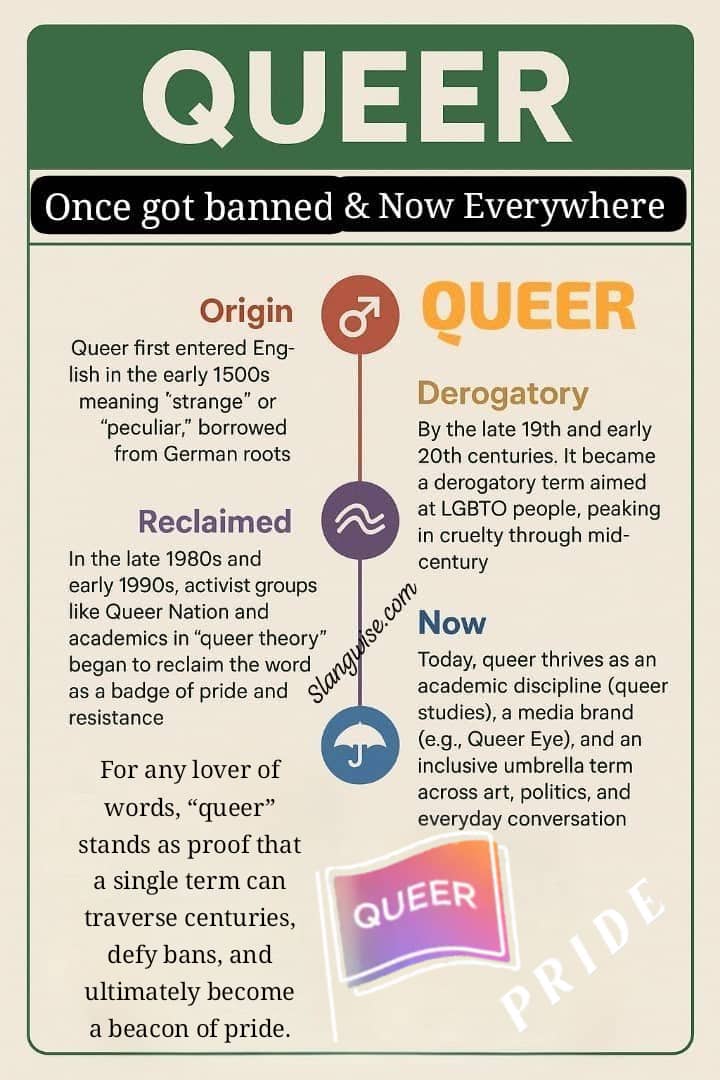
- Originally meant “strange” or “unusual”. The word dates back to the 1500s.
- Became a slur in the 19th and 20th centuries. It was used negatively against LGBTQ people.
- Reclaimed in the late 1980s and 1990s. Activists and scholars turned it into a symbol of pride.
- Now widely used as an umbrella identity. It includes diverse gender and sexuality experiences.
- Still depends on context. Some people embrace it, while others prefer different terms.
Slangwise Tip: Words can change meaning over time, but context always matters. What feels empowering to one person may feel uncomfortable to another.
So, What Does Queer Mean Today?
Today, queer is often used as a broad, inclusive term for people whose identities fall outside traditional ideas of gender and sexuality.
Some people use it because it feels flexible. Instead of picking one specific label, they prefer a word that leaves room for individuality and change.
Others use it because it connects them to a shared history of resistance and community.
At the same time, not everyone is comfortable with the word. Because of its history, some people still associate it with its earlier negative use. That is why understanding tone and context is so important.
Where Did the Word Queer Come From?
The story starts much earlier than most people expect. The word queer originally came into English in the 1500s, meaning something like strange, unusual, or off center.
For a long time, it had nothing to do with identity. It was simply a descriptive word for anything that felt different or out of place.
But over time, language shifts. By the late 1800s and early 1900s, the word started being used in a much more targeted and negative way, specifically toward people who did not fit into traditional norms around sexuality.
And from there, its meaning took a much darker turn.
Discover: 7 Slang Words That Were Banned in the past and the surprising reasons why.
When Queer Became Controversial
By the mid 20th century, queer had become a word many people avoided completely. It was often used as an insult, and in many spaces, it was considered too offensive for public use.
Media avoided it. Schools discouraged it. In some places, it was effectively pushed out of formal conversation altogether.
This is where the idea of it being a “banned” word comes from. Not always through official laws, but through strong social pressure and censorship.
For many people, hearing the word during that time carried real emotional weight.
The Comeback That Changed Everything
Here is where things take a powerful turn.
In the late 1980s and early 1990s, activists began to reclaim the word. Instead of letting it remain an insult, they turned it into a statement of identity and resistance.
Movements like Queer Nation used the word loudly and unapologetically. Their message was clear. If society tried to use the word to exclude them, they would use it to define themselves instead.
At the same time, scholars introduced ideas like queer theory, which explored identity, culture, and social norms in new ways.
This combination of activism and academic work gave the word a new kind of power. It was no longer just slang. It became part of serious conversations about identity and society.
Queer in 2026: Why It Is Everywhere Again
Fast forward to today, and queer is everywhere again, but this time, the meaning is very different.
- In media: Shows, documentaries, and publications use the word openly.
- In education: Universities offer courses focused on queer studies and history.
- In everyday language: Many people use it casually to describe identity.
- In activism: It continues to represent inclusion and community.
This shift shows something important. Language does not just change randomly. It changes because people actively reshape it.
Slangwise Thought: Based on what I have seen over time, queer is one of the strongest examples of how communities can take control of language and redefine it on their own terms.
Read Also: 7 most controversial Slang Words in Sports Right Now and why leagues want them banned.
Different Ways People Use “Queer”
Today, the word can show up in a few different ways depending on context.
- Identity label: Some people describe themselves as queer.
- Umbrella term: It can refer broadly to LGBTQ identities.
- Academic use: Used in research and theory discussions.
- Cultural expression: Seen in art, media, and storytelling.
There are also related terms like queer coded (used to describe characters or media that suggest queer identity) and queer community (referring to a shared social group).
Why This Word Still Sparks Debate
Even though queer is widely used today, it is still a word that can spark strong reactions.
Some people embrace it fully and feel it represents freedom and inclusivity. Others prefer more specific labels or feel uncomfortable with its past.
That does not mean one side is right or wrong. It simply shows how personal language can be.
Here is the simple rule: always respect how individuals choose to identify themselves.
Why Slang Lovers Should Pay Attention
If you enjoy learning about slang, queer is a perfect case study.
- It shows how meanings can completely change over time.
- It proves that communities shape language, not just dictionaries.
- It highlights the connection between language and identity.
- It reminds us that context always matters.
One thing I have learned from studying slang is this. Words are never just words. They carry history, emotion, and power.
DISCOVER: 20 Bad Internet Slangs Parents Should Never Ignore (And What They Really Mean)
Final Thought
The story of queer is not just about language. It is about transformation.
What started as a neutral word became an insult. What was once avoided became reclaimed. And what was once pushed aside is now widely recognized as a meaningful identity and cultural term.
That journey shows just how powerful language can be. It can divide, but it can also empower.
And if there is one thing this word proves, it is this. Language is never fixed. People shape it, challenge it, and redefine it every single day.
FAQs
Today, queer is often used as an umbrella term for identities outside traditional gender and sexuality norms. It can also be used as a personal identity label.
It depends on context. Many people use it positively, but some still find it uncomfortable because of its history. Respecting individual preferences is important.
It was not always legally banned, but it was often avoided or censored in media and public speech due to its use as a slur.
Activists and communities in the late 1980s and 1990s reclaimed the word, especially through movements like Queer Nation.
While the word is widely used today, it is best to use it respectfully and be mindful of how others feel about it.