
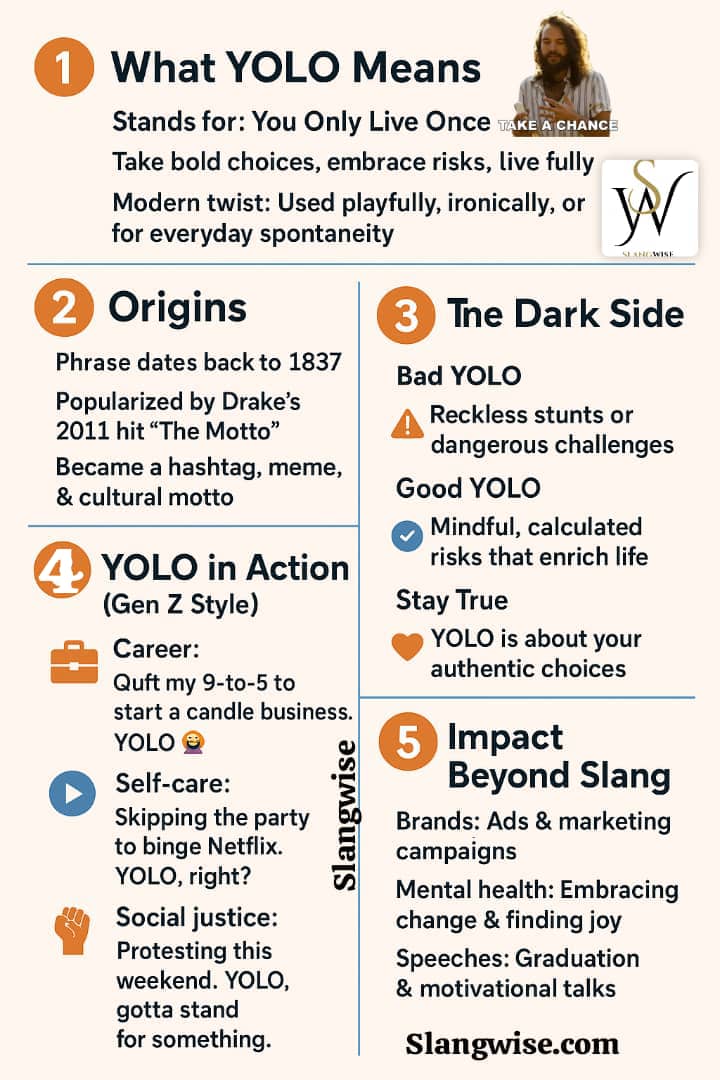
- YOLO means “You Only Live Once.” It usually expresses the idea of enjoying life, taking a meaningful chance, or not overthinking every opportunity.
- Drake popularized YOLO in 2011 through his song The Motto, but he did not invent the underlying phrase.
- YOLO is still understood in 2026, although it no longer has the same everywhere-all-at-once status it had during the early 2010s.
- Modern use is often playful or ironic. People may say YOLO after making a spontaneous decision, buying something unnecessary, trying something unfamiliar, or simply choosing to enjoy the moment.
- YOLO works best as encouragement, not an excuse for reckless choices. In modern slang, the phrase often carries more humor and self-awareness than it did at the height of its popularity.
Table of Contents
What Does YOLO Mean in Slang? (And Why People Still Say It in 2026)
Some slang terms explode onto the internet, dominate conversations for a few months, and then practically disappear.
Then there are the unusually durable ones.
YOLO belongs in that second group.
Anyone who remembers the social-media culture of the early 2010s probably remembers seeing YOLO everywhere. It appeared in captions, memes, hashtags, merchandise, jokes, music references, and everyday conversations.
For a while, it seemed impossible to spend much time online without running into those four letters.
But slang has a short memory. Once a phrase becomes heavily used, younger internet communities often move on to something fresher.
That is what makes YOLO interesting.
It never completely vanished.
From long-term observation of slang, one pattern becomes very clear: words often survive because their idea remains useful even after their peak trendiness disappears. YOLO is a perfect example.
The slang is old enough to feel nostalgic, simple enough to understand instantly, and flexible enough to work as both a sincere statement and a joke.
So, is YOLO still a thing in 2026?
Yes; but not quite in the same way it was in 2012.
Today, YOLO is less of a must-use youth buzzword and more of a familiar internet expression that people can pull out when the moment fits. That difference matters, because it tells us a lot about how slang evolves.
YOLO Meaning in Slang

Let’s start with the part that has never really changed.
YOLO stands for “You Only Live Once.”
In slang, people use it to communicate a willingness to take a chance, enjoy an opportunity, stop overthinking, or make the most of a moment.
The phrase is closely related to the older idea of “carpe diem,” or “seize the day.” But YOLO sounds much more casual. It feels like something you would text a friend or add to a caption rather than something you would find in a philosophy lecture.
And that casualness is part of its staying power.
For example:
“I’ve wanted to post my artwork for months. Finally doing it today. YOLO.”
Or:
“I signed up for that weekend photography class. YOLO.”
In both cases, YOLO is not really saying, “Ignore every consequence.”
It is closer to:
“I’ve thought about this long enough. I’m going for it.”
That is one of the biggest differences between the modern use of YOLO and its early-2010s image.
Ready to Live the YOLO Mindset?

If the idea behind YOLO speaks to you, why not wear it proudly? Check out our YOLO merch collection and grab something that reminds you to live boldly, take chances, and make every moment count. From stylish T-shirts to statement pieces, there’s something for every vibe.
Because at the end of the day, you only live once. So wear the mindset, inspire others, and make your story unforgettable.
Decode 250 of the most popular internet slang words in one easy guide. Perfect for TikTok, chats, memes, and everyday texting. Boost your online fluency fast.
Where Did YOLO Come From?
This is where a lot of people get the story slightly wrong.
Drake did not invent the phrase “You Only Live Once.”
The underlying idea is much older. Versions of the sentiment have existed for centuries, including expressions dating back to the 18th and 19th centuries. The exact acronym YOLO also existed before Drake became associated with it.
What Drake did was something much more important in the history of modern slang: he helped turn YOLO into a mainstream cultural expression.
In 2011, Drake released The Motto, and YOLO became strongly associated with the song and the internet culture surrounding it. Soon, the acronym spread across social media, hashtags, memes, merchandise, and everyday speech.
That distinction is important when studying slang.
There is a difference between inventing a word and popularizing a word.
Drake is best understood as the person who pushed YOLO from a relatively obscure acronym into one of the defining internet expressions of the early 2010s.
And once the internet got hold of it, the meaning expanded.
YOLO stopped being just a statement about enjoying life. It became a ready-made reaction to almost any spontaneous decision.
Buy the shoes? YOLO.
Book the trip? YOLO.
Try the new hobby? YOLO.
That repetition is partly why the expression became so memorable—and eventually so easy to parody.
Discover what “keep it 100” means in slang. Learn how to be authentic & genuine with this popular phrase, meaning 100% real & honest.
How Gen Z Uses YOLO Today
Here is where the slang gets more interesting.
Gen Z did not erase YOLO from the vocabulary. Instead, the phrase has moved into a different stage of its slang life.
During its peak, YOLO could sound like a genuine motto. In 2026, it is often used with a wink. It can be sincere, sarcastic, nostalgic, self-aware, or deliberately dramatic depending on the situation.
That is classic slang evolution.
1. Trying Something New
A person might say:
“I’ve never tried pottery before, but I booked a class anyway. YOLO.”
Here, the phrase is basically encouragement. It signals curiosity and a willingness to step outside a familiar routine.
2. Making a Spontaneous Purchase
Another modern use might be:
“Was I planning to buy this vintage camera? No. Did I buy it anyway? YOLO.”
The humor comes from exaggerating the decision. Nobody is necessarily treating it like a life-changing philosophical moment. That is exactly what makes the expression funny.
3. Finally Doing the Thing You Have Been Delaying
YOLO can also appear when someone decides to stop procrastinating:
“I finally applied for the internship I kept talking myself out of. YOLO.”
This is much closer to the phrase’s original positive spirit: life is limited, so meaningful opportunities should not always be postponed.
4. Using It Ironically
This is probably one of the most important modern uses.
Someone could post:
“Went to bed at 9:30 on a Friday night. YOLO.”
The joke is obvious. Going to bed early is hardly the stereotype of a wild YOLO decision.
That ironic reversal is exactly the sort of humor that keeps older slang alive. Once a word becomes familiar, people can play with it rather than simply use it literally.
Is YOLO Still Cool, or Is It Old Slang?
This is probably the question people really want answered.
YOLO is definitely older slang.
But “old” does not automatically mean “dead.”
In fact, YOLO is a good example of the difference between trending slang and established slang.
Trending slang needs constant social momentum. Established slang becomes familiar enough that people continue to understand it even after the trend has cooled.
YOLO has crossed into that second category.
It is no longer the kind of expression you expect to see in every conversation. But when somebody uses it, almost everyone understands the reference immediately.
That is a surprisingly strong position for a slang term that became famous more than a decade ago.
The Funny Thing About YOLO
YOLO eventually became so popular that it developed an ironic side.
And that is not unusual in slang.
When millions of people repeat the same expression, it often becomes overused. Once that happens, people begin exaggerating it, mocking it, or using it in deliberately ordinary situations.
That means a phrase can survive in two forms at once:
- Literal YOLO: “Life is short, so I’m going to give this opportunity a chance.”
- Ironic YOLO: “I ordered dessert after saying I was full. YOLO.”
The second version does not destroy the first. It gives the phrase another layer.
That flexibility is one reason old slang sometimes survives while newer terms disappear.
YOLO vs. FOMO: What’s the Difference?
YOLO and FOMO are often mentioned in the same conversations, but they are not the same thing.
YOLO focuses on your own choices: “Life is short, so I’m going to do this.”
FOMO means “Fear Of Missing Out.” It focuses more on the feeling that other people are experiencing something you are not.
Here is the easiest way to remember it:
YOLO says: “I want to experience this.”
FOMO says: “What if everyone else experiences this without me?”
Think you know your slang? Test yourself and see if you can ace the Gen Z lingo! Take the slang quiz now and prove you’re not out of the loop.
How to Use YOLO Naturally in 2026
There is an art to using older slang naturally.
The biggest mistake is forcing it into every sentence just because you know what it means.
YOLO works best when the situation already has a sense of spontaneity, opportunity, humor, or mild self-aware exaggeration.
For example:
- “I finally submitted my application. YOLO.”
- “I found my dream concert tickets, so I’m going. YOLO.”
- “I said I would learn Spanish this year, so I actually downloaded the course. YOLO.”
- “Ordering pancakes at dinner because apparently I’ve stopped following rules. YOLO.”
Notice what these examples have in common.
They are not about throwing caution away. They are about making a choice and embracing it.
When YOLO Should Be Used Carefully
There is one thing worth understanding about the phrase.
YOLO should not be treated as a free pass for dangerous decisions.
That was one of the criticisms surrounding the phrase during its original boom. Because “you only live once” sounds exciting, people sometimes used it to justify choices they had not thought through.
There is a big difference between:
✔ Trying a new hobby, applying for an opportunity, taking a creative chance, or saying yes to a meaningful experience.
✘ Ignoring obvious consequences simply because the phrase sounds adventurous.
Modern usage often recognizes that distinction more clearly.
Today, the strongest version of YOLO is not “do whatever you want.” It is closer to “do not let fear or endless hesitation stop you from living.”
Spill the tea means share gossip. Quick examples, proper tone and when it’s playful versus serious.
Why YOLO Has Survived So Long
From a slang perspective, YOLO has several advantages.
1. It Is Extremely Easy to Remember
Four letters. One familiar idea.
That is practically perfect slang architecture.
2. The Meaning Is Universal
The basic idea behind YOLO is not limited to one generation.
People across different ages and cultures understand the feeling that life is limited and opportunities can pass quickly.
3. It Works in Serious and Funny Conversations
A slang term that can move between sincerity and humor has a major advantage.
You can use YOLO to encourage someone to finally chase an important goal, or you can use it as a joke after ordering an extra slice of cake.
4. It Became Part of Internet Culture
YOLO rose alongside the major social-media culture of the early 2010s. That helped turn the acronym into something much bigger than a passing phrase. It became a recognizable piece of internet history.
YOLO Is More Than Just Slang Now
There is another reason YOLO refuses to disappear completely.
The acronym started as slang, but the idea behind it is bigger than slang.
That is why you can encounter the phrase outside ordinary texting and social-media conversations. The message fits motivation, personal goals, travel, creativity, celebrations, and countless everyday decisions.
In other words, the slang may have aged, but the concept did not.
That is an important distinction when studying language.
A phrase can stop being “cool” while remaining culturally recognizable. Some terms become historical references, some become jokes, and a few become ordinary vocabulary.
YOLO sits somewhere in the middle.
It still feels like internet slang, but it is also familiar enough to be used by people who were never part of the original YOLO craze.
Quick YOLO Cheat Sheet
YOLO means: You Only Live Once.
Use YOLO when:
- encouraging someone to take a meaningful chance
- celebrating a spontaneous choice
- trying something outside your normal routine
- making a playful or ironic comment
- reminding yourself not to overthink every opportunity
Avoid using YOLO as:
- an excuse to ignore obvious consequences
- a way to pressure someone into doing something
- a replacement for common sense
YOLO and FOMO are different: YOLO is about embracing your own experience, while FOMO is the fear of being left out.
Final Thoughts: Is YOLO Still a Thing?
So, after all these years, is YOLO still a thing?
Yes; but it has matured.
YOLO is not the unstoppable teenage buzzword it was when it exploded into internet culture in the early 2010s. You are not likely to see it dominating every caption or conversation the way it once did.
But that does not make it dead slang.
It has become one of those expressions people can instantly understand and still bring back whenever the context fits. Sometimes it is sincere. Sometimes it is nostalgic. Sometimes it is completely ridiculous on purpose.
And honestly, that may be the strongest evidence that YOLO survived.
Its popularity changed, but its usefulness did not.
The original message remains remarkably simple:
Life is limited. Do not let fear, hesitation, or endless overthinking stop you from making meaningful choices.
So the next time you finally sign up for the class, submit the application, start the project, book the experience, or simply decide to enjoy the moment, someone could still look at you and say:
“YOLO.”
And somehow, after all these years, everybody still knows exactly what they mean.
Frequently Asked Questions (FAQs)
YOLO stands for “You Only Live Once.” In slang, it is used to express the idea of enjoying life, taking a chance, trying something new, or not overthinking a decision.
Yes. YOLO is still understood and used in 2026, although it is less trendy than it was during its early-2010s peak. Modern use is often playful, ironic, nostalgic, or connected to a spontaneous decision.
Drake popularized YOLO in mainstream internet culture through his 2011 song “The Motto.” He did not invent the underlying phrase “You Only Live Once,” which existed long before the acronym became popular online.
Not necessarily. Although YOLO was sometimes used to justify reckless choices during its peak, the phrase can also encourage positive things such as trying a new hobby, applying for an opportunity, traveling, creating something, or making a meaningful decision.
YOLO means “You Only Live Once” and usually focuses on embracing your own choices or experiences. FOMO means “Fear Of Missing Out” and describes anxiety about being left out of experiences other people are having.