
Heavy on That Meaning in Slang
Some slang phrases are loud. Others are subtle. Then there is heavy on that, a short little expression that manages to say, “I agree,” “that is so real,” and “this point matters a lot” all at once.
In everyday online use, it is commonly used to emphasize a thought, strongly agree with someone, or show that a particular part of a statement really hits.
In a Nutshell
- Heavy on that means strong agreement or strong emphasis on a specific point.
- It is often used to say, “Yes, that exact part matters.”
- People use it in comments, captions, texts, and casual online talk.
- It can also show that something feels especially relatable or important.
So what does “heavy on that” mean?
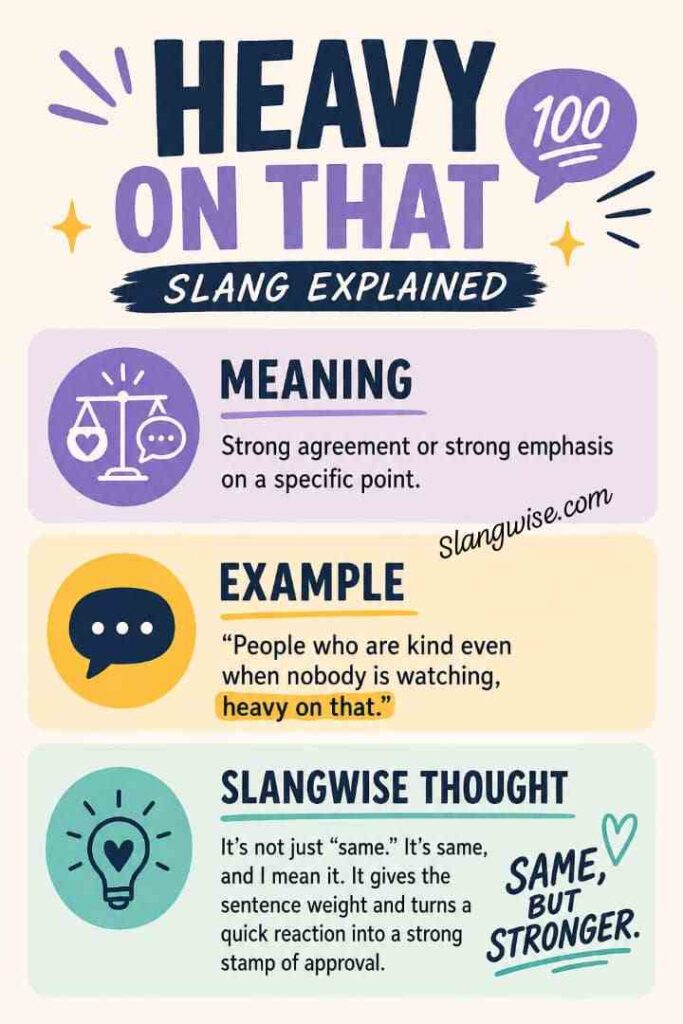
In simple slang terms, heavy on that means you are putting a lot of weight on a specific point. Not physical weight, of course, but emotional or conversational weight.
It is the kind of phrase people drop when they want to say, “Yes, that exact part,” or “That is the one I feel the most.” In the slang examples I found, people use it to show strong agreement, strong relatability, or emphasis on a key word or idea.
Think of it like this: someone says, “I do not trust fake energy,” and you reply, “Heavy on that.” You are not adding a long explanation. You are basically stamping the statement with extra yes. You are saying the point deserves attention, because it is not a small thing to you. That is the whole vibe.
READ ALSO: I Cant Even Meaning Explained: What This Viral Slang Really Says in One Tiny Phrase
Why the phrase works so well
One reason this slang lands so well is that the word heavy already carries a feeling of seriousness or intensity in standard English.
Dictionaries describe heavy in ways that connect it to seriousness, force, or using a lot of something, so the slang version feels natural even before the internet gives it extra flavor. That probably helps explain why the phrase feels so punchy and immediate.
In other words, the phrase sounds like it has substance. It does not feel fluffy or casual in the wrong way. It feels like you are leaning into a thought and saying, “This part right here matters.”
That is why it shows up so often in comment sections, reaction posts, and casual conversations where people want to sound engaged without writing a full paragraph.
How people actually use it
The most common use is agreement. Someone shares an opinion, a meme, a rant, or a relatable observation, and another person responds with heavy on that to say they fully back the point or relate to it strongly. The catchphrase can also be used to highlight one specific part of a post, especially when the speaker wants to say that the highlighted bit is the most important one.
For example, if a post says, “Protect your peace and stop explaining yourself to everyone,” a reply like “Heavy on the peace part” means that is the message that really stands out. It is a very internet style way of saying, “That is the part I am taking seriously.”
The phrase can also show up as “heavy on that one,” which people use in the same kind of way when reacting to a certain slide, line, or statement.
READ ALSO: Himbo Meaning: Why This “Sweet But Silly” Slang Word Became a Whole Personality
The different shades of meaning
What makes heavy on that interesting is that it is not locked to one tiny meaning. Depending on the context, it can mean:
You strongly agree with the statement.
You relate to it deeply.
You want to emphasize a specific part.
You think that part deserves more attention than the rest.
You are basically saying, “Yes, that. Exactly that.”
That flexibility is a big reason the phrase spread. Slang usually survives when it can move easily from one situation to another. This one works in serious conversations, funny conversations, and those very modern internet moments where a post has ten slides and only slide three is the one that actually speaks to your soul.
Examples of Heavy on that in Conversations
Here are a few original examples of how it sounds in conversation:
“People who are kind even when nobody is watching, heavy on that.”
“Waking up early is not for me. Heavy on that.”
“Good communication saves relationships. Heavy on that part.”
“Soft life and peace of mind? Heavy on that, always.”
“Respecting people’s boundaries, heavy on that.”
“Being real matters more than being loud. Heavy on that one.”
See how it works? The phrase adds emphasis without sounding like a speech. It feels direct, modern, and very social media coded. It is especially useful when you want to sound like you are nodding hard without typing a long explanation.
DISCOVER: 40 Most Popular Internet Catchphrases of 2026 (Updated)
Where you will hear it most
You are most likely to see heavy on that in captions, comment sections, text messages, and meme replies. It fits spaces where people talk fast and want to keep the energy moving.
It also works especially well in spaces where people respond to relatable opinions, personal truths, or strong takes. That matches the pattern described in the examples I looked at, where the phrase is used to show strong agreement or to highlight the part of a post that matters most.
It is less about grammar and more about tone. The phrase says, “I am not just reading this, I am feeling this.” That is why it sounds so natural in casual digital conversation. It has that quick, confident rhythm people love online.
How to use it naturally without sounding forced
If you want the phrase to sound real, keep it simple. Do not overbuild it. It works best when it comes after a statement that already has a strong opinion or emotion. You are not trying to explain the whole world. You are just highlighting the part that hit you hardest.
Use it when you want to: sound relatable, show agreement, emphasize a key point, or react to something with a little extra attitude.
The tone is usually casual, friendly, and a little bit internet slick. It is not formal language. It is not the kind of phrase you would use in a school essay or a work email. It belongs in the world of posts, stories, replies, and quick messages where people want to be expressive in a short space.
SEE ALSO: Main Plot Energy Meaning in Slang: Why It Sounds Like Your Life Just Got a Main Character Arc
Slangwise thought
What I like about heavy on that is that it feels like agreement with backbone. A lot of slang just says “same,” but this one says “same, and I mean it.” It gives the sentence weight.
It turns a quick reaction into a stronger stamp of approval. That is why it feels so current, so easy to reuse, and so fitting for the way people talk online today.
In my view, the phrase works because it is both simple and expressive. You do not need to overthink it. You just need to know that somebody is putting extra emphasis on the exact part they care about most.
Final takeaway
Heavy on that is a slang phrase people use to strongly agree with something, relate to it deeply, or emphasize a part of it that really matters. It is short, flexible, and very common in casual online talk. If someone drops it in a comment, they are not just saying “I agree.” They are saying, “That part right there is the truth.”
And honestly, that is exactly why it works so well. It is quick, it is clear, and it carries more feeling than the words on the screen first suggest.
READ MORE: When the Wallet Is Empty but the Humor Is Rich: 12 Funny Slang Words for Being Broke
Frequently Asked Questions
It means strongly agreeing with a point, relating to it deeply, or emphasizing the part that matters most.
Yes. It is often used as a strong way to say you agree with someone or fully support their point.
People usually use it in comments, captions, texts, and casual online conversation.
Yes. It can be used to highlight a specific part of a statement that feels especially important or relatable.
Table of Contents