

Crikey mate is one of those phrases that can make a sentence feel instantly Australian. It sounds surprised, cheerful, slightly dramatic, and ready for whatever happens next. But there is more going on here than a catchphrase people picked up from Steve Irwin.
When I study slang, I look at two things: what a word means and what it does socially. That second part matters here. Crikey mate is not simply “wow, friend.” The relationship, situation, and tone can change the feeling completely.
So let us unpack it properly. By the end, you will know what crikey mate means, why Steve Irwin became linked to it, how the words work separately, and how to use the phrase without sounding like an Australian stereotype.
Crikey Mate Meaning
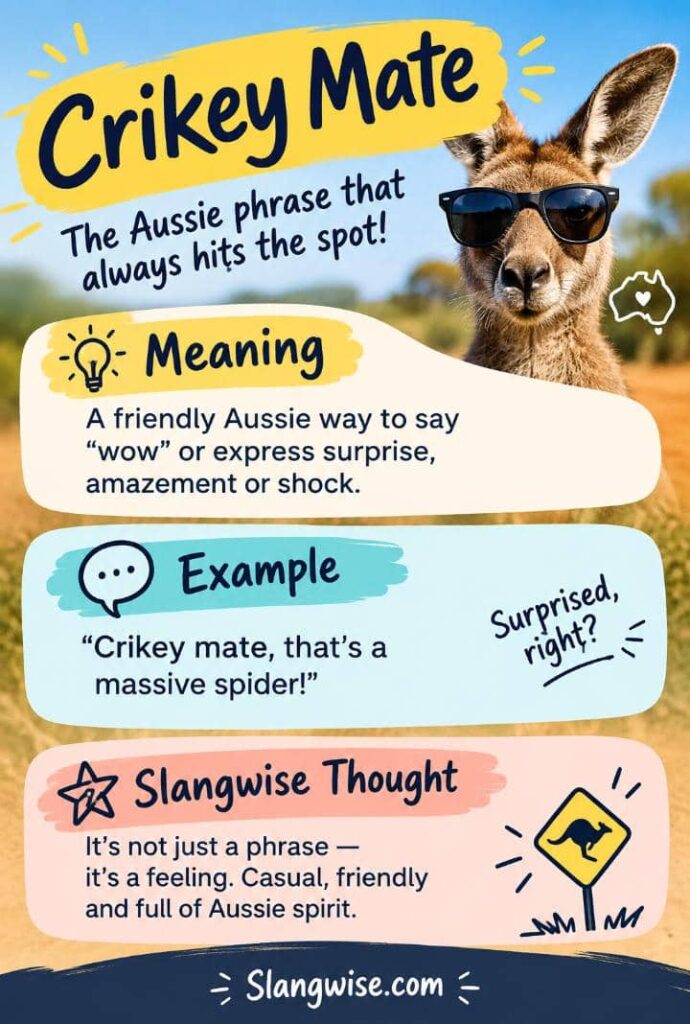
Crikey mate is a casual expression of surprise, amazement, shock, or admiration.
Crikey is the reaction. Mate is the social touch.
You might say crikey when something catches you off guard: an enormous bill, an unexpected result, a wild storm, a spectacular view, or an astonishing animal. Mate addresses the other person in a friendly, informal way.
That combination gives the phrase its personality. “Crikey!” can stand alone. “Mate” can stand alone. Together, they create a conversational reaction strongly associated with Australian speech.
There is also an interesting history behind crikey. It developed as a mild euphemistic exclamation related to “Christ,” rather than being invented for Australian television. Australian English adopted it, and Steve Irwin later helped make it globally recognizable.
The Steve Irwin Effect
I cannot explain crikey mate without talking about Steve Irwin because, for millions of viewers, his voice became closely connected with the word.
Irwin did not invent crikey. He gave it a massive international audience. His wildlife programs turned the expression into part of his on screen personality, especially when he was excited by an animal encounter.
A slang word can exist for generations, then one person can make the wider world notice it. For people outside Australia, the word may now feel almost inseparable from the enthusiastic wildlife presenter. In Australian speech, however, it has a broader history and is not simply a Steve Irwin imitation.
Learn 25 popular Australian slang words in 2026 with meanings and examples so you can sound like a true Aussie in chats, travel, footy and everyday conversations
When Crikey Works Best
I find it easiest to understand crikey by focusing on the emotion rather than memorizing a definition.
One scene I keep coming back to when explaining the phrase is this: a friend opens a message and discovers they have won concert tickets. “Crikey mate, you actually got them!” sounds excited and genuinely impressed.
Now imagine someone shows you the final price of a small home repair. “Crikey mate, that cost a bit” expresses surprise without sounding furious.
Or picture a street performer suddenly delivering an incredible routine. “Crikey mate, that was brilliant” turns surprise into admiration.
It can also be playful. A friend brings home an absurdly large sandwich and you say, “Crikey mate, are you feeding the whole neighborhood?” The situation supplies the tone.
Mate Is Doing More Work Than You Think
This is the part slang learners sometimes miss.
Mate is not always literally your closest friend. In Australian and British usage, it can be a casual form of address for a friend, acquaintance, stranger, or simply the person you are speaking to.
Context does a lot of the work.
- “Mate, you left your phone here.”
- “Thanks, mate.”
- “Crikey mate, that was close.”
Same word, different social feeling. That is why I would not treat crikey mate as one frozen phrase that must always be spoken together. People can use crikey and mate separately, depending on what the conversation needs.
How to Use Crikey Mate Naturally
My biggest advice is simple: focus on the situation, not the accent.
You do not need an exaggerated Australian voice. In fact, that can make an otherwise harmless phrase sound forced. Use crikey mate when the moment genuinely deserves a little extra reaction.
- Your friend sends a photo of a packed beach: “Crikey mate, where did everyone come from?”
- Your team scores in the final seconds: “Crikey mate, that was close!”
- Someone shows you a cake they baked for the first time: “Crikey mate, look at that!”
- A delivery arrives in a box far bigger than expected: “Crikey mate, what did you order?”
Notice the pattern. None of these situations require a crocodile. The phrase works because the reaction has a little more energy than an ordinary “wow.”
DISCOVER: What Does Simp Really Mean? The Slang Word Everyone Uses But Few Explain Well
When It Can Sound Awkward
Slang has a social setting, and crikey mate is no exception.
I would avoid it in formal writing, serious professional situations, or moments where a playful reaction could feel insensitive. I also would not force it into every conversation simply because you have learned it.
There is another common mistake: treating Australian slang like a costume. Real slang sounds natural because speakers know when to use it and when to leave it alone.
Knowing when not to use a slang word is part of knowing the slang.
What Crikey Mate Says About the Speaker
This is where the phrase gets especially interesting.
When someone says “crikey mate,” they are often making a reaction feel lighter, warmer, or more humorous. They are not just reporting surprise. They are turning that surprise into a shared moment.
That helps explain why the phrase works so well online. Someone can type “crikey mate” under a ridiculous video and instantly add a playful Australian flavor without explaining the joke.
Still, I would not use the phrase as a shortcut for describing all Australians. Slang is too varied for that. What it really shows is how strongly tone, relationship, and context shape informal language.
Zesty Meaning Explained: The Gen Z Slang Everyone’s Using to Describe Bold Energy
In a Nutshell
- Crikey is a mild exclamation of surprise, amazement, alarm, or emphasis.
- Mate is a casual form of address that can mean friend, buddy, or simply the person being spoken to.
- Crikey mate usually creates a friendly, playful reaction to something unexpected or impressive.
- Steve Irwin did not invent crikey, but his television career helped make the expression famous around the world.
- The phrase sounds most natural in relaxed conversation, especially when you genuinely have something surprising to react to.
Final Thought
I have found that the best way to understand slang is to stop treating it like a vocabulary test. Learn what the word means, then pay attention to what the speaker is doing socially.
That is how I read crikey mate. Crikey delivers the surprise, while mate brings another person into the moment. Together, they make a simple reaction feel warmer, more playful, and distinctly informal.
So the next time a friend shows you something unexpected, you know the move: “Crikey mate, what am I looking at?”
FAQs
Crikey mate is a casual expression used to show surprise, amazement, shock, or admiration in a friendly and informal way.
Crikey is strongly associated with Australian English, although the expression has a broader British history and was not invented in Australia.
No. Steve Irwin did not invent crikey. He helped make the expression internationally famous through his wildlife television programs.
Yes. Mate can be used casually for friends, acquaintances, strangers, or simply the person being addressed, depending on the situation and tone.
Yes. The phrase remains recognizable in Australian slang and is also widely understood internationally, especially through Australian popular culture.
For more background on Australian slang, ABC Education’s guide to Australian slang is a useful reference because it places expressions such as crikey and g’day mate in a wider language context.
Table of Contents